The Dome of the Rock Jerusalem: History, Architecture, and Significance
In the heart of Jerusalem, the Dome of the Rock stands as one of the most recognizable monuments in the world. This sacred shrine, crowned by a gleaming gold dome, sits atop the Temple Mount and anchors a complex of religious and political histories that reach across continents and centuries. The edifice commonly known as the Dome of the Rock is not a mosque, though it is a central element of Islamic heritage in the city. Instead, it is a monumental octagonal sanctuary built to proclaim a distinctive Islamic architectural voice while preserving connections to the site’s ancient religious associations. The dome of the Rock Jerusalem, as a physical object and a symbol, has influenced architecture, worship, and diplomacy from the early medieval era to the present day.
The creation of the Dome of the Rock is generally dated to the late 7th century, with construction completed around 691–692 CE under the Umayyad caliph Abd al-Malik. This period marked a deliberate effort to articulate a distinctly Islamic monumental language in the newly established caliphal capitals. The project was as much a political statement as a religious one: a public display that Islam had come to Jerusalem, a city already venerable in Jewish and Christian memory.
On the Temple Mount, a site already sacred for many peoples, the dome of the rock jerusalem was conceived as a shrine built around a central stone known as the Foundation Stone. This rock—revered in Jewish tradition as the place where creation began and where the world was anchored—was repurposed to signal a new religious epoch. Islamic writers of later centuries framed the rock as the pulsing heart of a cosmological narrative: a place from which Muslims could imagine the ascent of the Prophet Muhammad to the heavens, traditionally associated with the Isra and Mi’raj.
Earlier Sacred Landscape and Later Transformations
The Temple Mount site carries a layered memory: in ancient times, the first and second Jewish Temples stood here, and in the Christian era the location remained a focal point of pilgrimage and controversy. When the Dome of the Rock rose, it did not erase these associations; instead, it layered Islamic sacred geography atop a preexisting canvas. Over the centuries, successive rulers—Abbasids, Fatimids, Ayyubids, Mamluks, Ottomans, and others—made restorations, alterations, and additions. The exterior and interior decorations were refreshed to reflect evolving tastes, theological emphasis, and craft traditions, while maintaining the emblematic octagonal geometry and the commanding silhouette of the gilded dome.
The Plan and Architecture
Overall Form and Spatial Organization
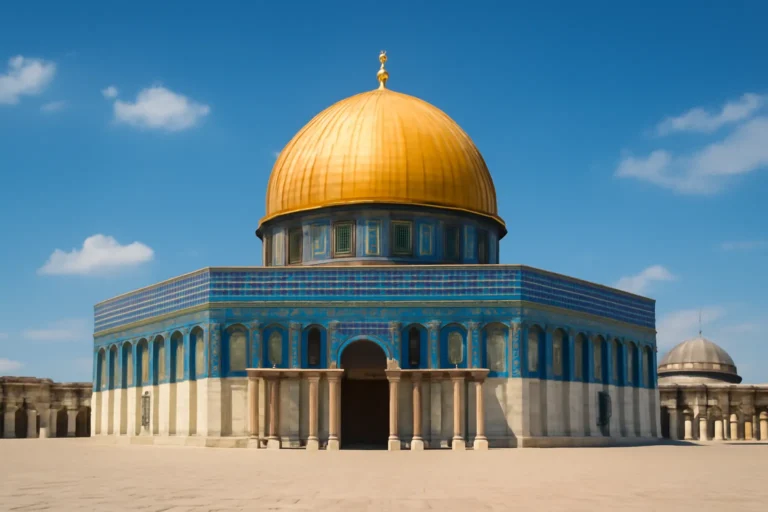
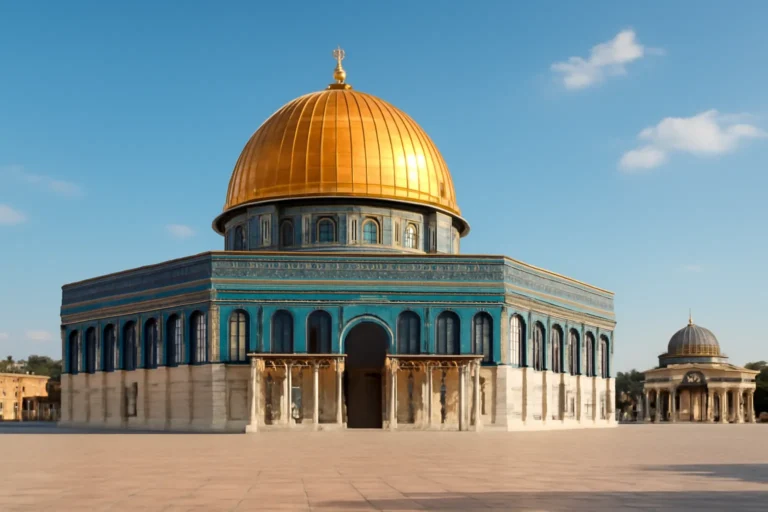
The most striking architectural feature of the Dome of the Rock is its octagonal plan, a geometric choice that sets it apart from many other early Islamic shrines. The shrine sits on a raised platform that itself is a testament to engineering in the medieval world, translating an abstract spiritual program into a tangible architectural field. Inside, visitors encounter a central rock that forms the spiritual epicenter of the space. Around this core, the surrounding ambulatory spaces are arranged to create a sense of procession and contemplation, inviting a visitor to move in a circular, meditative rhythm.
The dramatic golden dome crowns the structure and is a defining image of the city. The dome sits atop a drum that rises above the octagonal base, creating a vertical axis that can be seen from long distances in the landscape of Jerusalem. The material story of the dome—wooden substructure, a drum with its own interior and exterior decorative programs, and an external gilding that gleams in the sun—speaks to a long tradition of monumental architecture wherein light, color, and metalwork converge to signal the sacred nature of the space.
Exterior and Interior Ornament
The exterior walls are clad in a combination of marble, mosaic, and faience, with a rhythm of arches and blind openings that give the building a texture both solid and luminous. The Qur’anic inscriptions arranged around the drum and along upper friezes present a textual program that reinforces the monument’s message: this is a place where divine revelation and human artistry meet. Inside, the decoration reaches a balance between abstract vegetal motifs and script, a hallmark of early Islamic interior decoration that aims to honor the sacred space without sacrificing architectural clarity.
Decoration, Materials, and Ornament
Materials Across the Exterior and Interior
Stone and marble provide a durable, luminous base that anchors the building visually in the surrounding landscape.
Faience and glazed tile surfaces create a colorful, reflective exterior that catches the changing light.
mosaics inside the chamber, featuring abstract patterns and inscriptions, form a luminous narrative around the central rock.
Gold plating on the dome itself delivers a powerful, radiant halo over the complex.
Decorative arabesques and Kufic script contribute to a dense, scriptural language that encodes religious and political meaning.
Interior Program and the Rock
At the core lies the Foundation Stone, a raised surface around which the interior is designed. In Islamic tradition, the rock is associated with the Prophet Muhammad’s Night Journey and ascent to the heavens, a narrative that gives the two-tone interior its sacred center. The surrounding screen work and the low parapet around the rock serve to delineate a holy precinct while allowing visitors to contemplate the center of the shrine. The space has undergone restorations that preserved the original intention of guiding a pilgrim’s gaze toward the rock and upward toward the dome.
Rock, Ascension, and Sacred Narrative
The Night Journey and Ascension
The dome of the rock jerusalem has long been associated with the Isra and Mi’raj—an event in which the Prophet Muhammad is said to have traveled in a single night from Mecca to Jerusalem and then ascended to the heavens. For Muslims, this story anchors the site’s sanctity and provides a narrative bridge between earthly pilgrimage and heavenly ascent. The Rock’s placement and the surrounding enclosure reinforce the idea that Jerusalem is a hinge between the human and the divine, a concept reinforced by the shrine’s architectural rhetoric.
Interfaith Resonances and Jewish Significance
The sacred geography of this location makes the dome of the rock jerusalem a focal point not only for Islam but also for Jewish and Christian memory. For many Jews, the site is linked to the ancient Temple Mount and the Holy of Holies; for Christians, Jerusalem embodies a locus of biblical drama. The existence of a striking Islamic monument on this site has shaped centuries of dialogue and conflict, influence, and coexistence. The layered significance has produced a durable symbol that travels beyond religious boundaries, appearing in art, literature, and political discourse.
The Dome of the Rock sits within the Haram al-Sharif, or the Noble Sanctuary, a precinct whose administration has historically been shared among religious authorities, with the Jerusalem Waqf playing a central role. The contemporary governance of access to the Temple Mount complex involves a complex arrangement among local authorities, religious custodians, and state actors. This status quo has been a central element in ongoing debates about sovereignty, worship, and heritage management.
Access for Visitors and Pilgrims
Access policies for the Dome of the Rock—and for Jerusalem’s sacred precincts more broadly—reflect a balance between religious practice, tourism, and security considerations. Muslims visiting the Haram al-Sharif typically arrive to pray and reflect within designated areas, while non-Muslim visitors may be allowed at certain hours and through regulated procedures. The site thereby remains a living place of worship as well as a global heritage site, drawing pilgrims, scholars, and curious travelers from around the world.
Modern Significance and Debate
In the modern era, the dome of the rock jerusalem has become a symbol in political and cultural debates about identity, memory, and the future of Jerusalem. Its gilded silhouette is a visual shorthand for centuries of religious devotion and territorial contest. Scholars, archaeologists, and conservationists continue to study the structure to understand how medieval artisans achieved such a durable, luminous work, while artists and writers draw on its image to explore themes of faith, power, and heritage.
Conservation, Restoration, and Scholarship
Preservation Challenges
The Dome of the Rock faces typical challenges of longevity: weathering of stone and tile, the need to maintain the gold coating on the dome, and the delicate balance between preserving historic materials and ensuring structural safety. Conservation work has to account for seismic risks, corrosion of metal components, and the sensitivity of inscriptions and mosaics to cleaning and restoration methods.
Notable Restorations and Projects
Early Islamic to Ottoman-era stabilization and cleaning, addressing wear from centuries of exposure.
Mid-20th-century renovations that stabilized the dome’s structure and refreshed exterior gilding.
Late-20th and early-21st-century conservation programs which integrated modern materials with historic designs while safeguarding inscriptions and mosaics.
International organizations and regional authorities have collaborated on cataloging the complex’s architectural elements, documenting inscriptions, mosaics, and structural changes. The Dome of the Rock Jerusalem’s conservation history reflects broader debates about the ethics and methods of preserving monuments that sit at the intersection of sacred space and public memory.
Influence, Legacy, and Comparative Context
A Model for Islamic Architecture
The Dome of the Rock is widely regarded as one of the earliest and most influential works of Islamic architecture. Its combination of octagonal plan, monumental dome, and richly decorated interior set a template that would influence mosque design, palace architecture, and religious commemorations across the Islamic world. The building’s visual logic—vertical emphasis, crowned dome, scriptural ornament, and a carefully controlled interior space—resonates in many later structures, both in the Near East and beyond.
In architectural history, this shrine’s relationship to other monumental religious sites is a subject of study. Comparisons are drawn with large central-domed structures from the Byzantine and Persian traditions, as well as with the early forms of mosque architecture in the region. The way the Dome of the Rock asserts an Islamic sacred geography on a site with deep memory in Judaism and early Christianity reveals a confluence of cultures that characterizes Jerusalem as a crossroads of civilizations.
Literary, Artistic, and Media Representations
The image of the gold dome atop the cityscape has appeared in countless works of art, music, film, and literature. It serves as a powerful symbol of Jerusalem itself—the city’s spiritual gravity, its contested boundaries, and its enduring capacity to evoke awe. As a subject in newspapers, textbooks, and travel writing, the dome of the rock jerusalem anchors discussions about history, sacred space, and the responsibilities of stewardship in places where memory runs deep.
Key Points to Remember
The Dome of the Rock is a monumental Islamic shrine on the Temple Mount in Jerusalem, completed around 691–692 CE.
It features an octagonal plan, a central Rock, and a gold-dome that dominates the skyline.
The architecture blends universal geometric form with intense decorative programs, including inscriptions and arabesques.
The shrine is closely tied to the narrative of the Prophet Muhammad’s Night Journey and ascension, which anchors its sacred significance in Islamic tradition.
As a site within the Haram al-Sharif, it sits at the center of contemporary debates about access, governance, and heritage in Jerusalem.
Glossary of Terms and Concepts
Octagonal Plan
A rare but influential geometric layout in early Islamic monumental architecture, giving the structure a sense of balance and movement.
Foundation Stone
The central stone around which the shrine is built; linked in Muslim tradition to the Prophet’s ascent and to creation narratives.
Haram al-Sharif
Arabic for the Noble Sanctuary, the broader sacred precinct that includes the Dome of the Rock and the al-Aqsa Mosque.
The dome of the rock jerusalem remains a fulcrum around which memory, faith, and politics pivot. It is a monument whose age and beauty invite visitors to reflect on the ways sacred places endure and adapt. Whether viewed from the surrounding streets, approached for contemplation, or studied in scholarship, this sanctuary continues to offer a powerful lens on the long arc of history that unites and divides human communities.
For travelers and scholars alike, a visit to the Dome of the Rock is a reminder that architecture can translate faith into form, and that form, in turn, can carry memory forward across generations. The Dome of the Rock in Jerusalem, with its radiant dome and its octagonal shell, remains a beacon of cultural heritage, a testament to the enduring human impulse to crown space with beauty and to inscribe place with meaning.