Temple Mount History: A Complete Guide to Its Past and Significance
Temple Mount History: A Complete Guide to Its Past and Significance
The Temple Mount, arguably the most contested and revered hill in the world, sits at the apex of Jerusalem’s Old City and commands a sweep of history that mirrors the region’s religious, political, and cultural currents. For two thousand years or more, this elevated precinct has been a stage for sacred memory, monumental architecture, and overlapping claims. In the modern era, the phrase Temple Mount history stretches across Archaeology, Theology, Conflict, and Diplomacy, making it one of the most studied and debated sites on earth. Known to Muslims as Haram al-Sharif, to Jews as a cornerstone of biblical memory, and to Christians as a place woven into the story of the Holy Land, the hill continues to shape contemporary discourse while preserving layers of ancient life beneath its stones. This comprehensive guide surveys the long arc of the history of the Temple Mount, from its earliest associations through the present day, and explains why its past remains central to its present significance.
Overview: the Temple Mount’s enduring significance
Several truths converge on the Temple Mount. It is a site of deep religious meaning for Judaism, Islam, and to a lesser extent Christianity, while also functioning as a palimpsest of urban history in Jerusalem. The precinct includes, on its platform, two major religious structures—the Dome of the Rock and the Al-Aqsa Mosque—as well as surrounding walls, ramps, and courtyards that have been rebuilt, renovated, and reimagined across centuries. The story of this place is about more than buildings: it is about how people remember the past, how they claim rightful presence in the present, and how international diplomacy negotiates access, sovereignty, and sacred space. In discussing the Temple Mount history, it is helpful to keep in mind three interwoven dimensions: sacred memory, architectural evolution, and political sovereignty. Each era added a layer to the site’s meaning and, at times, reshaped who could access and how the space could be used.
Origins and the ancient period: biblical memory and early urban identity
The earliest echoes of the Temple Mount stretch into biblical and ancient Near Eastern memory. In Jewish tradition, the hill is linked to Mount Moriah, where biblical narratives center on Abraham and, later, King Solomon’s temple. The First Temple period is marked by a royal project—the construction of a central sanctuary that would become the focal point of Jewish worship, national identity, and temple-centric rituals. While the precise archaeological record for Solomon’s Temple remains a matter of scholarly debate, the consensus holds that a monumental sanctuary crowned the site in the late 10th century BCE, serving as a spiritual and administrative heart of the kingdom. When the Babylonians sacked Jerusalem in 586 BCE, the First Temple was destroyed, and a long period of exile and rebuilding followed. This cataclysm reshaped the hill’s meaning, turning it into a symbol of national memory and religious longing for generations of Jews and later for communities living in and around the city.
Temple Mount as a national sanctuary: In the biblical narrative, the sanctity of the site is inseparable from the presence of the divine temple, making it a focal point of Jewish identity even after destruction.
Second Temple preparations: After the exile, the community rebuilt the sanctuary on the same sacred ridge, laying the groundwork for an enduring architectural and ritual center.
Historical memory: The hill accumulated layers of ritual memory over centuries, shaping later religious claims and cultural associations.
First Temple era: memory, ritual, and upheaval
In the biblical framework, the First Temple stood as a monumental expression of unity and worship, linking the sacred space to the political power of the Davidic monarchy. Its destruction by the Babylonians did not erase memory; instead, it seeded a centuries-long cycle of longing, restoration, and reinterpretation that would influence later attitudes toward the hill. For Jews, the account of the destroyed sanctuary became a foundational story that endured in liturgy, prophecy, and later religious imagination. For others, the site remained a powerful symbol of Jerusalem as a city of covenantal memory, even as political rulers changed and new religious communities entered the scene.
Second Temple period and the Herodian expansion
With the return from exile, a renewed Jewish community began rebuilding the sanctuary around 516 BCE, giving rise to the period known as the Second Temple era. The temple complex itself underwent a dramatic physical transformation under King Herod the Great, who expanded and refurbished the complex into a monumental precinct that projected imperial ambition and religious grandeur. The Herodian remodeling dramatically enlarged the platform, creating a vast public space that could host large crowds for rituals, festivals, and national ceremonies. The site’s height and visibility made it a symbol of civic pride, as well as a focal point for later political and religious contestation. The destruction of the Second Temple by the Romans in 70 CE did not erase the place from memory; instead, it intensified its place in Jewish prophecy and Christian thought and informed the broader medieval and modern sensibilities about sacred time and sacred space.
Second Temple construction and religious life on the hill
Construction of the Second Temple on the hill marked a transition from a single sanctuary to a broader religious campus, where priestly activity, worship, and ritual life were organized around a programmatic sacred geography. The surrounding urban landscape grew to accommodate pilgrims, traders, and scholars during festival seasons, turning the hill into a nexus of religious and social life. The Herodian enhancements—expansions, anew walls, and improved access routes—reflected the political realities of the era and helped shape how visitors engaged with the sacred precinct for centuries to come.
Islamic domination and the Haram al-Sharif: sacred space under a new civilization
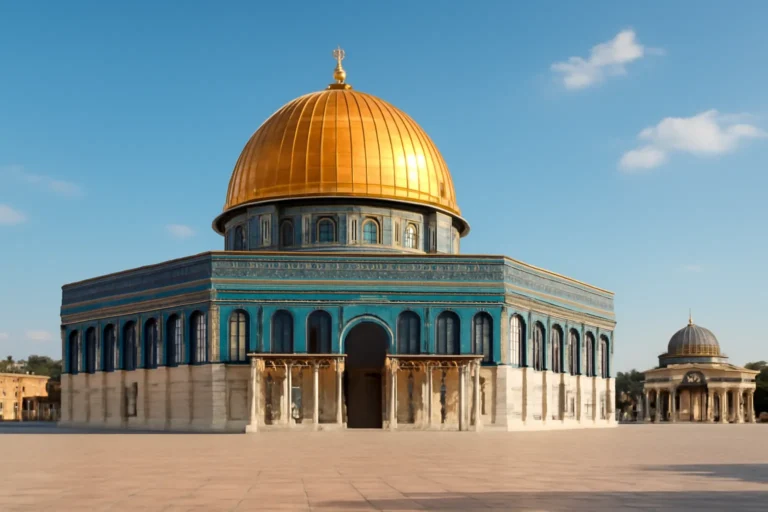
In the 7th century CE, Jerusalem came under Islamic rule, and with it, the Temple Mount acquired a new layer of meaning within the Muslim world. The Islamic authorities designated the site as Haram al-Sharif, a term that emphasizes its status as a noble sanctuary. The early Islamic period did not erase memory of the earlier sanctuaries; rather, it reframed the hill as a locus of divine presence and a place of spiritual instruction for Muslims. The most visible monuments on the platform—the Dome of the Rock and the Al-Aqsa Mosque—were constructed during the early medieval era and became enduring symbols of Islamic architectural achievement and religious devotion. The Dome, with its iconic golden or gilded dome, and the Al-Aqsa Mosque, with its long prayer hall, together anchor the Haram al-Sharif as a living center of worship, scholarship, and ritual life for Muslims across generations.
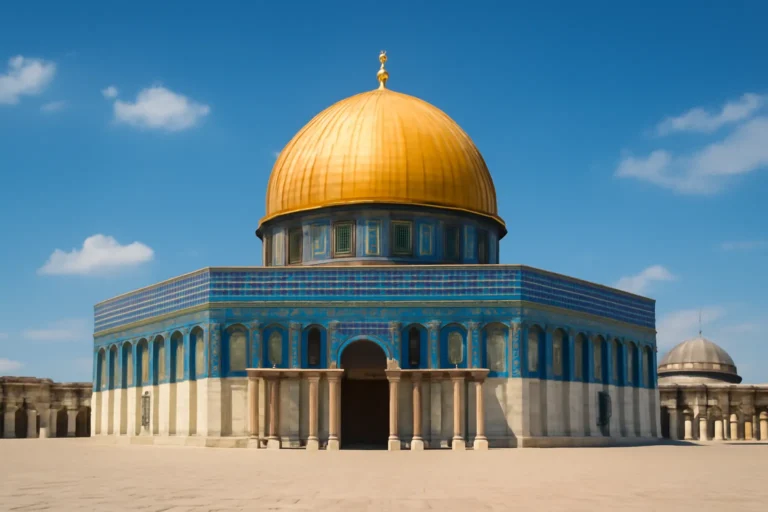
Dome of the Rock (completed around 691 CE) stands as one of the finest examples of early Islamic architecture and as a visual proclamation of the Muslim claim to spiritual primacy in the city.
Al-Aqsa Mosque later emerged within the same sacred precinct, expanding into a major congregational space that has hosted countless prayers and gatherings over the centuries.
Religious practice on the hill reflected a new theological vocabulary while continuing to honor earlier sacred associations with the site.
Early Islamic access, architecture, and the sanctity of time
The early Islamic rulers treated the Haram al-Sharif as a noble sanctuary, integrating the site into the broader Muslim religious landscape. The architecture of the Dome of the Rock and the Al-Aqsa Mosque, though distinct in purpose, shared a common intent: to express reverence for the divine through space, light, calligraphy, and geometry. The complex became a center for ilm (knowledge), jurisprudence, and prayer, linking sacred space to daily life and study. Because of its layered past and ongoing religious significance, the Temple Mount history in the Islamic era is often read as a dialogue between homage to ancient memory and the emergence of a distinct Islamic civilizational presence in Jerusalem.
Medieval transformations: Crusaders, Ayyubids, and Ottoman stewardship
From the 11th to the 18th centuries, the hill’s story was tightly interwoven with the broader fortunes of the Crusades, the Ayyubid recapture, and successive Ottoman governance. The Crusaders seized Jerusalem in 1099 and occupied the city for nearly a century, altering the religious landscape and repurposing or adding structures within the sacred precinct. After Saladin’s reconquest, the Muslim world renewed its Islamic identity on the hill and repaired many aspects of the medieval complex. The Ottoman period, beginning in the 16th century, brought substantial stabilization and architectural renewal. The Ottomans rebuilt, repaired, and maintained the Haram al-Sharif, ensuring continued religious function while also shaping the site’s appearance for centuries. The urban fabric around the Temple Mount also evolved under Ottoman urban planning, religious courts, and waqf endowments that preserved the site for both worship and education.
Crusader legacies and Ayyubid restoration
The Crusader era left physical reminders and, more importantly, a lasting memory of the hill as a symbol of conflict between competing Christian and Muslim powers. When Saladin restored control, the precinct’s sanctity and functionality were reaffirmed within an Islamic framework. This period underscored how sacred space could function as a political stage, with religious authority and military power entwined in the city’s fate. By the time the Ayyubids governed the region, efforts were directed at reconstructing mosques, repairing walls, and ensuring access for pilgrims and worshippers, a pattern that persisted under later rulers.
From the late Ottoman era to the modern period: a site within a changing world
In the 19th and 20th centuries, the Temple Mount continued to be a focal point as empires shifted and modern nationalism emerged. The Ottoman Empire maintained administrative control and supported the maintenance of religious sites while facing internal modernization challenges. The collapse of the Ottoman system after World War I placed Jerusalem under the British Mandate, and the following decades saw intensified debates over sovereignty, access, and governance of sacred spaces. The religious leadership under the Waqf—an Islamic charitable trust—continued to manage the day-to-day operations of the Haram al-Sharif, while state actors navigated the political realities of a city at the crossroads of three major faiths. The mid-to-late 20th century witnessed dramatic geopolitical shifts: the 1948 war divided the city, the 1967 Six-Day War reconfigured control, and subsequent peace processes introduced new mechanisms for access and governance, often described as a delicate status quo arrangement that preserves a fragile peace around sacred space.
British Mandate period: Administrative changes, infrastructure projects, and growing political mobilization around Jerusalem shaped the modern perception of the site.
1967 and aftercare: Israel’s capture of East Jerusalem brought new jurisdictional questions and ongoing negotiations over worship rights and access.
Status Quo arrangements: Measures intended to balance Jewish and Muslim religious rights and to avoid escalations around worship times and site control.
Archaeology, preservation, and the questions of heritage
The Temple Mount is not only a living religious space but also an archaeological archive, with layers dating back more than three millennia. Excavations and surveys near and beneath the site have revealed a complex stratigraphy that includes ancient fortifications, ritual precincts, and evidence of urban phases in Jerusalem’s long history. These discoveries provide critical context for scholars and help the public understand how the hill evolved from a royal sanctuary to a diversified sacred precinct. Yet archaeology on and around the platform is politically sensitive, because discoveries can influence claims about the site’s past and therefore its present-day uses. Preservation philosophies must balance the integrity of ancient remains with respectful access for worshipers and visitors, a challenge that has defined the modern Temple Mount history in an era of heightened public attention and international scrutiny.
Layered archaeology: Excavations have uncovered remnants from multiple eras, including the First and Second Temple periods, and from Islamic and Ottoman phases.
Conservation debates: Preservation strategies must consider structural stability, religious sensitivities, and tourism needs.
Public understanding: Museums, guides, and educational programs aim to explain the site’s complex past without reducing its sacred significance to mere antiquarian interest.
Architectural highlights: what each element on the platform signifies
The Haram al-Sharif platform is a constellation of structures and spaces, each carrying its own architectural language and symbolic purpose. Among its most recognizable features are the Dome of the Rock and the Al-Aqsa Mosque, both perched on the limestone platform that dominates the skyline. The Dome of the Rock, with its iconic octagonal plan and radiant dome, is widely regarded as a masterpiece of early Islamic architecture and an enduring emblem of Jerusalem. The Al-Aqsa Mosque, extending along the southern edge of the platform, has a long prayer hall and a courtyard that has hosted generations of worshippers. Surrounding walls, ramped approaches, and ancillary buildings complete the sacred ensemble, while the Western Wall—though technically outside the platform proper—forms an important axis of prayer and memory for many visitors. Together, these monuments illustrate how architecture can express theology, politics, and communal identity in a single urban space.
Key architectural elements and their meanings
Dome of the Rock: A shrine that symbolizes the sanctity of the site and its status within the Islamic world; its visual impact is inseparable from the history of the hill’s religious life.
Al-Aqsa Mosque: A major congregational space for Muslims, reflecting centuries of liturgical practice and scholarship on the platform.
Western Wall and surrounding terraces: The spiritual magnet for Jewish prayer and a symbol of the city’s contested religious landscape.
Walls and ascents: The configuration of stairways, ramps, and courtyards illustrates how access and visibility have evolved with changes in governance and ritual practice.
Religious and political significance today: ongoing debates and shared memory
In contemporary times, the Temple Mount remains a focal point of national and religious identities. For Jews, the site is tied to biblical narratives and to aspirations for rebuilding a temple in the future, while for Muslims it is an enduring space of devotion, jurisprudence, and spiritual learning. Christians also recognize the hill’s place in the sacred geography of the Holy Land, linking it to the broader narrative of Jerusalem in sacred antiquity. The political tools used to manage access—and the tensions that arise when one community’s religious rituals begin to impinge on another’s—continue to shape policy, diplomacy, and daily life. UNESCO, the United Nations, and various national governments have all weighed in on preservation, access, and the need to protect a site that is both a monument and a lived religious center. Thus, the Temple Mount history in the present moment is not only about past events but about how civilizations negotiate shared space in a city that remains a stage for international dialogue and sometimes conflict.
Access rules: Protocols for worshippers and visitors differ between faith communities, often influenced by security concerns and political developments.
International diplomacy: The site serves as a touchstone in peace processes, with negotiating frameworks aimed at safeguarding religious practice and public order.
Educational and interfaith initiatives: Museums, scholarly programs, and interfaith dialogues seek to illuminate the site’s layered past while promoting mutual respect.
Important questions and common misconceptions about the Temple Mount history
Scholars, policymakers, and visitors frequently encounter questions about what happened on the hill, who has the right to pray there, and how the site should be interpreted for future generations. A few clarifications can help separate legend from historiography and policy from faith:
Historicity: The precise dating and details of the biblical temple(s) are the subject of ongoing research and interpretation, with archaeology offering corroborating but not always definitive evidence.
Continuity: The site is characterized by a long continuity of sacred use, even as the specific structures and custodianship have changed hands many times.
Memory and identity: For many communities, memory attached to the hill shapes identity just as much as it informs policy.
How to read the Temple Mount history: a methodological approach
Approaching the temple mount history requires an interdisciplinary method that respects religious sensibilities while allowing historical inquiry. Historians, archaeologists, theologians, and political scientists contribute different but complementary perspectives. A robust study typically includes:
Chronological mapping of major periods: First Temple, Second Temple, Islamic period, Crusader era, Ottoman rule, and the modern state period.
Architectural analysis: How the physical changes reflect religious priorities and political power shifts.
Textual and liturgical sources: Sacred scriptures, liturgy, legal rulings, and travelogues that illuminate how communities understood the site.
Archaeological evidence: Stratigraphy, artifacts, and structures that offer a material window into the past.
Policy and diplomacy: How governance, access, and sovereignty are negotiated in the present context.
Reflections on the future of the Temple Mount: memory, reverence, and responsibility
Looking ahead, the future of the Temple Mount history will likely involve efforts to preserve its multi-layered heritage while maintaining space for peaceful worship and scholarly inquiry. The site’s significance endures not only in the stones that compose the Dome and the Mosque but also in the way memory, faith, and politics interact in the modern world. For many, the hill remains a symbol of enduring faith and a testament to human beings’ capacity to build, debate, and coexist around a single urban landmark. The ongoing dialogue—between religious communities, between local authorities and international actors, and between past and present—will determine how the Temple Mount is understood, accessed, and cared for in the decades to come.
In studying the Temple Mount history, it is essential to acknowledge the human element: the people who worship, study, guard, and govern this sacred space; the communities that interpret its meaning through prayer, archaeology, or politics; and the visitors who come to reflect on a site where thousands of years of memory intersect with contemporary life. The story of the Temple Mount is a story of memory becoming place, and of place becoming a shared stage for humanity’s most enduring questions about sacred space, authority, and reconciliation.




Leave a Reply