Dome of the Rock Israel: History, Architecture, and Significance in Jerusalem
Dome of the Rock, also known as Qubbat al-Sakhrah in Arabic, stands on the Temple Mount in Jerusalem, a site revered by Muslims, Jews, and Christians alike. This iconic shrine is one of the oldest surviving Islamic monuments and a defining element of Jerusalem’s urban and religious landscape. In discussions that bridge history, architecture, and sacred geography, the phrase Dome of the Rock Israel appears in contemporary discourse as part of debates about sovereignty, access, and preservation. Yet at its core, the Dome of the Rock is a masterpiece of early Islamic architecture that emerged from a moment when the Arab-Islamic world sought to visually articulate its rapture with the sacred while claiming a distinguished presence within the city’s ancient milieu. The following article surveys the history, the architectural vocabulary, and the multifaceted significance of the Dome of the Rock in the context of Jerusalem.
The shrine is most often referred to as the Dome of the Rock in English-language sources, though it carries several names that reflect its layered meanings. In Arabic, it is called Qubbat al-Sakhrah, literally “the Dome over the Rock.” The entire compound on which the jewel-like octagonal building sits is part of the larger complex known in English as the Temple Mount, while Muslims frequently call the elevated enclosure Haram al-Sharif, meaning the Noble Sanctuary. The juxtaposition of names—Dome of the Rock, Qubbat al-Sakhrah, Haram al-Sharif, Temple Mount—highlights how this site functions as a crossroads of memory, devotion, and contestation.
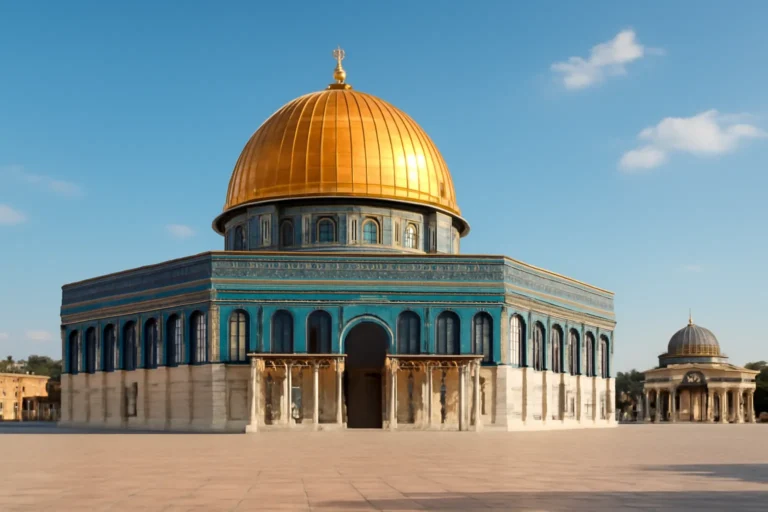
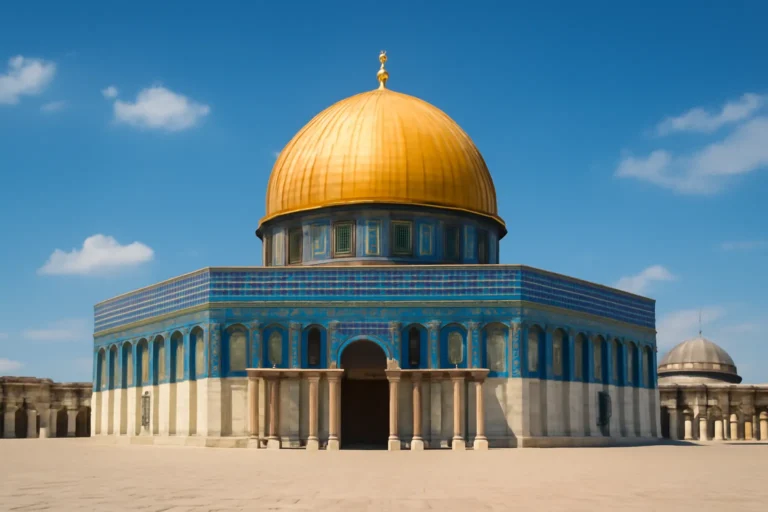
Located in the heart of the Old City of Jerusalem, the Dome of the Rock is not a mosque, but a shrine that houses a sacred rock, traditionally identified as the Foundation Stone. The octagonal structure is set within a precinct that contains other holy buildings, including the nearby Al-Aqsa Mosque. The monument’s visible iconography and its visible قرار—turning points in Jerusalem’s skyline—have made it one of the most instantly recognizable signs of the city worldwide. The Dome of the Rock’s silhouette—an octagonal drum topped by a gilded dome—has inspired admiration in travelers, scholars, and artists for centuries, reflecting a fusion of architectural ideas that defined a distinctive early Islamic architectural language.
Historical overview: from the Temple Mount to the Umayyad era and beyond
Pre-Islamic roots and the sacred geography of the Temple Mount
Before the advent of Islam, the hilltop site hosted two successive Jewish Temples and served as a focal point of biblical memory and ritual life. For Judaism, the site on which the Rock rests is intimately linked with the Foundation Stone, a rock formation associated with creation and with the earliest days of the Temple in Jerusalem. The rock is believed by Jewish tradition to have been the center of the Holy of Holies during the First and Second Temples. The area’s sanctity extended into Christian reverence as well, given Jerusalem’s central place in early Christian history. The long arc of history makes the Temple Mount one of the most contested and storied sacred precincts in the world, where ancient memory and modern politics meet.
Umayyad initiative: constructing a monumental Islamic shrine
The Dome of the Rock was built in the late 7th century CE, during the early decades of the Umayyad Caliphate, under the leadership of Abd al-Malik and his court. The project is widely associated with a deliberate program to articulate a distinctly Islamic sacred architecture that could stand alongside and repurpose the sacred geography of the city. The Dome of the Rock emerged not merely as a place of worship but as a public statement of the legitimacy and splendor of the Umayyad state. The design blends elements drawn from the surviving architectural vocabulary of late antique cities—especially Byzantine forms—with new decorative idioms that would become identifiers of Islamic visual culture.
The exact dating of the project is commonly placed around the years 691–692 CE. Its octagonal plan, the central position of the Rock, and the soaring dome all contributed to a sense of drama and permanence. The interior and exterior ornamentation reveal a synthesis of influences: geometric patterns, calligraphic inscriptions, and lush vegetal motifs that would become hallmarks of early Islamic art. The building’s purpose was not only liturgical but also political—an architectural statement that the Umayyads were shaping a center of gravity for the Muslim world within a city already saturated with memory and meaning.
Medieval transformations, Crusaders, and Muslim restorations
After the turbulent decades that followed the initial Umayyad project, Jerusalem changed hands multiple times. When Crusaders took control of the city in the 11th century, the Haram al-Sharif precinct was repurposed, and the Dome of the Rock’s aura as a sacred monument continued even as its function within the Christian dominion altered. Saladin’s reconquest in the late 12th century restored the site to Muslim custodianship, and subsequent dynasties—Ilkhanids, Mamluks, and Ottomans—administered and sometimes refurbished the sanctuary. During these centuries, the shrine’s exterior and interior spaces were maintained, repaired, and enriched with new inscriptions, tiles, and decorative programs that underscored its religious and cultural significance.
Modern times: the 19th–21st centuries and the contemporary sanctuary landscape
In the modern era, the Dome of the Rock has continued to function within a highly charged political and religious landscape. The 20th and 21st centuries brought debates about sovereignty, access, and stewardship that have reverberated beyond religious life into political institutions and international diplomacy. The Temple Mount/Haram al-Sharif has remained under a unique governance arrangement: while Israeli sovereignty governs the broader political space, the religious trust (the Waqf) presides over daily worship and custodial responsibilities on the site. This arrangement has been a source of ongoing negotiation and controversy, reflecting the broader Arab-Israeli and Palestinian-Israeli context in which the Dome of the Rock stands as a symbol of memory, piety, and contested space.
Architectural analysis: form, ornament, and materiality
Urban context and the octagonal plan
The Dome of the Rock stands atop a raised platform within the Temple Mount precinct, a position that enhances its visibility and symbolic reach. The building’s octagonal exterior footprint translates a geometric logic into a monumental volume. The eightfold rhythm—an architectural choice that appears in a number of early Islamic buildings—conveys both cosmological symbolism and a practical solution for enclosing the central sacred rock while accommodating large crowds. The drum that supports the dome is punctuated by windows, which light the interior and create a luminous, reverent atmosphere beneath the gilded shell.
The dome: silhouette, structure, and gilded coating
The dome itself is the most recognizable feature of the dome-shaped shrine. Its bulbous, hemispherical form rises above the octagonal base, creating a striking silhouette that can be seen from many corners of Jerusalem. The exterior of the dome has been clad with a gold-colored covering for centuries. In the modern era, the outer surface has been described as gold-plated—utilizing modern materials to achieve the desired gleam—while the inner drum is ornamented with windows that illuminate the interior. The relationship between the dome and the rock beneath gives the visitor a sense of vertical ascent that reinforces the sacred drama of the site.
Exterior decoration: tilework, inscriptions, and polychromy
The exterior of the Dome of the Rock is famous for its intricate tilework and surface decoration. The lower levels of the exterior are often treated with ceramic tile in rich hues—blues, greens, and whites—that create a shimmering, mosaic-like field against the stone. In the Umayyad period and in later restorations, inscriptions in Kufic script and ornate floral motifs were integrated into the façade. These inscriptions typically contain Quranic verses, blessings, or phrases that affirm the sanctity of the site. The combination of inscription, pattern, and color articulates a program in which text and form work together to express reverence, power, and legitimacy.
Interior ornament: mosaics, calligraphy, and the rock itself
Inside, the Dome of the Rock is equally rich. The interior space is organized around the Foundation Stone, which remains visible to pilgrims and visitors. The walls and arches are adorned with mosaics and intricate calligraphy. The mosaics often display vegetal and geometric motifs, reflecting both a continuation of late antique decorative traditions and the distinctive Islamic sensibility toward abstraction and order. The inscriptions—some dating back to the early Islamic period—deliver Qur’anic verses and phrases that elevate the interior as a space of contemplation, prayer, and memory.
Relational architecture: the shrine within the Haram precinct
The Dome of the Rock does not exist in isolation. It sits within a sacred landscape that includes the Al-Aqsa Mosque and surrounding courtyards. The architectural logic of the site integrates with the urban fabric of Jerusalem’s ancient quarters, creating a sequence of spaces designed to accommodate processions, rituals, and gatherings. The complex becomes a stage on which the community and visitors encounter the divine, the historic past, and the present-day political moment in one panoramic frame.
Religious significance: Islam, Judaism, and the shared heritage
In Islam: Isra, Mi’raj, and a pulsing center of devotion
For Muslims, the Dome of the Rock occupies a central place in the story of the Prophet Muhammad’s Night Journey (Isra and Mi’raj). Tradition holds that Muhammad was transported from the Sacred Mosque in Mecca to the farthest mosque, and then raised to the heavens from the rock at this site. The rock—revered as the Foundation Stone—becomes a physical anchor for a narrative that unites heaven and earth, the prophetic mission, and the city’s sacred memory. The shrine is thus more than a monument; it is a place where the divine drama of Islam is felt as a living part of everyday worship and public life.
In Judaism: the Foundation Stone and a memory of ancient Temples
In Jewish memory, the rock under the Dome of the Rock is linked with the sacred geography of the Temple Mount, the site of the ancient Temple in Jerusalem. The Foundation Stone is associated with origins of the world and the holiest space in Jewish tradition, even as the exact material remains and temple-era configurations are subjects of historical, religious, and archaeological contemplation. For many Jews, the Temple Mount remains the locus of the original sanctity of the Temple, and the area continues to symbolize the long arc of Jewish longing for a rebuilt temple and a reconstituted sacred center.
Interfaith dialogues and shared memory
Beyond doctrinal concerns, the Dome of the Rock has become a touchstone for interfaith dialogue about memory, sovereignty, and the stewardship of sacred spaces. The shrine’s presence in a city that has long hosted diverse faith communities invites ongoing conversation about how sacred geography can be protected, interpreted, and respected by people with deeply rooted religious identities. The way the site is curated—balancing worship with public access, security with dignity—reflects broader questions about respect, coexistence, and the responsibilities of custodianship in a contested metropolis.
Architectural heritage, conservation, and governance
Heritage status and preservation challenges
The Dome of the Rock sits at the center of Jerusalem’s UNESCO-recognized heritage fabric. Preservation efforts confront a range of pressures: environmental exposure, centuries of restoration work, and the need to maintain authenticity while accommodating millions of visitors. Conservation plans must account for weathering, structural integrity, and the preservation of precious decorative programs—both outside and inside the octagonal walls. The challenge is not merely to protect a historic structure but to sustain the experiential sacredness that visitors seek when they approach the site.
Governance, access, and the balance of custodianship
The governance of the Temple Mount precinct is a uniquely layered arrangement. The religious trust known as the Waqf manages day-to-day worship and religious activities. Security and some administrative functions are handled by Israeli authorities in the context of the city’s broader political framework. This dual arrangement has been the subject of controversy, negotiation, and intense scrutiny, illustrating how sacred space can become a flashpoint in geopolitical disputes even as it remains a place of prayer, memory, and cultural achievement. Visitors—whether pilgrims, tourists, or scholars—often encounter different rules for access, times for prayer, and guidelines for behavior, depending on one’s faith and the political climate at any given moment.
Tourism, education, and public perception
The Dome of the Rock attracts millions of visitors from around the world. For many, it is a learning-laden encounter with medieval Islamic architecture, Islamic art, and the shared urban history of Jerusalem. Educational programs, guided tours, and museum-like exhibits in the surrounding precinct help convey the monument’s story to diverse audiences. The experience is layered: a traveler might reflect on the building’s craft and artistry, consider its place in religious narratives, and simultaneously engage with the political complexity of a site that continues to shape regional and international conversations about peace, justice, and memory.
Key architectural features and notable details in perspective
Shape and footprint: an octagonal base supports a vertical drum and a towering dome, creating a sculptural volume that reads clearly from multiple approaches.
Rock at the center: the Foundation Stone sits at the core of the shrine, offering a focal point for contemplation and a stage for sacred narratives in Islam and Judaism.
Exterior tilework and inscriptions: a mosaic of glazes and tiles, interwoven with Qur’anic script, enhances the sense of a living monument rather than a museum piece.
Dome treatment: the gleaming dome, often described as golden in appearance, crowns the structure and anchors its silhouette in the surrounding cityscape.
Interior decoration: mosaics, calligraphic panels, and vegetal motifs envelop the interior in a luminous, tranquil atmosphere designed to elevate prayer and reflection.
Scholars frequently emphasize that the Dome of the Rock should be understood not only as a building but as a material expression of a pivotal moment in Islamic art and architecture. Its early adoption of a centralized, domed form and its sophisticated use of inscription and pattern anticipate later developments in the Islamic world. The interplay of light, color, and geometry in the interior creates an atmosphere that invites meditative attention to the sacred rock and to the wider spiritual meanings that the site has carried through the centuries.
Further reflections: the Dome of the Rock as a symbol and as a living space
Symbolic resonance across centuries
The Dome of the Rock has carried symbolic weight across generations. For Muslims, it embodies a connection to a moment of ascent and revelation; for Jews, its location above the Foundation Stone resonates with ancient memory of the Temple. For visitors of many faiths and backgrounds, the structure’s aesthetic power and historic aura offer a powerful reminder of Jerusalem’s role as a crossroads of civilizations. The shrine’s endurance—through earthquakes, fires, political upheavals, and modern development—speaks to a broader human desire to link memory with space and to find meaning in built forms that outlive their builders.
Contemporary discourse: heritage, access, and coexistence
In today’s discourse, the Dome of the Rock is often discussed within the frameworks of heritage preservation, interfaith dialogue, and political resolution. Balancing the rights of worship with the rights of visitors, protecting artistic heritage while enabling education and tourism, and negotiating sovereignty with responsibility are ongoing tasks for the communities that steward the Haram al-Sharif/Haram al-Sharif precinct. The building thus serves as a case study in how sacred architecture can be a forum for negotiation, where memory is not merely commemorated but actively interpreted, contested, and reimagined in response to new circumstances.
Concluding thoughts: the enduring appeal of the Dome of the Rock
The Dome of the Rock in Jerusalem—the Dome of the Rock Israel in various contemporary references—remains a landmark that transcends simple description. It is a monument of early Islamic architecture, a sacred space with deep religious meaning, and a keystone of a city that has shaped world history. Its octagonal geometry, its lantern-like dome, its inscriptions, and its central rock all contribute to a narrative that continues to evolve as new generations encounter the site. Whether approached as a symbol of faith, a milestone in architectural history, or a focal point of modern geopolitics, the Dome of the Rock invites reflection on how human beings preserve memory, express devotion, and negotiate peace within a shared urban landscape.
In the end, the Dome of the Rock on the Temple Mount stands as a testament to a moment when a city’s sacred geography became a global icon. The building’s beauty, its layered meanings, and its fragile, contested context together make it one of the most studied and most loved architectural wonders in the world. As a living space that hosts prayer and pilgrimage even today, it remains a vivid reminder that history is not merely a record of the past but a dynamic field where culture, faith, and politics continue to meet.