Commentary on Matt 21: Jesus’ Kingship, Temple Cleansing, and Calls to Fruitful Faith
Matthew 21 · King James Version
Quick Answer: This commentary on Matt 21 highlights Jesus’ royal entry, his cleansing of the temple, and his call for genuine faith that bears fruit. Through the fig tree and two parables, he exposes religious hypocrisy and warns that God’s kingdom moves toward those who repent and respond. The chapter ends with leaders recognizing Jesus’ authority yet refusing to submit.
Matthew 21 (King James Version)
“And when they drew nigh unto Jerusalem, and were come to Bethphage, unto the mount of Olives, then sent Jesus two disciples,
Saying unto them,
Go into the village over against you, and straightway ye shall find an ass tied, and a colt with her: loose
them,
and bring
them unto me.
And if any
man say ought unto you, ye shall say, The Lord hath need of them; and straightway he will send them.
All this was done, that it might be fulfilled which was spoken by the prophet, saying,
Tell ye the daughter of Sion, Behold, thy King cometh unto thee, meek, and sitting upon an ass, and a colt the foal of an ass.
And the disciples went, and did as Jesus commanded them,
And brought the ass, and the colt, and put on them their clothes, and they set
him thereon.
And a very great multitude spread their garments in the way; others cut down branches from the trees, and strawed
them in the way.
And the multitudes that went before, and that followed, cried, saying, Hosanna to the Son of David: Blessed
is he that cometh in the name of the Lord; Hosanna in the highest.
And when he was come into Jerusalem, all the city was moved, saying, Who is this?
And the multitude said, This is Jesus the prophet of Nazareth of Galilee.
And Jesus went into the temple of God, and cast out all them that sold and bought in the temple, and overthrew the tables of the moneychangers, and the seats of them that sold doves,
And said unto them,
It is written, My house shall be called the house of prayer; but ye have made it a den of thieves.
And the blind and the lame came to him in the temple; and he healed them.
And when the chief priests and scribes saw the wonderful things that he did, and the children crying in the temple, and saying, Hosanna to the Son of David; they were sore displeased,
And said unto him, Hearest thou what these say? And Jesus saith unto them,
Yea; have ye never read, Out of the mouth of babes and sucklings thou hast perfected praise?And he left them, and went out of the city into Bethany; and he lodged there.
Now in the morning as he returned into the city, he hungered.
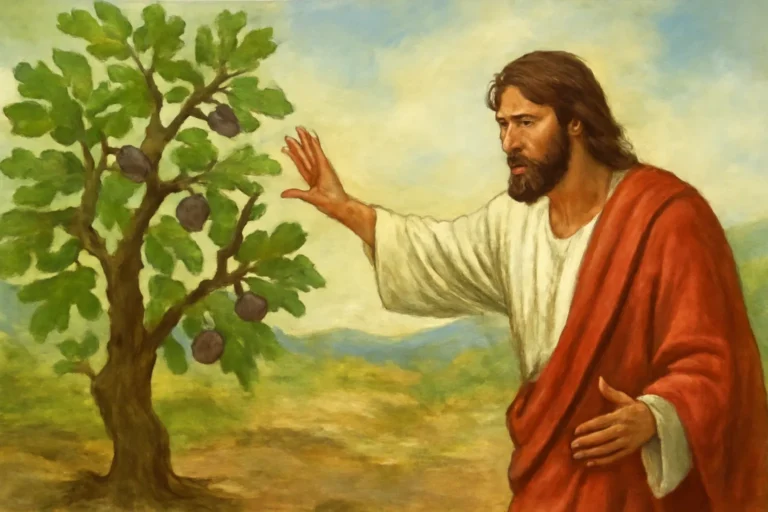
And when he saw a fig tree in the way, he came to it, and found nothing thereon, but leaves only, and said unto it,
Let no fruit grow on thee henceforward for ever. And presently the fig tree withered away.
And when the disciples saw
it, they marvelled, saying, How soon is the fig tree withered away!
Jesus answered and said unto them,
Verily I say unto you, If ye have faith, and doubt not, ye shall not only do this
which is done to the fig tree, but also if ye shall say unto this mountain, Be thou removed, and be thou cast into the sea; it shall be done.
And all things, whatsoever ye shall ask in prayer, believing, ye shall receive.And when he was come into the temple, the chief priests and the elders of the people came unto him as he was teaching, and said, By what authority doest thou these things? and who gave thee this authority?
And Jesus answered and said unto them,
I also will ask you one thing, which if ye tell me, I in like wise will tell you by what authority I do these things.
The baptism of John, whence was it? from heaven, or of men? And they reasoned with themselves, saying, If we shall say, From heaven; he will say unto us, Why did ye not then believe him?
But if we shall say, Of men; we fear the people; for all hold John as a prophet.
And they answered Jesus, and said, We cannot tell. And he said unto them,
Neither tell I you by what authority I do these things. But what think ye? A
certain man had two sons; and he came to the first, and said, Son, go work to day in my vineyard.
He answered and said, I will not: but afterward he repented, and went.
And he came to the second, and said likewise. And he answered and said, I
go, sir: and went not.
Whether of them twain did the will of
his father?
They say unto him, The first. Jesus saith unto them,
Verily I say unto you, That the publicans and the harlots go into the kingdom of God before you.
For John came unto you in the way of righteousness, and ye believed him not: but the publicans and the harlots believed him: and ye, when ye had seen
it, repented not afterward, that ye might believe him.
Hear another parable: There was a certain householder, which planted a vineyard, and hedged it round about, and digged a winepress in it, and built a tower, and let it out to husbandmen, and went into a far country:
And when the time of the fruit drew near, he sent his servants to the husbandmen, that they might receive the fruits of it.
And the husbandmen took his servants, and beat one, and killed another, and stoned another.
Again, he sent other servants more than the first: and they did unto them likewise.
But last of all he sent unto them his son, saying, They will reverence my son.
But when the husbandmen saw the son, they said among themselves, This is the heir; come, let us kill him, and let us seize on his inheritance.
And they caught him, and cast
him out of the vineyard, and slew
him.When the lord therefore of the vineyard cometh, what will he do unto those husbandmen?
They say unto him, He will miserably destroy those wicked men, and will let out
his vineyard unto other husbandmen, which shall render him the fruits in their seasons.
Jesus saith unto them,
Did ye never read in the scriptures, The stone which the builders rejected, the same is become the head of the corner: this is the Lord’s doing, and it is marvellous in our eyes?
Therefore say I unto you, The kingdom of God shall be taken from you, and given to a nation bringing forth the fruits thereof.
And whosoever shall fall on this stone shall be broken: but on whomsoever it shall fall, it will grind him to powder.
And when the chief priests and Pharisees had heard his parables, they perceived that he spake of them.
But when they sought to lay hands on him, they feared the multitude, because they took him for a prophet.”
Matthew 21 Bible commentary in its Jerusalem setting
Matthew 21 unfolds during the final approach to Jerusalem, in a season when pilgrimage was intense and messianic hope ran high. Bethphage on the Mount of Olives was near the route many travelers would take into the city. Public expectation about a coming “King” created a charged atmosphere, especially during Passover-linked gatherings when crowds remembered God’s promises.
In the temple precincts, financial activity was not incidental; moneychangers served worshipers who needed acceptable currency for offerings, and sellers provided sacrificial animals. Yet Jesus treats the temple as more than an economic service center. His action signals that worship must be aligned with holiness and prayer, not profit and exploitation.
The chapter also reflects a common Jewish pattern of teaching through symbolic acts and parables. Jesus’ cursing of the fig tree operates like a living sermon: appearances without fruit reveal spiritual emptiness. Likewise, his stories about two sons and a vineyard communicate covenant responsibility—Israel has received God’s care and instruction, but the leadership has often failed to produce the faithfulness God requires.
Finally, the religious leaders’ questioning of Jesus’ authority shows the political and spiritual tension of the moment. They fear the people because Jesus’ words and works draw crowds, making neutrality difficult. Understanding this setting helps the reader see that Matthew 21 is not merely moral instruction; it is also a clash over who truly represents God’s kingdom.
Original-language nuance: “faith” and trust in action
While Matthew was written in Greek, the key concepts here carry a relational weight common to biblical language of faithfulness. In Matthew 21, Jesus repeatedly ties belief to concrete response—repentance, obedience, and spiritual fruit. The Greek terms related to faith and doubting (and the idea of trust that does not waver) often denote more than mental agreement. They point to reliance that moves the will.
When Jesus says that believers who do not doubt can see astonishing outcomes, the emphasis is not on using God as a tool, but on a life aligned with God’s will—prayer offered in confidence, not in fear. His teaching assumes that God’s kingdom breaks into history through the posture of trusting obedience.
So, the nuance to hold is this: faith in Matthew 21 is not passive. It is active trust that reorients behavior, especially when God’s authority is confronted by human skepticism.
Jesus enters as King—yet his kingship demands humble submission
Matthew begins this chapter with the approach to Jerusalem and Jesus’ deliberate, symbolic entry. Jesus sends two disciples to find a donkey and its colt, a scene that signals both fulfillment and providence: God’s promise is not merely spoken; it is orchestrated. The crowd’s response—spreading garments, cutting branches, crying “Hosanna” and praising the one who comes in the name of the Lord—shows that expectation for a Davidic King is alive.
Yet Matthew’s framing keeps the reader from sentimental triumphalism. Jesus is not enthroned as a conquering warrior. He comes in meekness, seated upon an animal associated with travel and labor. The fulfillment from the prophets underscores that God’s King arrives differently than human rulers. This is the first turning point of Matthew 21: the crowd can celebrate royalty while still misunderstanding its nature.
When the city asks, “Who is this?” and the crowd answers with titles like “prophet,” the chapter reveals a spectrum of recognition. Some perceive truth; others reduce Jesus to a manageable category. Meanwhile, Jesus moves quickly toward the temple, not toward political accommodation. His kingship is revealed in holiness and in the correction of worship.
For a devotional takeaway, this means that Jesus’ authority is not established by how loudly people praise, but by what they are willing to obey. In every age, God can receive worship that is emotionally intense yet spiritually empty. True recognition of Jesus’ kingship produces repentance and fruit.
Temple cleansing: prayer replaces profit—worship must be holy
Once Jesus arrives in Jerusalem, he goes into the temple and confronts practices that distort worship. He drives out those who sell and buy, overturns the tables of the moneychangers, and removes the seats of those selling doves. Matthew portrays this as more than a single upset customer moment; it is an act of judgment against corruption.
Jesus cites Scripture: “My house shall be called the house of prayer; but ye have made it a den of thieves.” The contrast is stark. The temple exists to draw near to God. But the behaviors he overturns turn nearness into exploitation—turning sacred space into commerce and using religion as a shield for greed.
This is why Matthew immediately links the action to healing: “the blind and the lame came to him in the temple; and he healed them.” The cleansing is not simply negative. It clears the space so that God’s mercy can be seen. Jesus’ authority is displayed in compassion as well as confrontation.
Meanwhile, the children cry “Hosanna,” and the religious leaders become displeased. Their discomfort suggests a pattern: they are more concerned with maintaining control of who may speak and praise than with the reality that God’s work is happening in their midst.
At the same time, the chapter does not ignore the leaders’ theological seriousness—they are not portrayed as ignorant. But they are resistant. Jesus answers them by pointing to Scripture about praise from the mouths of babes and sucklings. The point is that genuine worship often comes from humble mouths, not only from religious gatekeepers.
This section challenges Christians to examine the “temple” in their own lives. What practices distract from prayer? Where do we let religious activity become a means of self-protection rather than communion with God?
Fig tree warning: religious appearance without fruit invites judgment
Matthew then narrates a symbolic act on the road from Jerusalem to Bethany: Jesus hungers, sees a fig tree, and finds leaves only—no fruit. He speaks judgment: “Let no fruit grow on thee henceforward for ever.” The tree withers quickly, and the disciples marvel at the speed.
This is not merely a story about botany. It functions like a parable in physical form. A fig tree covered with leaves communicates life and expectation, yet it fails the test of fruitfulness. In the spiritual sense, Matthew uses it to warn against the mismatch between outward religious signals and inward obedience.
Jesus’ teaching afterward makes the theological link explicit. If the disciples have faith and do not doubt, they can experience God’s power—not only over the fig tree but also in the movement of obstacles (“this mountain”). He also states that prayer offered with belief will be received.
Together, these statements interpret the sign. The fig tree is not just a lesson in anger; it is a lesson in faithfulness. God can remove what looks alive but proves empty. At the same time, God invites believers to pray and trust rather than to respond with fear or unbelief.
The disciples’ marvel reflects normal human surprise: they experience the result immediately. But Jesus emphasizes that faith and prayer are the posture that aligns with God’s kingdom purposes.
In devotional terms, Matthew 21 confronts the temptation to treat spirituality as appearance. The question is not, “Do we look religious?” but, “Do we bear fruit that matches our claims?”
Two parables of responsibility: repent when you are confronted with truth
In the temple, the chief priests and elders ask Jesus about his authority. They want legal and political legitimacy before they will acknowledge his actions. Jesus responds with a question about the baptism of John: was it from heaven or from men? Their dilemma reveals their deeper issue: they fear the people and are unwilling to commit.
Then Jesus tells two parables that expose hearts. The first parable is about two sons. One refuses to work in the vineyard but later repents and goes. The other agrees but does not go. Jesus asks which did the father’s will; they answer correctly—repentant obedience in the end is what counts.
Jesus applies it: “the publicans and the harlots go into the kingdom of God before you.” This is a startling reversal. Many religious leaders assumed moral respectability automatically meant closeness to God. But Jesus argues that John’s call to righteousness reached some who recognized their need and believed; while religious leaders saw and heard yet did not repent afterward.
The second parable is the vineyard story. A householder plants a vineyard, protects it, and entrusts it to tenants. When the time of fruit comes, the tenants beat and kill the servants sent to collect fruit. Finally the owner sends his son, whom the tenants kill to seize inheritance. Jesus’ audience is meant to see covenant betrayal: God gives care and time; leaders respond with violence and self-interest.
The leaders themselves pronounce the verdict—God will destroy the wicked tenants and give the vineyard to others who will produce fruit in season. Jesus then seals it with Scripture about the cornerstone: the rejected stone becomes the head of the corner. This means rejection of God’s appointed Messiah will not stop God’s work; it will instead bring judgment.
Matthew’s warning is not abstract. It targets the leaders who question authority while refusing repentance. Faith is measured by response, not by agreement in a courtroom.
Kingdom transfer: God’s purposes move, and refusal hardens into loss
The closing movement of Matthew 21 emphasizes that Jesus’ parables are about real people with real responsibility. The leaders recognize that he speaks about them. Yet even after understanding, they seek to lay hands on him. Their fear of the multitude shows how public opinion and spiritual courage collide.
When Jesus declares that the kingdom of God will be taken from those who fail to bear fruit and given to a nation bringing forth fruits, he describes a covenant principle: God’s gifts are not static privileges. They call for faithful stewardship.
The “stone” imagery deepens this. A stone can either be stumbled over or used as a foundation. Jesus states that whoever falls on the stone will be broken, while whoever the stone falls on will be crushed to powder. In other words, the Messiah is not neutral: rejecting him results in catastrophic consequences; yet those who embrace him find stability.
This is why the chapter’s theme unites symbol, speech, and parable. The fig tree dramatizes emptiness. The two sons dramatize repentance versus mere words. The vineyard tenants dramatize violent misuse of responsibility. The cleansing of the temple dramatizes worship corrupted by greed and self-rule.
The result is a profound spiritual logic: God calls for fruitful faith, and refusal converts opportunity into judgment. Matthew 21 therefore functions as both mercy and warning—mercy for those who will repent, warning for those who will harden themselves.
For readers today, the question becomes personal: will we respond when Christ’s authority confronts us? Or will we hide behind religious respectability while avoiding the costly obedience that genuine repentance requires?
How to Apply This Today from Matthew 21
Matthew 21 presses you to examine what your “fruit” actually looks like. Start with repentance that leads to action. Like the second son, you may be tempted to say “Yes” spiritually while delaying obedience. Choose one next step this week that costs you something: forgive a person you have avoided, return honesty in your work, set aside a habit that harms your conscience, or commit to consistent prayer.
Second, protect your worship from becoming transactional. Jesus’ temple cleansing exposes the danger of using religion as a means to personal gain or control. Ask: do I treat prayer like a last-minute mechanism, or do I truly seek God’s presence? Are my spiritual conversations encouraging, or do they elevate me above others?
Third, pray with trust rather than doubt. Jesus ties faith to believing prayer and to God’s power over obstacles. That doesn’t mean every request becomes immediate gratification. But it does mean you can bring your requests to God honestly, with confidence that he hears.
Finally, accept that Jesus’ authority is not something to debate endlessly—it is something to yield to. If conviction comes, do not postpone response. Matthew 21’s leaders saw truth and yet refused to repent. You can choose the opposite: respond quickly, bear fruit faithfully, and let Christ reshape your “inner vineyard.”
Related Bible Passages
Isaiah 56:7
Jesus’ quotation about the temple as a house of prayer connects his cleansing to Isaiah’s vision of God-honoring worship.
Mark 11:12-14
The fig tree episode also appears in Mark, highlighting the symbolic judgment against barrenness and the need for fruit.
Matthew 7:17-20
Jesus links fruit to real discipleship, reinforcing Matthew 21’s theme that outward profession must match inward life.
Psalm 118:22
The cornerstone imagery Jesus uses echoes Psalm 118, affirming that rejection of the appointed stone leads to reversal and judgment.
Frequently Asked Questions
What does Matthew 21 teach about faith and fruit?
Matthew 21 teaches that faith is not only belief—it shows up as repentance and obedience that produces fruit. The fig tree sign warns against spiritual emptiness, and the parables show that “right words” without action are insufficient. Trusting God leads to a changed life, not just religious activity.
Why did Jesus cleanse the temple in Matthew 21?
Jesus cleansed the temple because the space meant for prayer had become corrupted by profit and exploitation. By overturning the moneychangers’ tables and addressing worship practices, he revealed that God’s house must honor holiness and mercy. The healing that follows shows his cleansing aims at restoration.
How should Christians understand the parable of the two sons in Matthew 21?
In the parable, one son refuses at first but later repents and does the work, while the other agrees yet fails to go. Jesus applies this to those who recognize truth but refuse to change. The lesson is that repentance must lead to action—delayed obedience is still disobedience.
What is the meaning of the “stone” in Jesus’ parable language (Matthew 21)?
The stone represents the rejected Messiah who becomes the foundation of God’s kingdom. Rejecting him brings breakdown and judgment, while embracing him provides stability. Jesus is warning that resistance to God’s authority has consequences, even if people initially refuse to acknowledge it.
A Short Prayer
Lord Jesus, you entered Jerusalem as the humble King and you confronted empty religion with truth. Search my heart for places where I look faithful but produce no fruit. Teach me to repent quickly and to trust you when obstacles feel immovable. Cleanse my worship from selfish motives and renew my prayer with belief. Make me fruitful in your vineyard, for your glory and my good. Amen.
Key Takeaway: Matthew 21 calls you to respond to Jesus’ authority with repentant, fruitful faith—because religious appearance without obedience invites judgment.