Commentary on Matthew 21: Jesus’ Kingship, Cleansing, and Fruitful Faith
Matthew 21 · King James Version
Quick Answer: This commentary on Matthew 21 highlights Jesus’ royal entry, His cleansing of the temple, and His call to faith that bears fruit. The fig tree judgment warns against empty religious appearances, while the parables of the two sons and the wicked tenants expose hypocrisy and demand repentance. Jesus’ authority is contested, yet His words reveal that God’s kingdom will be given to those who produce obedient “fruit.”
Matthew 21 (King James Version)
“And when they drew nigh unto Jerusalem, and were come to Bethphage, unto the mount of Olives, then sent Jesus two disciples,
Saying unto them,
Go into the village over against you, and straightway ye shall find an ass tied, and a colt with her: loose
them,
and bring
them unto me.
And if any
man say ought unto you, ye shall say, The Lord hath need of them; and straightway he will send them.
All this was done, that it might be fulfilled which was spoken by the prophet, saying,
Tell ye the daughter of Sion, Behold, thy King cometh unto thee, meek, and sitting upon an ass, and a colt the foal of an ass.
And the disciples went, and did as Jesus commanded them,
And brought the ass, and the colt, and put on them their clothes, and they set
him thereon.
And a very great multitude spread their garments in the way; others cut down branches from the trees, and strawed
them in the way.
And the multitudes that went before, and that followed, cried, saying, Hosanna to the Son of David: Blessed
is he that cometh in the name of the Lord; Hosanna in the highest.
And when he was come into Jerusalem, all the city was moved, saying, Who is this?
And the multitude said, This is Jesus the prophet of Nazareth of Galilee.
And Jesus went into the temple of God, and cast out all them that sold and bought in the temple, and overthrew the tables of the moneychangers, and the seats of them that sold doves,
And said unto them,
It is written, My house shall be called the house of prayer; but ye have made it a den of thieves.
And the blind and the lame came to him in the temple; and he healed them.
And when the chief priests and scribes saw the wonderful things that he did, and the children crying in the temple, and saying, Hosanna to the Son of David; they were sore displeased,
And said unto him, Hearest thou what these say? And Jesus saith unto them,
Yea; have ye never read, Out of the mouth of babes and sucklings thou hast perfected praise?And he left them, and went out of the city into Bethany; and he lodged there.
Now in the morning as he returned into the city, he hungered.
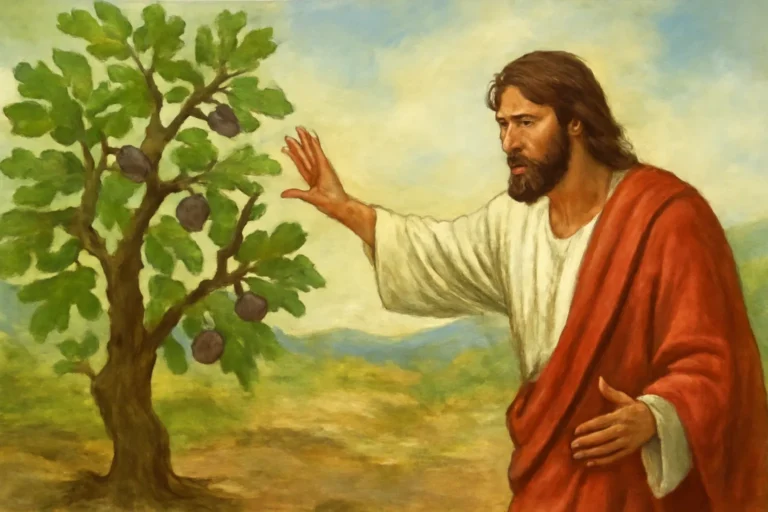
And when he saw a fig tree in the way, he came to it, and found nothing thereon, but leaves only, and said unto it,
Let no fruit grow on thee henceforward for ever. And presently the fig tree withered away.
And when the disciples saw
it, they marvelled, saying, How soon is the fig tree withered away!
Jesus answered and said unto them,
Verily I say unto you, If ye have faith, and doubt not, ye shall not only do this
which is done to the fig tree, but also if ye shall say unto this mountain, Be thou removed, and be thou cast into the sea; it shall be done.
And all things, whatsoever ye shall ask in prayer, believing, ye shall receive.And when he was come into the temple, the chief priests and the elders of the people came unto him as he was teaching, and said, By what authority doest thou these things? and who gave thee this authority?
And Jesus answered and said unto them,
I also will ask you one thing, which if ye tell me, I in like wise will tell you by what authority I do these things.
The baptism of John, whence was it? from heaven, or of men? And they reasoned with themselves, saying, If we shall say, From heaven; he will say unto us, Why did ye not then believe him?
But if we shall say, Of men; we fear the people; for all hold John as a prophet.
And they answered Jesus, and said, We cannot tell. And he said unto them,
Neither tell I you by what authority I do these things. But what think ye? A
certain man had two sons; and he came to the first, and said, Son, go work to day in my vineyard.
He answered and said, I will not: but afterward he repented, and went.
And he came to the second, and said likewise. And he answered and said, I
go, sir: and went not.
Whether of them twain did the will of
his father?
They say unto him, The first. Jesus saith unto them,
Verily I say unto you, That the publicans and the harlots go into the kingdom of God before you.
For John came unto you in the way of righteousness, and ye believed him not: but the publicans and the harlots believed him: and ye, when ye had seen
it, repented not afterward, that ye might believe him.
Hear another parable: There was a certain householder, which planted a vineyard, and hedged it round about, and digged a winepress in it, and built a tower, and let it out to husbandmen, and went into a far country:
And when the time of the fruit drew near, he sent his servants to the husbandmen, that they might receive the fruits of it.
And the husbandmen took his servants, and beat one, and killed another, and stoned another.
Again, he sent other servants more than the first: and they did unto them likewise.
But last of all he sent unto them his son, saying, They will reverence my son.
But when the husbandmen saw the son, they said among themselves, This is the heir; come, let us kill him, and let us seize on his inheritance.
And they caught him, and cast
him out of the vineyard, and slew
him.When the lord therefore of the vineyard cometh, what will he do unto those husbandmen?
They say unto him, He will miserably destroy those wicked men, and will let out
his vineyard unto other husbandmen, which shall render him the fruits in their seasons.
Jesus saith unto them,
Did ye never read in the scriptures, The stone which the builders rejected, the same is become the head of the corner: this is the Lord’s doing, and it is marvellous in our eyes?
Therefore say I unto you, The kingdom of God shall be taken from you, and given to a nation bringing forth the fruits thereof.
And whosoever shall fall on this stone shall be broken: but on whomsoever it shall fall, it will grind him to powder.
And when the chief priests and Pharisees had heard his parables, they perceived that he spake of them.
But when they sought to lay hands on him, they feared the multitude, because they took him for a prophet.”
Devotional insight for Matthew 21: Jerusalem, worship, and expectation
Matthew 21 is set in the final days of Jesus’ public ministry, as He approaches Jerusalem during a season when crowds gathered for major festivals. The mount of Olives and Bethphage connect the journey with a well-known spiritual landscape: pilgrims looked to Jerusalem as the center of worship and God’s promises. In this context, Jesus’ entry is not merely “popular”; it is deliberately symbolic.
The temple precincts were also a place where worship could be distorted. Moneychangers and sellers of approved sacrifices helped pilgrims transact for offerings, but Jesus exposes a deeper corruption: commerce and exploitation replace reverent worship. His citation of Scripture frames the temple as belonging to God’s purposes—prayer and holiness—rather than profit.
Finally, the controversies with chief priests and scribes reflect how religious leaders guarded authority and interpretation. Jesus’ teaching and miracles—especially those connected to the temple and faith—force a confrontation: will the hearers submit to God’s Messiah, or defend their own position? Matthew’s portrayal emphasizes that true faith produces transformed allegiance, visible in obedience and fruitfulness.
Original language nuance: “faith” and the request-believing posture
Matthew’s Greek emphasizes faith as more than mental agreement. In the fig tree episode, Jesus links faith with doubtlessness—confidence in God’s action rather than wavering expectations. The tone is relational and active: believing prayer is not treated as a magical technique, but as trust that aligns the heart with God’s will.
Also, the “authority” question (who gave you this?) is portrayed with legal and legitimacy overtones. The leaders are not only asking “where did you learn,” but “by what right do you act and teach.” Jesus’ response exposes the gap between institutional power and divine commissioning. Matthew’s language repeatedly contrasts outward roles with inward submission to God.
Commentary on Jesus’ triumphal entry: meek kingship and prophetic fulfillment
As Jesus approaches Jerusalem, He sends two disciples to secure a donkey and its colt. This is intentionally ordinary—yet prophecy makes it extraordinary. The king arrives in meekness, not with military dominance. Matthew connects the scene to Scripture about Zion’s King, stressing that God’s rule comes with gentleness and purpose.
The crowd responds with garments spread, branches cut, and cries of “Hosanna.” In the moment, this sounds like an enthronement. But Matthew’s emphasis is more searching: the question becomes whether the crowd’s praise leads to repentance and fruit or whether it remains spectacle.
Once Jesus enters Jerusalem, the city is “moved,” and people debate identity. Some call Him “the prophet.” But Matthew keeps steering readers toward a deeper conclusion: Jesus is not merely a messenger; He is the rightful Lord who will bring judgment and renewal.
This opening sets the trajectory for the rest of the chapter. The King’s meekness does not mean weakness. It is the pathway into cleansing, confrontation, and ultimately a demand for truth. In other words, Jesus’ kingship is both comforting (for the humble) and disturbing (for those who profit from false religion).
Matthew 21 temple cleansing meaning: worship corrupted by commerce
Jesus goes into the temple and challenges the marketplace atmosphere. He overturns the tables of moneychangers and the seats of those selling doves. The significance is not that all transactions are wrong; rather, Matthew presents a heart-level corruption—religious space turned into profit space.
Jesus quotes that God’s house is to be a house of prayer, but they have made it a den of thieves. That phrase exposes a moral diagnosis. Thievery here is not merely theft of coins; it is misuse of sacred opportunity—turning worship into exploitation and blocking people from approaching God.
The immediate response is striking: the blind and the lame come, and Jesus heals them. This shows what “prayer” and “God’s presence” look like in practice—God’s power reaching those who cannot help themselves. In contrast, the religious leaders become angry not because the temple is being purified, but because Jesus’ actions and teaching disrupt their control.
When children cry out “Hosanna” and the leaders object, Jesus answers with Scripture about perfected praise from the mouths of babes. Matthew’s point is that the credibility of praise does not depend on elite approval. God receives worship from the humble, and the leaders’ refusal reveals a heart hardened against truth.
Thus the temple cleansing is not just an event; it is a spiritual pattern: wherever devotion is replaced by self-interest, Jesus steps in to restore God’s intended purpose.
Parables of Matthew 21 explained: fruitlessness, authority, and accountable repentance
The fig tree incident functions like a visible parable. Jesus finds leaves but no fruit, and the tree withers. The disciples marvel at the speed, and Jesus responds by teaching faith that acts. Beyond the miracle, the lesson is moral and spiritual: outward appearance without inward reality is exposed.
This prepares for the religious leaders’ confrontation. They ask by what authority Jesus does these things. Jesus replies with a question about John’s baptism—heaven or men. Their dilemma reveals a refusal to choose repentance: if they say “from heaven,” they are accountable for not believing; if “from men,” they fear the people who regarded John as a prophet. Their inability to answer highlights the deeper issue: compromised integrity.
Then Jesus gives two parables. First, the parable of the two sons contrasts professed refusal with later repentance, versus claimed obedience that never becomes real obedience. The second parable, about the wicked tenants, describes a vineyard entrusted to caretakers who reject God’s messengers and even kill the heir. This imagery warns that privilege without faithfulness brings judgment and that God will transfer stewardship to those who produce fruit.
Matthew’s theological emphasis is clear: God’s kingdom is not secured by status, and repentance is not delayed indefinitely. Public acclaim, religious offices, and talk of loyalty mean little if there is no responsive obedience.
Faith, prayer, and kingdom transfer: what Jesus expects from His followers
Interwoven with the confrontations are promises about prayer and faith. Jesus states that if believers have faith and doubt not, they will see God act beyond natural limitations—moving mountains and answering petitions aligned with trust. The immediate context is not that faith replaces God’s sovereignty, but that faith recognizes God’s authority and therefore prays with confidence.
In Matthew 21, the kingdom transfer language (“taken from you, and given to a nation bringing forth the fruits”) underscores accountability. The religious leaders who reject Jesus’ authority are not judged merely for disagreement; they are judged for rejecting God’s revealed pathway to righteousness.
This also explains why Matthew juxtaposes healings and confrontations. Jesus is not only condemning; He is restoring. The chapter calls readers to stop treating faith as performance and start treating it as obedient trust.
Finally, the last note about leaders fearing the multitude shows the fragile nature of human power. They want to arrest Jesus, but they fear public opinion. Meanwhile, God’s purposes advance regardless of human intimidation. That should steady believers: God’s kingdom is not held hostage by leaders’ status games.
Overall, Matthew 21 teaches that the King’s arrival requires a decision—either repentance and fruit follow, or rejection leads to spiritual loss.
How to Apply This Today: move from religious talk to trustworthy fruit
Matthew 21 confronts us with a simple but sobering question: do we look faithful—or are we faithful? Start by examining what “fruit” looks like in your life this week: obedience to God’s commands, honesty in worship, compassion toward others, and repentance when you’re convicted. If the heart is producing leaves only, ask God for the courage to change.
Next, respond to Jesus’ authority with humility. If you disagree with a Scripture, don’t hide behind arguments—bring it to God in prayer and ask for alignment. Mature faith is not the refusal to be corrected; it is the willingness to submit.
Let the temple cleansing warn you about quiet forms of corruption: using spiritual language to gain advantage, cutting corners in ministry, or letting priorities squeeze out prayer. Make space for worship that actually turns into intercession and service.
Finally, practice faith-filled prayer. Jesus ties believing prayer to confidence in God’s action. Choose one area where you need God to help—then pray specifically, with perseverance, and pair prayer with obedient steps.
In short, let Jesus be the King who purifies worship and produces fruit in your life.
Related Bible Passages
Isaiah 56:7
Jesus’ quote about the temple as a house of prayer echoes Isaiah’s vision of worship centered on God rather than exploitation.
Mark 11:12-21
The fig tree judgment appears in Mark as well, reinforcing the theme that empty religious performance cannot stand before the Lord.
John 2:13-17
John records the temple cleansing, highlighting that Jesus challenges misdirected worship and restores reverent purpose.
Matthew 7:16-20
Jesus links true discipleship to fruit, making the fig tree and parables in Matthew 21 a direct continuation of the same teaching.
Frequently Asked Questions
What is the main message in a commentary on Jesus’ triumphal entry in Matthew 21?
Jesus enters Jerusalem as a meek King whose arrival fulfills prophecy, not military ambition. The crowd’s praise matters only if it leads to repentance. Matthew uses the scene to set up a deeper test: will people recognize God’s authority and produce obedient fruit?
How does Matthew 21 temple cleansing meaning relate to Christian worship today?
The temple cleansing shows that God’s presence cannot be reduced to profit, manipulation, or show. For Christians, it challenges us to keep worship sincere—making prayer central, resisting exploitation, and ensuring ministry is shaped by holiness rather than advantage.
How can we understand the parables of Matthew 21 explained in daily life?
The parables teach that true obedience is not measured by promises or position. God calls for repentance that changes actions. A “yes” that never becomes a changed life is empty; a delayed “no” that turns to faith is welcomed.
What does Jesus mean about faith and doubt in Matthew 21?
Jesus links faith to trustful prayer and obedient reliance on God’s power. Faith is not mere optimism or control; it is confidence that God acts. In context, it also contrasts with religious leaders who refuse to respond to God’s revealed truth.
A Short Prayer
Lord Jesus, You are the meek King who still confronts false worship and calls us to real fruit. Purify our hearts where we have only leaves—religious activity without obedience. Give us faith that prays and follows through. Teach us to submit to Your authority, repent quickly, and love others with sincere compassion. Make our worship a house of prayer, and our lives testimonies of Your kingdom. Amen.
Key Takeaway: Jesus’ authority demands repentance that produces visible fruit—worship without obedience cannot endure His refining King.