Commentary on Mark 11: Jesus’ Authority, Judgment, and Living Faith
Mark 11 · King James Version
Quick Answer: This commentary on Mark 11 shows Jesus entering Jerusalem with humble kingship, then cleansing the temple, cursing a barren fig tree, and confronting religious leaders about His authority. The chapter calls you to faith that trusts God’s word, repentance that guards worship, and forgiveness that keeps your prayers honest—because God cares about what your life produces.
Mark 11 (King James Version)
“And when they came nigh to Jerusalem, unto Bethphage and Bethany, at the mount of Olives, he sendeth forth two of his disciples,
And saith unto them,
Go your way into the village over against you: and as soon as ye be entered into it, ye shall find a colt tied, whereon never man sat; loose him, and bring
him.
And if any man say unto you, Why do ye this? say ye that the Lord hath need of him; and straightway he will send him hither.
And they went their way, and found the colt tied by the door without in a place where two ways met; and they loose him.
And certain of them that stood there said unto them, What do ye, loosing the colt?
And they said unto them even as Jesus had commanded: and they let them go.
And they brought the colt to Jesus, and cast their garments on him; and he sat upon him.
And many spread their garments in the way: and others cut down branches off the trees, and strawed
them in the way.
And they that went before, and they that followed, cried, saying, Hosanna; Blessed
is he that cometh in the name of the Lord:
Blessed
be the kingdom of our father David, that cometh in the name of the Lord: Hosanna in the highest.
And Jesus entered into Jerusalem, and into the temple: and when he had looked round about upon all things, and now the eventide was come, he went out unto Bethany with the twelve.
And on the morrow, when they were come from Bethany, he was hungry:
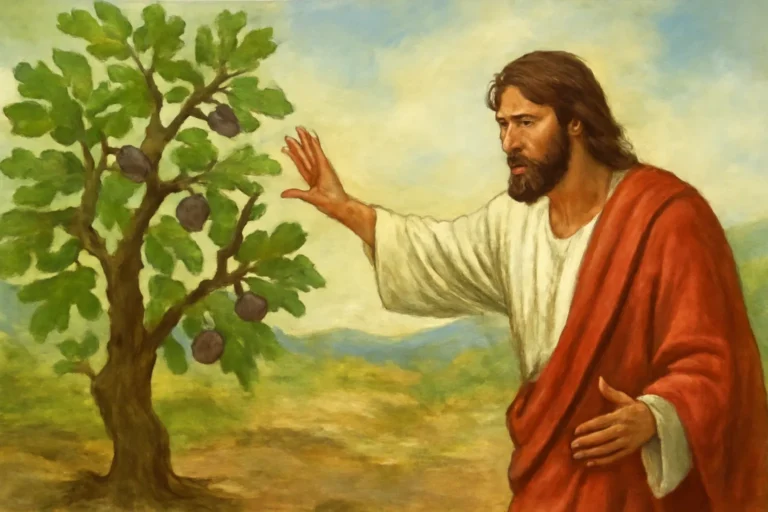
And seeing a fig tree afar off having leaves, he came, if haply he might find any thing thereon: and when he came to it, he found nothing but leaves; for the time of figs was not
yet.
And Jesus answered and said unto it,
No man eat fruit of thee hereafter for ever. And his disciples heard
it.
And they come to Jerusalem: and Jesus went into the temple, and began to cast out them that sold and bought in the temple, and overthrew the tables of the moneychangers, and the seats of them that sold doves;
And would not suffer that any man should carry
any vessel through the temple.
And he taught, saying unto them,
Is it not written, My house shall be called of all nations the house of prayer? but ye have made it a den of thieves.
And the scribes and chief priests heard
it, and sought how they might destroy him: for they feared him, because all the people was astonished at his doctrine.
And when even was come, he went out of the city.
And in the morning, as they passed by, they saw the fig tree dried up from the roots.
And Peter calling to remembrance saith unto him, Master, behold, the fig tree which thou cursedst is withered away.
And Jesus answering saith unto them,
Have faith in God.
For verily I say unto you, That whosoever shall say unto this mountain, Be thou removed, and be thou cast into the sea; and shall not doubt in his heart, but shall believe that those things which he saith shall come to pass; he shall have whatsoever he saith.
Therefore I say unto you, What things soever ye desire, when ye pray, believe that ye receive
them, and ye shall havethem.
And when ye stand praying, forgive, if ye have ought against any: that your Father also which is in heaven may forgive you your trespasses.
But if ye do not forgive, neither will your Father which is in heaven forgive your trespasses.And they come again to Jerusalem: and as he was walking in the temple, there come to him the chief priests, and the scribes, and the elders,
And say unto him, By what authority doest thou these things? and who gave thee this authority to do these things?
And Jesus answered and said unto them,
I will also ask of you one question, and answer me, and I will tell you by what authority I do these things.
The baptism of John, was
it from heaven, or of men? answer me.
And they reasoned with themselves, saying, If we shall say, From heaven; he will say, Why then did ye not believe him?
But if we shall say, Of men; they feared the people: for all
men
counted John, that he was a prophet indeed.
And they answered and said unto Jesus, We cannot tell. And Jesus answering saith unto them,
Neither do I tell you by what authority I do these things.”
Mark 11 devotional commentary in its Jerusalem setting
Mark 11 occurs during Jesus’ final approach to Jerusalem for Passover, when the city swelled with pilgrims from many regions. This made the temple both a spiritual center and a busy marketplace. Religious leaders and moneychangers controlled important economic activities tied to worship, such as currency exchange for temple use and the sale of sacrificial animals. That context helps explain why Jesus’ actions were not merely “mood swings,” but a direct challenge to how worship had been distorted.
Jesus’ entry also reflects a tension between expectation and fulfillment. Crowds welcomed Him with shouts of “Hosanna” and references to the kingdom of David, which many understood as national deliverance. Yet Mark presents Jesus as the one who advances His mission with symbolic humility and prophetic authority rather than political force.
The fig tree episode, too, fits the seasonal rhythms of the region. By showing leaves without fruit, the tree becomes a vivid picture of outward religious appearance lacking inner reality. In such a setting, Jesus’ confrontation of temple commerce and the authority debate that follows reveal how seriously God evaluates not only worship practices, but also the heart behind them.
Original-language nuance: faith-words and the temple’s meaning
In Mark 11, Jesus’ teaching about prayer and faith emphasizes trust in God’s word and character. While Mark writes in Greek, the key idea is expressed with a tone of certainty: Jesus speaks as though God’s promises are reliable and their outcomes can be expected when believers “do not doubt.” The Greek phrasing communicates more than intellectual agreement; it stresses an inward confidence that shapes action—such as prayer with forgiveness and bold expectation.
Jesus also frames the temple according to Scripture: “house of prayer” versus “den of thieves.” The language is not subtle. It uses strong moral contrast to judge what was happening in the temple courts. Mark’s Greek underscores Jesus’ authority to interpret the purpose of worship, implying that God’s “house” cannot be reduced to transactional advantage or religious performance.
Mark chapter 11: The entry that reveals Jesus’ kingship
Mark begins with Jesus approaching Jerusalem from the Mount of Olives, sending two disciples to secure a colt. The detail that the animal had “never man sat upon” highlights preparation for a sacred mission, echoing how God often uses what is set apart. Jesus’ instruction also includes a defense—when questioned, the disciples are to answer that “the Lord hath need of him.” That brief phrase signals that what looks like ordinary borrowing is actually covenant work.
As the disciples bring the colt, the crowd’s response becomes worshipful announcement. Many spread garments in the road, and others cut branches and lay them down. Their shouts—“Hosanna” and blessing connected to the name of the Lord and David’s kingdom—show the crowd believes God is moving. Yet Mark’s narrative tone implies that celebration alone is not enough. The crowd praises, but the chapter will soon reveal whether religious leadership and even the disciples understand what Jesus’ kingdom is for.
Jesus’ movement into the temple underscores this point. He looks around at “all things,” then leaves for the evening. This rhythm suggests deliberate observation and purposeful confrontation. He is not reacting blindly to a scene; He is judging what the scene represents. In Mark’s Gospel, Jesus repeatedly links outward actions with inward spiritual reality—so the entry is both an honor to Him and a test for the people’s hearts.
lesson from Mark 11 fig tree and temple: Judgment on outward religion
The next day, Jesus goes to the fig tree and finds leaves but no fruit. He declares that no one will eat fruit from it “for ever.” When the disciples notice the tree has withered, Peter interprets it as the fulfillment of Jesus’ words. Jesus’ response then expands the event into teaching: “Have faith in God,” followed by promises connected to prayer, doubt, and forgiveness.
In the flow of Mark 11, the fig tree is more than a lesson about plants. It is a symbol. A fig tree in season should bear figs. But it gave only foliage—appearance without provision. That image parallels what Jesus finds in the temple: a place intended for worship becomes something else. When Jesus overturns tables of the moneychangers and disrupts commerce, He is not only clearing space. He is contesting misdirected worship—turning what should be a “house of prayer” into a “den of thieves.”
Mark’s sequence matters. First, Jesus demonstrates that faith is real and not performative. Second, he cleanses the temple so worship can return to its true purpose. Third, He teaches the disciples that faith connects to prayer and ethical realities, especially forgiveness. The withered fig tree becomes a warning: God evaluates fruit, not merely leaves.
study of Mark 11 Jesus in Jerusalem: Authority questioned, truth unhidden
After Jesus’ teaching and the temple disruption, the chief priests, scribes, and elders confront Him. Their question—by what authority He does these things—reveals that they perceive His actions as an existential threat. If Jesus is truly acting with God-given authority, then their control over religious life is exposed.
Jesus answers with a counter-question about the baptism of John: was it from heaven or from men? The leaders reason to themselves: if they say “from heaven,” they fear He will ask why they did not believe; if they say “of men,” they fear the people, who regarded John as a prophet. Their dilemma shows the core problem—fear. Their public uncertainty is rooted in what they value more than truth: reputation, control, and safety.
Jesus’ response is severe in its simplicity: “Neither do I tell you by what authority I do these things.” In Mark, this is not evasion; it is a judgment upon refusal to recognize God’s work. Earlier, Jesus entered Jerusalem with a prophetic, humble authority. Now, when questioned, the leaders show they cannot—or will not—respond faithfully.
The chapter’s authority theme connects back to prayer and faith. If God’s activity is present, true faith acknowledges it. If fear dominates, people stall and protect themselves. Mark 11 therefore invites readers to examine what directs their decisions when spiritual authority intersects with personal comfort.
How to Apply This Today: Faith that produces fruit, worship that stays pure
Begin by asking whether your faith looks like “leaves without figs.” Do you keep religious routines while neglecting the character God expects—repentance, mercy, honesty, and obedience? Mark 11 warns that God is not impressed by appearance.
Second, protect worship from becoming a transaction. Just as Jesus confronted temple commerce, you can examine how money, status, or performance may quietly shape your spiritual life. In practical terms: practice generosity, keep your giving accountable, and ensure your church practices do not function mainly to impress or control.
Third, connect prayer to forgiveness. Jesus links answered prayer to an ethical posture: when you stand praying, forgive. If you harbor unresolved resentment, your prayers can become disconnected from the heart. A simple daily step is to identify one person you need to forgive, pray honestly for them, and decide on a next step toward reconciliation (even if gradual).
Finally, when God’s guidance challenges you, resist fear-based reasoning. Instead of asking, “What will it cost me?” ask, “What does faithful obedience look like right now?” Mark 11 calls you to live with courageous trust in God’s word.
Related Bible Passages
Isaiah 56:7
Jesus quotes the temple purpose as a house of prayer, tying Mark 11 to God’s vision for worship that welcomes all nations.
Matthew 21:12-13
Matthew records the same cleansing of the temple, helping confirm the prophetic intent behind Jesus’ actions.
James 1:19-20
James emphasizes slow to speak and the need to lay aside anger, supporting Jesus’ teaching that prayer and forgiveness belong together.
Frequently Asked Questions
What is the main message in a Mark 11 devotional commentary?
Mark 11 centers on Jesus’ true authority and what God values: real spiritual fruit, not appearances. The temple cleansing warns against corrupted worship, the fig tree illustrates judgment on emptiness, and the authority debate exposes fear-driven refusal to believe.
Why did Jesus curse the fig tree in commentary on mark 11?
The fig tree episode functions as a symbol of outward religiosity without inward fruit. In the same chapter, Jesus also condemns temple practices that had replaced prayer with exploitation, so the curse becomes a warning to expect and produce what God desires.
How does Mark 11 connect faith, prayer, and forgiveness?
Jesus links confidence in God with prayer that believes God will act, but He also ties that confidence to forgiving others. In other words, faith is not only words—it is aligned with a forgiving heart and a willingness to repent.
What should Christians learn from the leaders asking Jesus about authority?
The religious leaders in Mark 11 avoid truth because fear controls their choices. Christians can learn to respond to God with openness rather than self-protection, recognizing that genuine faith acknowledges God’s work even when it challenges power or comfort.
A Short Prayer
Lord Jesus, you entered Jerusalem with authority and confronted what was hollow. Teach me to bear real fruit, not just religious activity. Cleanse my worship from any selfish motives, and make my prayers honest by forgiving those who have wronged me. Strengthen my faith when doubt rises, and help me trust that your word is dependable. Amen.
Key Takeaway: Mark 11 teaches that Jesus’ authority exposes hollow religion and calls believers to fruitful faith expressed through worship, prayer, and forgiveness.