Psalm 23 Explanation Verse by Verse: The Shepherd Who Leads Through Every Valley
Psalms 23 · King James Version
Quick Answer: Psalm 23 explanation verse by verse shows how the LORD shepherds His people with provision, guidance, restoration, courage in danger, and abundant grace even amid opposition. The psalm moves from “green pastures” to “still waters,” then to righteousness and fearlessness in death’s shadow. It ends with goodness, mercy, and a promised home with God forever.
Psalms 23 (King James Version)
“The LORD
is my shepherd; I shall not want.
He maketh me to lie down in green pastures: he leadeth me beside the still waters.
He restoreth my soul: he leadeth me in the paths of righteousness for his name’s sake.
Yea, though I walk through the valley of the shadow of death, I will fear no evil: for thou
art with me; thy rod and thy staff they comfort me.
Thou preparest a table before me in the presence of mine enemies: thou anointest my head with oil; my cup runneth over.
Surely goodness and mercy shall follow me all the days of my life: and I will dwell in the house of the LORD for ever.”
Psalm 23 verse by verse commentary in its ancient setting
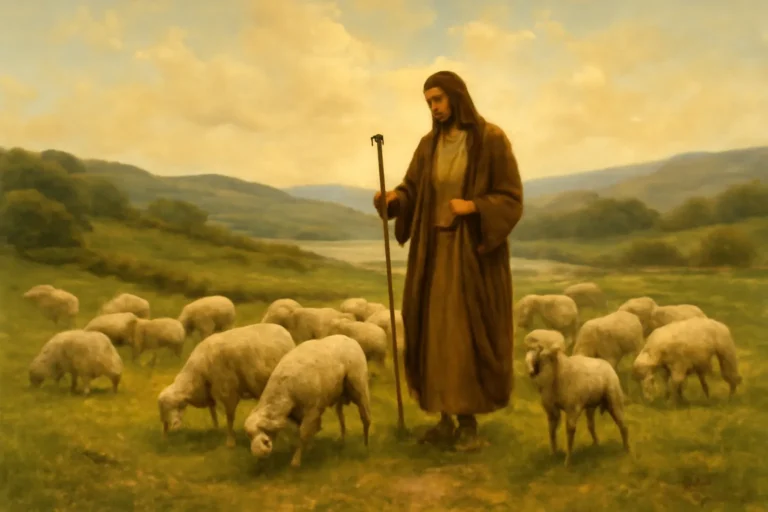
Psalms like Psalm 23 were Israel’s prayer-song—used in personal devotion and public worship. In an agrarian society, shepherding was an everyday reality: shepherds led flocks to pasture, guarded them from predators, and guided them through terrain that could suddenly become dangerous. The psalm’s images—pastures, still waters, a valley, a rod and staff—would have been immediately understandable to hearers.
The LORD’s role as shepherd also echoes God’s covenant care for Israel and His kingship over His people. At the same time, the psalm shifts from outward circumstances to inward trust, emphasizing that God’s guidance and presence are experienced even when life turns barren or frightening.
Though Psalm 23 is often read privately, its language fits a community’s theology: God provides, rescues, and leads His people toward righteousness “for his name’s sake.” The closing confidence—goodness and mercy following and dwelling with the LORD forever—sounds like faith rooted not only in past experiences, but also in God’s character and promise. This is why the psalm continues to be read at funerals, during anxiety, and at turning points in life: it interprets suffering through God’s shepherding love.
Original Hebrew nuance behind “the valley of the shadow of death”
Psalm 23 is written in Hebrew, and the phrase commonly translated “valley of the shadow of death” uses imagery rather than a clinical description. Hebrew often communicates intensity through metaphor and parallel thought, and this line carries a sense of extreme danger and darkness. The “shadow” language suggests not only that death is near, but that fear and uncertainty flood the mind when one walks through life-threatening circumstances.
Importantly, the psalm does not deny terror; it redirects fear toward God’s presence: “for thou art with me; thy rod and thy staff they comfort me.” So the Hebrew nuance serves the theological point—real danger may be encountered, but God’s shepherding presence turns the valley from a place of hopelessness into a place where courage can be sustained.
1) The LORD as Shepherd and the promise of sufficiency (Psalm 23:1)
The psalm begins with identity: “The LORD is my shepherd.” This is more than metaphorical comfort; it frames the entire life of faith as relationship. A shepherd is not merely a distant ruler who issues commands—he personally tends, searches, and protects the sheep. By calling God “my shepherd,” the psalmist anchors trust in personal possession (“my”), not in general religious ideas.
Then comes the consequence: “I shall not want.” In context, “want” does not mean a life without difficulties or suffering. It means lack of what is ultimately necessary for God’s purpose—guidance, protection, restoration, and the ability to endure. The confession functions like a spiritual economy: the LORD’s care is adequate, even when circumstances feel inadequate. When the soul is rightly oriented toward God, deprivation does not have the final word.
Devotionally, this verse teaches how to interpret needs. Instead of treating God as a last resort, faith treats Him as the present Shepherd. The psalmist’s confidence is not passive; it anticipates God’s ongoing action. Shepherding implies continual care: provision for today, direction for tomorrow, and protection in between.
2) Provision and refreshment: green pastures and still waters (Psalm 23:2)
“He maketh me to lie down in green pastures” pictures rest that is both cared for and given. Sheep do not naturally “choose” safety and nourishment in hostile terrain; shepherds lead and create the conditions for rest. The verb here carries the sense of active guidance—God makes the believer able to rest. This is crucial for anxious hearts: the psalm does not romanticize calm as something generated by human strength. It presents peace as the outcome of divine care.
“He leadeth me beside the still waters” continues the theme of guidance. “Still waters” suggest quietness, refreshment, and relief from frantic searching. In practical terms, God’s leadership restores the pattern of life: what once exhausted the soul becomes a place of recovery.
Taken together, verses 1–2 establish a rhythm: God provides pasture (nourishment) and water (refreshment), and He leads the believer into a posture of rest. This is not only about emotions; it’s about spiritual health. The rest of faith includes choosing God’s paths and rhythms over the noisy impulses of panic.
In a world of constant movement, “still waters” challenge believers to trust that God’s timing is trustworthy. Sometimes “still” is not an absence of conflict; it is God’s presence calming the inner storms.
3) Restoration of the soul and righteousness for His name’s sake (Psalm 23:3)
“He restoreth my soul” shifts from outward imagery (pastures and water) to inward renewal. The soul is where desires, fears, motives, and hope live. Restoration implies repair—something that has been damaged, worn down, or displaced is made whole again. The Shepherd’s work reaches deeper than circumstances; it addresses inner life.
“He leadeth me in the paths of righteousness” shows that restoration does not end in comfort alone; it aims at right living. God leads “in the paths” (plural) indicating a way of life with steps, decisions, and ongoing direction. Righteousness is not merely moral performance; in this psalm it is aligned with God’s purposes.
“For his name’s sake” grounds everything in God’s character and reputation. God’s leadership is not random kindness; it flows from who He is. He guides so that His name—His truthfulness, faithfulness, and saving love—will be honored. This phrase matters for suffering too: when the believer cannot see the outcome, trust rests on God’s integrity.
Devotionally, Psalm 23:3 teaches that God’s care includes both renewal and direction. Restoration without guidance can become self-centered comfort; guidance without restoration can become burdensome obligation. The Shepherd provides both—renewed soul and righteous paths.
4) Courage in the shadow of death: God’s presence, rod, and staff (Psalm 23:4)
“Yea, though I walk through the valley of the shadow of death” acknowledges reality. The psalmist does not deny death’s proximity or the darkness that can accompany mortal threat, grief, or severe trials. The language of “walk through” is important: it suggests a journey with a beginning and an end, not a permanent home. Faith walks through, even when it cannot avoid the valley.
“I will fear no evil” is not the removal of all dread through denial; it is the choice of courage rooted in God. The psalm’s reasoning connects fear with presence: “for thou art with me.” In other words, the ground of fearlessness is not that danger disappears, but that God’s companionship does not.
“Thy rod and thy staff they comfort me” adds pastoral detail. The rod can signify protection and authority; it guards against threats. The staff supports the shepherd’s work in guiding, lifting, and retrieving. Together they comfort because they symbolize active care.
This verse therefore becomes a devotional anchor: even in the darkest experiences, the believer is not abandoned. Comfort comes not only from ideas about God but from God’s active shepherding—protection, guidance, and steadfast presence.
Many people read this verse at funerals because it gives language to grief while still asserting hope. Yet the valley is not limited to death; it includes any experience that feels like “shadow”—fear, uncertainty, and oppressive danger.
“Thou preparest a table before me in the presence of mine enemies” is one of the psalm’s most striking images. A table suggests welcome, nourishment, and fellowship. Preparing it “before” enemies means God’s provision is not hidden in private safety alone; it can be experienced openly, even where opposition exists.
The psalmist’s faith does not insist that enemies vanish first. Instead, it insists that God can still host, sustain, and bless in the midst of hostility. This shifts the reader’s perspective: God’s comfort is not always contingent on external peace.
“Thou anointest my head with oil” symbolizes honor and consecration. In ancient life, oil carried practical and ceremonial significance: it could soothe and bless, and it also marked a person for a role. Here it indicates that the shepherd prepares the sheep as a cared-for, dignified guest.
“My cup runneth over” conveys abundance. The overflow image suggests more than survival: God’s provision surpasses minimal need. In spiritual terms, this can include joy, clarity, and strength that exceed what the trial seems to justify.
So verse 5 teaches that God’s shepherding includes public grace. Whether enemies are literal adversaries, internal accusations, spiritual oppression, or social pressures, God can create moments of meaningful blessing that break the power of intimidation.
Prayerfully, this verse invites believers to ask not only, “Will God remove the threat?” but also, “Will God nourish me, honor me, and fill me even in the conflict?”
6) Goodness and mercy follow: lifelong faith and eternal dwelling (Psalm 23:6)
“Surely goodness and mercy shall follow me all the days of my life” finishes the psalm with a forward-looking confidence. “Surely” emphasizes certainty. The imagery of “follow” suggests pursuit: God’s goodness and mercy trail behind and keep pace—always able to catch up with the believer wherever the road leads. This is not a once-and-done kindness; it’s a continuing companionship.
Goodness points to God’s beneficial nature—His care that provides what is good. Mercy points to God’s compassion—His willingness to treat the undeserving with kindness. Together they cover both the upright path and the moments when the believer needs forgiveness and renewed strength.
“And I will dwell in the house of the LORD for ever” brings the psalm to its eternal horizon. The metaphor of dwelling implies stable presence, not brief visitation. The “house of the LORD” represents God’s fellowship and covenant life.
This ending matters: the Shepherd is not merely guiding the psalmist through temporary hardship; He is escorting the believer into everlasting communion. The psalmist’s earlier journey through the valley finds its ultimate resolution in a home with God.
In devotion, verse 6 encourages endurance. If goodness and mercy follow “all the days,” then life’s twists are not outside God’s reach. And if the psalm ends with forever, then death and sorrow do not have the final claim on meaning.
Reading Psalm 23:6 can steady a grieving heart: the same God who leads through darkness also promises a permanent dwelling with Him.
How to read Psalm 23 as a whole (a shepherd-shaped journey)
When reading this psalm as a single song, the internal logic becomes clear. It begins with identity (the LORD as shepherd) and moves to provision (pastures and waters). It then turns inward (restoring the soul) and outward in practice (paths of righteousness). Next, it addresses fear in the deepest danger (the valley of death’s shadow), grounding courage in God’s presence and protective care.
After that, Psalm 23 widens the scene: instead of only describing survival, it depicts celebration and abundance (table, oil, overflowing cup). Finally, it seals the journey with a promise: goodness and mercy follow throughout life, and the believer will dwell with the LORD forever.
This structure helps believers interpret seasons. God does not always lead in a way that feels like “green pastures.” Yet the Shepherd’s work is consistent: He restores, leads, comforts, and provides. Even the valley is within the Shepherd’s care—fear can be replaced with trust because presence remains.
A healthy devotional approach is to notice how each verse addresses a different need: lack of provision (verse 1), need for rest and refreshment (verse 2), need for inner renewal and righteous direction (verse 3), need for courage in threat (verse 4), need for grace amid opposition (verse 5), and need for hope that reaches beyond the grave (verse 6).
In doing so, Psalm 23 becomes not only a description of God’s care but also a template for prayer. The reader learns to bring real life needs to the LORD and trust His shepherding character from pasture to forever.
How to Apply Psalm 23 Explanation for Today
Practice Psalm 23 as a daily trust rhythm. First, start your day by confessing God as Shepherd (verse 1) rather than beginning with your fears or plans. Second, invite God’s “green pastures” and “still waters” (verse 2): schedule actual rest, reduce spiritual noise, and ask God to restore your inner life, not just your schedule.
Third, ask for “paths of righteousness” (verse 3). Choose one concrete step of obedience—an honest action, a reconciled relationship, a disciplined thought life—and ask God to lead you in that step “for his name’s sake.” Fourth, when you face a “valley” (verse 4), replace panic with presence: pray the sentence “You are with me” and ask the Shepherd to comfort you through His word and counsel.
Fifth, in conflict or opposition, remember the “table” (verse 5). Instead of waiting to be treated well, practice gratitude, receive God’s provision, and honor God through your response.
Finally, end each day with hope shaped by verse 6. Journal one example of goodness or mercy you noticed, and pray for perseverance toward the promised dwelling with God. This turns the psalm from a comforting memory into lived faith.
Related Bible Passages
Isaiah 40:11
God is described as a shepherd who gathers and cares for His flock, aligning with Psalm 23’s theme of provision and guidance.
John 10:11
Jesus identifies Himself as the Good Shepherd, fulfilling the personal shepherding trust expressed in Psalm 23.
Romans 8:38-39
Paul teaches that nothing can separate believers from God’s love, echoing Psalm 23’s confidence in God’s following goodness and mercy.
Frequently Asked Questions
What is the main message in the Psalm 23 verse by verse commentary?
The main message is that the LORD shepherds His people through every season—providing what is needed, restoring the soul, guiding toward righteousness, and sustaining courage in danger. The psalm ends with lifelong confidence that goodness and mercy follow, culminating in dwelling with God forever.
How should I understand “valley of the shadow of death” in analyzing Psalm 23 line by line?
The phrase describes real darkness and danger, not fantasy fearlessness. The key is the verse’s logic: you do not fear because God is with you. His rod and staff symbolize protection and guidance, so the valley becomes a place where comfort and courage can be found.
What does “table before me in the presence of mine enemies” mean in Psalm 23 explanation for today?
It means God can provide hospitality, nourishment, and grace even when opposition remains. The psalm does not claim enemies disappear first; it shows that God’s care and honor are stronger than intimidation, allowing believers to experience blessing amid hostility.
Why does Psalm 23 say “goodness and mercy shall follow me” rather than “goodness and mercy will stop me”?
“Follow” suggests ongoing companionship—God’s kindness and compassion keep pace with you throughout life. It emphasizes continuity: even after setbacks or hard days, mercy and goodness remain active, leading ultimately to eternal dwelling with the LORD.
A Short Prayer
LORD, You are my Shepherd. Teach my heart to rest in Your care, to follow Your righteous paths, and to trust Your presence when I walk through dark valleys. Comfort me with Your rod and staff—protect me, guide me, and restore my soul. Prepare a table before me even when I face opposition, and let goodness and mercy follow me all my days. Lead me safely to dwell with You forever. Amen.
Key Takeaway: Psalm 23 teaches that God’s shepherding presence provides rest, restoration, courage, and overflowing grace from this valley to eternal life with Him.