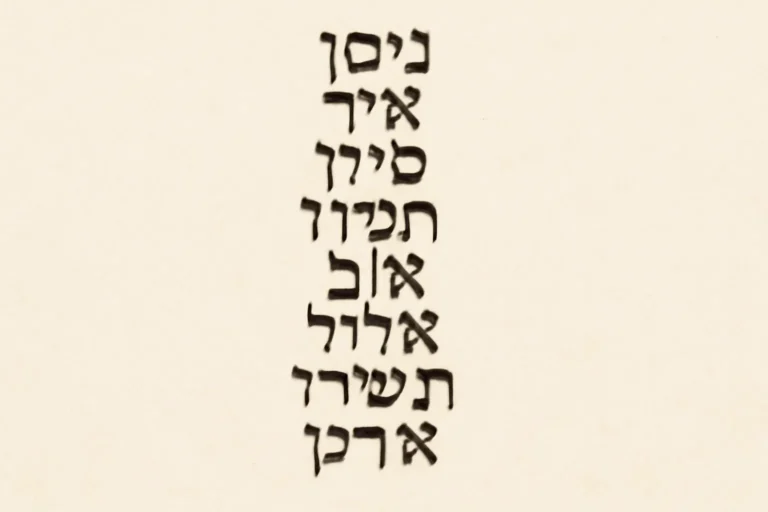
Biblical Calendar vs Gregorian Calendar: Key Differences
Many people encounter two major calendar systems in daily life and in religious study: the biblical calendar (often referred to as the Hebrew calendar in Jewish tradition) and the Gregorian calendar. Each calendar serves distinct purposes, rests on different astronomical and cultural assumptions, and has shaped history in unique ways. This article explores the key differences between the two, including how months and years are organized, how leap years are handled, when a day begins, and how these calendars influence holidays, rituals, and civil life. By understanding both systems side by side, readers can gain a clearer sense of why dates fall on particular days in one calendar and shift in another, as well as why these calendars continue to be relevant in religious observance, cultural identity, and international civil timekeeping.
The biblical calendar you often hear about in religious or scholarly contexts is a lunisolar system: it tracks both the months (based on the lunar cycle) and the seasons (based on the solar year). In practical terms, months are tied to the lunar cycle, but the year is kept aligned with the solar year so that festivals occur in their traditional seasons. The classic example of this approach is the Hebrew calendar, which uses a combination of lunar and solar considerations to maintain seasonal integrity for agricultural festivals and liturgical observance. By contrast, the Gregorian calendar is a solar calendar designed primarily to keep civil time in step with the solar year, so that the same date corresponds to roughly the same point in the year over long periods and seasonal events remain anchored to the same months and seasons.
Key terms you will see when studying these calendars include lunisolar, solar, months, days, and leap adjustments. The biblical system places a strong emphasis on the new moon as the anchor for the start of months in many historical descriptions, though modern practice relies on calculated rules (the fixed calendar) rather than direct observation. The Gregorian calendar, conversely, fixes the month lengths and adds an extra day in leap years to approximate the solar year.
How months and years are computed
In the biblical calendar, months are traditionally tied to lunar phases, but the year is kept in line with the solar cycle. The result is a calendar where the months have alternating lengths of 29 and 30 days in most cases, and the year length can vary depending on several interlocking rules. In the Hebrew system, a common year contains 353, 354, or 355 days, while a leap year contains 383, 384, or 385 days. The presence of a leap month is what makes the calendar “lunisolar” rather than purely lunar: adding a second Adar (Adar II) in leap years keeps the agricultural seasons in their expected positions relative to the months.
– The leap year occurs in a precise 19-year cycle, 7 times within the cycle. This cycle ensures that holidays like Passover (Pesach) stay in the spring season rather than drifting into winter over centuries.
– The insertion of a leap month (Adar II) is the mechanism that realigns the calendar with the solar year. In leap years, Adar I is followed by Adar II, and the regular month of Adar is extended by adding a second Adar in those years.
– The start of months in the biblical calendar has historically involved considerations of the new moon, but in the modern fixed calendar, a set set of calculations determines month beginnings. The Deḥiyyah rules (postponement rules) ensure that certain days of the week are avoided for Rosh Hashanah and that the calendar remains coherent with religious and agricultural requirements.
In contrast, the Gregorian calendar uses a straightforward rule set:
– It is a solar calendar whose year is designed to be as close as possible to the tropical year (the time it takes Earth to orbit the Sun once). The mean tropical year is about 365.2422 days.
– The year length is fixed at 365 days in common years and 366 days in leap years.
– Leap years occur in a precise 400-year cycle: years divisible by 4 are leap years, except years divisible by 100 are not, except years divisible by 400 are. This keeps the average year length very close to the solar year.
– The months in the Gregorian calendar have fixed names and lengths, with February adjusting between 28 and 29 days in leap years, while other months have 30 or 31 days according to a fixed pattern.
Because of these foundational differences, the two calendars handle time in fundamentally different ways. The biblical calendar’s dual aim—to keep months aligned with lunar phases while preserving festival seasons—makes it inherently more complex to compute and to communicate across centuries without a canonical set of rules. The Gregorian calendar’s single aim—to keep civil time consistent with the solar year and seasons—makes it straightforward and stable for civil life, commerce, and international coordination.
Leap years and adjustments: how they keep things in sync
Leap adjustments are central to both calendars, but they are enacted in very different ways and for different reasons:
Biblical calendar (Hebrew calendar): Leap years occur seven times in a 19-year cycle. The extra month, Adar II, is inserted so that Passover and other seasonal holidays remain in their correct seasons. The leap month lengthens the year by approximately 30 days, and the system as a whole maintains alignment with both lunar months and solar seasons.
Gregorian calendar (civil calendar): Leap years occur when the year is divisible by 4, with exceptions: years divisible by 100 are not leap years unless divisible by 400. This rule yields an average year length of about 365.2425 days, which is extremely close to the tropical year and keeps the date of the equinoxes and solstices stable over long periods.
The consequence is that in the biblical calendar, the drift of months relative to the solar year is corrected through a cultural and religious rule set that guarantees festivals stay in their traditional seasons. In the Gregorian calendar, the drift is corrected by a mechanical arithmetic rule designed for civil timekeeping rather than liturgical alignment.
Days, weeks, and the start of a day
Two calendars also differ in how they define a day and a week, which has practical and ceremonial consequences:
Biblical calendar often emphasizes the day beginning at sunset in Jewish practice. This framing affects the timing of holidays, the observance of the Sabbath (Shabbat), and the way liturgical days are calculated. Some holidays run from sunset to sunset, so dates labeled as 15 Nisan, for example, begin on the evening of the 14th and continue into the next day.
Gregorian calendar uses a conventional midnight-to-midnight day timeline. Civil life—work, school, government, commerce—is organized around days that begin at midnight and end at midnight in most places around the world. This standard makes scheduling straightforward across time zones and cultures but does not automatically encode religious observance into the calendar structure.
The weekly cycle in both calendars aligns to a seven-day week, but the religious practice of counting days and observing rest or holy days in the biblical system gives extra meaning to the week and to certain days in proximity to the Sabbath. Meanwhile, the Gregorian calendar’s week structure is primarily a civil construct used globally for scheduling and governance. This divergence helps explain why religious holidays anchored to specific weekdays can appear at different times on the civil calendar from year to year.
Holidays and liturgical observances
Because the biblical calendar is designed to reflect both lunar months and seasonal seasons, the dates of major religious feasts are tied to the calendar’s rules rather than to fixed civil dates. Some examples:
Passover (Pesach) begins on 15 Nisan in the biblical calendar, which places it in the spring season. The exact date can shift relative to the Gregorian calendar from year to year, but it remains tied to a specific month in the Hebrew calendar year.
Shavuot and Rosh Hashanah are anchored to the Hebrew month of Tishrei, with the latter marking the Jewish New Year and the onset of autumn in the biblical scheme. These dates are not fixed to a single date on the Gregorian calendar; instead, they appear each year on different Gregorian dates depending on the cycle.
Yom Kippur occurs on 10 Tishrei and is computed within the same lunar-solar framework as the other holidays, reflecting the calendar’s goal of keeping sacred time in the right season.
The Gregorian calendar, however, tracks secular holidays and civic observances that rely on fixed civil dates or predictable leap-year adjustments (for example, New Year’s Day on January 1, or Easter, which is calculated by a separate ecclesiastical rule but still expressed within the Gregorian framework). The separation of religious holiday timing (biblical calendar) from civil holiday timing (Gregorian calendar) is a notable difference in how societies coordinate time and ceremonial life.
Historical development and authority
The biblical calendar has a long historical lineage, with ancient practices rooted in observation of lunar phases and seasonal cycles. In ancient communities, there was a reliance on the appearance of the new moon or other astronomical signs to declare the beginning of a month. In the medieval and early modern eras, Jewish communities adopted a fixed, calculated Hebrew calendar as a practical way to standardize dates across scattered populations. This calendrical system uses a formal set of rules developed by scholars and sages, and the current fixed calendar (as used today) is anchored in long-standing calculations that ensure consistency for religious observance and ritual life.
The Gregorian calendar has a different historical trajectory. It was introduced by Pope Gregory XIII in 1582 to reform the Julian calendar, correcting drift with respect to the solar year and the equinoxes. The reform was partly ecclesiastical and partly scientific, designed to realign the calendar with the tropical year so that liturgical events (like Easter) could be observed at the intended times. The reform quickly spread across much of Europe and later worldwide through colonization and modernization. Today, the Gregorian calendar is the de facto global civil calendar, used for international law, commerce, and daily life, with some religious communities supplementing it with their own religious calendars for liturgical purposes.
Epochs, numbering, and year counts
Two calendars differ in how they count years. The biblical calendar uses a ceremonial counting system tied to a tradition of creation-based epoch, often described as Anno Mundi (year of the world), which places the current era in the five-thousand-year range, depending on the counting method. This numbering is primarily a religious and historical convention used to label years within the Hebrew calendar and to connect contemporary dates with biblical chronology.
The Gregorian calendar uses a convention tied to the birth of Jesus Christ as its anchor point for year numbering, designating years as BC (Before Christ) and AD (Anno Domini). In modern usage, the secular term CE (Common Era) and BCE (Before Common Era) is often used. The proleptic Gregorian calendar can be extended backward or forward for historical analysis, but the standard civil usage remains anchored in the AD/CE system.
Practical implications for daily life, interfaith study, and calendar planning
For individuals and communities that use the biblical calendar for religious life, planning around holidays requires attention to the moon, the solar year, and the rules that govern leap months. For scholars and interfaith groups, comparing dates across calendars requires understanding:
How the month names map between calendars (Nisan, Iyar, Sivan, etc., in the biblical system vs January, February, etc., in the Gregorian system).
How the start of the year differs (Nisan or Tishrei in the biblical system vs January 1 in the Gregorian system).
How holiday dates shift year to year when translated into the Julian or Gregorian civil calendar, and how to interpret the time of day for observances that begin at sunset.
How the cycle of leap years in the biblical calendar maintains seasonality, while the Gregorian leap day (February 29) maintains civil year accuracy with respect to the tropical year.
In practical terms, someone planning religious observances, pilgrimage, or cross-cultural events should be aware that the biblical calendar’s dates do not align one-to-one with fixed Gregorian dates. This can affect the scheduling of educational programs, interfaith dialogues, and travel itineraries that depend on precise date conversion. The availability of reliable conversion tables and calendar tools helps, but understanding the underlying principles helps prevent miscommunication and misalignment of events that depend on sacred timing.
Common misconceptions and clarifications
When discussing biblical vs Gregorian calendars, a few misunderstandings frequently arise. Here are some clarifications that help distinguish fact from myth:
Myth: The biblical calendar is purely lunar. Clarification: While the biblical system tracks lunar months, it is lunisolar, designed to keep festivals in their proper seasons.
Myth: The biblical calendar uses random, observation-based months that vary wildly year to year. Clarification: In modern practice, the calendar is governed by a fixed set of calculations that prevent drift, though the historical method did rely on observation in earlier times.
Myth: The Gregorian calendar was designed to replace a religious calendar. Clarification: The Gregorian reform was primarily a solar-year adjustment intended to stabilize civil time and match the vernal equinox for Easter computation, with widespread adoption for secular purposes.
Myth: Day starts at midnight in all contexts. Clarification: In biblical practice, a day can begin at sunset for ceremonial purposes, while civil life generally uses midnight. This difference matters for the timing of certain observances and how dates are calculated in liturgical contexts.
Glossary of key terms
To help readers navigate discussions of biblical vs Gregorian calendars, here is a concise glossary of essential terms:
Lunisolar calendar: A calendar that uses lunar months but also tracks the solar year to keep the calendar in sync with the seasons.
Solar calendar: A calendar that tracks the solar year with fixed month lengths designed to keep civil time aligned with the seasons.
Molad: The conventional moment of conjunction of the moon and sun, used in the traditional Hebrew calendar to determine the start of months.
Deḥiyah: Postponement rules in the Hebrew calendar that delay certain months’ start to avoid certain days of the week for Rosh Hashanah and other holidays.
Adar II: The leap month added in Hebrew leap years to create 13 months in that year.
Anno Mundi: Latin for “in the year of the world,” a counting system used in some interpretations of the Hebrew calendar’s epoch.
Leaps and cycles: The Hebrew calendar uses a 19-year cycle with 7 leap years to maintain seasonality; the Gregorian calendar uses a 400-year cycle for leap years to approximate the solar year.
For readers who want a compact comparison, here is a practical summary of the most salient differences between the biblical calendar and the Gregorian calendar:
Basis: Biblical calendar is lunisolar; Gregorian calendar is solar.
Leap mechanism: Biblical leap is a leap month (Adar II) added in 7 of 19 years; Gregorian leap is a leap day (February 29) added in 97 of 400 years.
Month structure: Hebrew months are tied to lunar phases but adjusted to keep seasons; Gregorian months have fixed lengths and names with a varying February.
Start of day: Biblical observances often begin at sunset; civil life uses midnight.
Holidays: Biblical times link important feasts to months like Nisan and Tishrei; Gregorian civil holidays are fixed to calendar dates (January 1, December 25, etc.) or calculated with separate ecclesiastical rules for movable feasts like Easter in some traditions.
Epochs: Biblical year numbering is tied to religious chronology (Anno Mundi, etc.); Gregorian dating uses the Anno Domini CE system.
Practical guidance for readers navigating both calendars
If you are learning about or working across both calendars, here are some practical tips to keep dates aligned and avoid confusion:
When planning events that depend on biblical holidays, consult a reliable Hebrew calendar that includes the current year’s Adar II status and the molad-based calculations and defer to authoritative religious authorities for exact observance times if needed.
For civil planning or travel, use the Gregorian calendar as the primary reference for scheduling, while using the biblical calendar to set religious observance or liturgical time frames.
In interfaith or cross-cultural contexts, provide both dates side by side when possible (for example: 15 Nisan 5784 / Pesach begins on the evening of [Gregorian date]).
Be mindful of time zone differences and daylight saving time when converting dates that are tied to the start of days in the biblical sense (sunset to sunset) versus the civil midnight-based day.
Historical reflection: why two calendars matter
Calendars are more than tools for marking days; they encode theological beliefs, agricultural knowledge, and cultural memory. The biblical calendar preserves a continuous link to ancient ritual cycles, the harvest calendar, and the liturgical year described in religious texts. The Gregorian calendar, by contrast, provides a robust civil infrastructure that supports global commerce, travel, education, and governance by keeping the civil year anchored to the solar cycle. Together, these calendars illustrate how humanity responds to time through multiple lenses: one that sees time through the horizon of sacred festivals and seasonal order, and another that aligns daily life with a shared, practical, solar-based rhythm.
Examples of how the two systems interact in practice
To illustrate how the two calendars work side by side in real life, consider these scenarios:
During a year when a leap month is added in the biblical calendar, the year becomes long, and the corresponding Gregorian year will not necessarily reflect the extra month in any fixed way; the two calendars diverge in date mapping, but they still exist side by side for different purposes.
If you attend a religious service that follows the biblical calendar, you may observe Shabbat starting Friday evening and a festival such as Passover beginning on 15 Nisan, regardless of what the Gregorian date is.
When planning a trip to a place with significant Jewish heritage, a traveler might want to know both the Hebrew dates of major holidays and the Gregorian dates for flights, visas, or hotel bookings. Having a cross-calendar converter can help prevent scheduling conflicts and ensure respectful observance of holy days.
Conclusion: embracing two timekeeping traditions with clarity
While many readers may not need to choose between these calendars, understanding the differences, the rationales, and the implications of each system can enrich both scholarly study and practical living. The biblical calendar’s lunisolar design emphasizes the harmony between lunar months and solar seasons, preserving the integrity of sacred times across generations. The Gregorian calendar’s solar precision provides a reliable framework for global civil life, enabling consistent, predictable scheduling across cultures and continents. Recognizing how each calendar operates—and how people use them in tandem—helps reduce confusion when dates drift across calendars and clarifies why certain holidays appear on different Gregorian dates from year to year. In a world that relies on precise timekeeping for science, commerce, and spirituality, the coexistence of these calendars reflects a broader human endeavor: to map the passage of time in ways that honor both cosmic cycles and communal identity.