The Hebrew leap year calendar is a fascinating example of a lunisolar system designed to keep sacred months in sync with the solar seasons. Unlike purely lunar calendars that drift through the solar year, the Hebrew calendar uses a fixed pattern to ensure that holidays tied to agricultural seasons—such as Passover and Sukkot—occur in their expected seasons. This balancing act is achieved through a combination of monthly lunar cycles and a periodic addition of an extra month in certain years. When a leap year arrives in the Hebrew cycle, an additional month—Adar I—is inserted, and the year then contains 13 months instead of the usual 12. The result is a calendar that looks ahead across many years, preserving the relationship between the actual lunar month and the solar year while keeping the timing of major holidays coherent.
In everyday language, many people simply hear about the Hebrew leap year as “the year with Adar II” or “the year that adds Adar I.” Behind that familiar phrase lies a precise mechanism: a 19-year cycle that repeats, with leap years occurring at regular positions within the cycle. Although the system is deeply rooted in religious and agricultural traditions, it also serves as a practical civil calendar that can be used for planning, education, and cultural observance. This article explores how the leap-year pattern works, what changes in leap years, and why certain years in the cycle are considered key or notable in Jewish timekeeping.
The Metonic cycle and leap years
At the heart of the Hebrew leap-year calendar is a centuries-old idea known as the Metonic cycle, a 19-year period in which lunar months and solar years align closely. While the term “Metonic” is borrowed from Greek astronomy, the Hebrew calendar implements a practical version of this 19-year cycle to keep months aligned with the seasons over the long run.
In this 19-year cycle, seven years require the addition of an extra month to maintain the seasonal placement of holidays. The leap years are not random; they occur in a fixed set of positions within the cycle. Specifically, leap years fall in the years numbered 3, 6, 8, 11, 14, 17, and 19 of the cycle. Across history and in future planning, this seven-year pattern recurs every 19 years, preserving the relationship between the months of the year and the solar year while keeping lunar months in step with the annual cycle.
Because of this arrangement, a typical Hebrew year alternates between common years (with 12 months) and leap years (with 13 months). The leap-year months are not arbitrarily appended; they have a precise place in the yearly sequence, which affects the ordering and length of months in that year. The existence of Adar I in leap years and Adar II as the subsequent month is a defining feature of the leap-year structure and a cornerstone of how the calendar maintains its accuracy.
Common year (non-leap): 12 months; length commonly expressed as 353, 354, or 355 days depending on how the months fall in terms of 29- and 30-day lengths.
Leap year (with Adar I and Adar II): 13 months; length commonly expressed as 383, 384, or 385 days depending on the same 29- and 30-day rhythm of the months.
For learners and calendar enthusiasts, this cycle is often described as a repeating rhythm that keeps holidays anchored to the seasons across centuries. It also means that the day of the week on which a given festival begins will shift in a predictable pattern from year to year, with leaps creating a notable pause in that shifting rhythm due to the extra month. In short: the leap-year sequence is a powerful mechanism that marries lunar phases to solar timing, ensuring the calendar remains emotionally and practically stable for communities that follow it.
Leap year structure: Adar I and Adar II
When a Hebrew year is a leap year, the calendar introduces a distinct pair of months and reorders the sequence of months accordingly. The two months in question are Adar I and Adar II, with Adar II taking the position of the customary Adar month in common years. The leap-year months are not interchangeable with other months; they have specific lengths and roles within the year’s rhythm.
Adar I and Adar II: what changes in practice
Adar I is inserted after Shevat and before Adar II in leap years. Its presence adds 30 days to the year, helping to balance the overall length of the year with the solar year.
Adar II is the second Adar, appearing after Adar I and before Nisan. It contains 29 days, mirroring the classical rhythm of most months in the calendar and aligning with the overall arithmetic of the year’s lunar months.
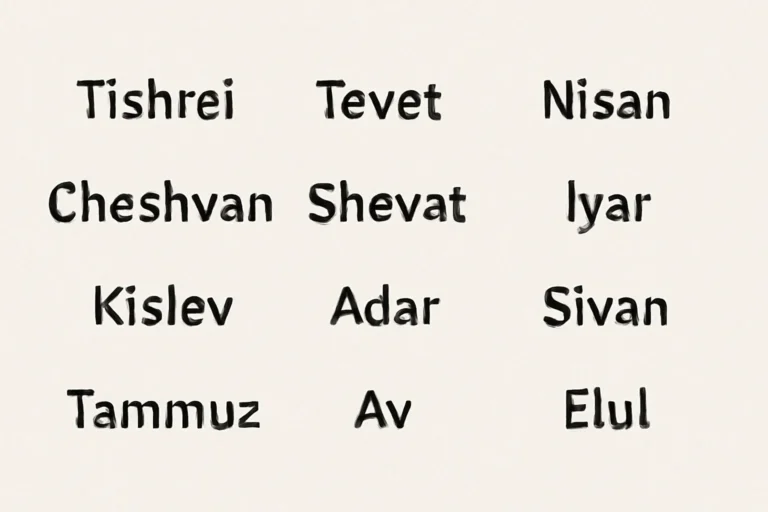
In leap years, the sequence around the period of Adar reads: Shevat, Adar I, Adar II, Nisan, Iyar, Sivan, Tammuz, Av, Elul, Tishrei, Cheshvan, Kislev, Tevet, Shevat, and so on, with the year ending in Elul.
Why Adar I and Adar II matter for holidays and ritual planning
The insertion of Adar I shifts the dates of holidays that occur later in the civil year. For example, the appearance of Adar II before Nisan can influence the day of week for Purim and other winter-spring celebrations in leap years.
Some ritual readings and synagogal scheduling depend on the month count or the presence of Adar II, which can affect special Torah portions, readings, and communal calendars.
When planning events in Jewish communities that use the calendar for civil purposes (schools, festivals, public holidays), leap years require adjustments to avoid conflicts with long-established patterns for holidays like Rosh Hashanah, Yom Kippur, and Sukkot.
In short, Adar I and Adar II are not just labels; they are functional changes to the calendar that keep the cycle coherent with both the lunar month count and the solar year. The extra month is essential for preserving the seasonal regularity of the holidays, ensuring, for instance, that Passover does not drift into winter or summer over many years.
Month lengths and year lengths
Like most lunisolar systems, the Hebrew calendar uses a fixed pattern of 29- and 30-day months. There is some variability in how long a month like Cheshvan and Kislev lasts in a given year, which is what leads to the different year-length options (deficient, regular, complete) for common years and (deficient, regular, complete) for leap years as well. The arithmetic behind these numbers is deliberate and precise, designed to keep the entire year aligned with the seasons while maintaining a practical, predictable cycle for communities and institutions that rely on the calendar.
Common year lengths
Deficient year (short): 353 days
Regular year (standard): 354 days
Complete year (long): 355 days
Leap year lengths
Deficient leap year: 383 days
Regular leap year: 384 days
Complete leap year: 385 days
These day-count patterns are not arbitrary; they reflect the underlying idea that each month alternates between 29 and 30 days, with occasional adjustments in the shorter months (notably Cheshvan and Kislev) to fit the annual length. In leap years, the addition of Adar I and the subsequent Adar II adds a fixed amount of extra month length, ensuring that the total days still approximate the solar year closely enough to keep agricultural and seasonal timing coherent over centuries.
Understanding month lengths helps explain how holidays fall on particular weekdays. Because the calendar is fixed in the sense of month lengths, the day of the week for major holidays drifts in a well-documented way from year to year. Leap years interrupt that drift in a predictable manner, creating a recognizable “pause” in the sequence of weekday alignments for holidays that are tied to the lunar months.
Keviut and postponements: keeping the calendar stable
Practically speaking, the Hebrew calendar uses a set of fixed rules to ensure that Rosh Hashanah, the first day of the year, does not land on certain weekdays and that the length of the year remains within sensible bounds. This part of the calendar is known in Hebrew as Keviut (the fixed calendar rules). Central to Keviut are a small set of postponement rules that adjust the timing of the molad (the mean moment of lunar conjunction) and, in turn, the start of Tishrei (Rosh Hashanah).
Rosh Hashanah weekday restrictions in practice
Rosh Hashanah cannot begin on Sunday, Wednesday, or Friday. This three-day restriction is widely quoted as a basic feature of the calendar, ensuring that certain sequences of holidays do not begin on those weekdays for ritual and practical reasons.
Because of this restriction, some potential calendar configurations must be postponed, which can lead to the year starting a day later or in a slightly different weekday than might otherwise be predicted by a purely lunar calculation.
Simple explanation of the postponement idea
In practice, calendar calculations use a combination of the molad (the mean conjunction of the new moon), the length of the lunar month (29 days, 12 hours, and 793 parts), and the year’s status (common vs leap) to determine if the first day of Tishrei can begin on a valid weekday. If the preliminary calculation would place Rosh Hashanah on a prohibited day (or would create a year length that would push holidays too far out of season), the calendar rules call for a one-day or two-day postponement. These steps are collectively known as dehiyyot (postponements). They are a compact and practical way to ensure the calendar remains stable over long spans of time and is predictable for generations to come.
In modern usage, the keviut rules are integrated into generational knowledge in rabbinic communities, mathematicians who study calendars, and software that computes Hebrew dates. For most readers and learners, the key takeaway is that the Hebrew leap-year calendar is deliberately designed to avoid certain weekdays for Rosh Hashanah and to maintain a practical year length, using a small set of postponement rules tied to the molad and the year type (common or leap).
Impact on holidays and the annual cycle
The leap-year pattern has tangible effects on how the holidays and the annual cycle unfold. Because the leap year adds an extra month, some holidays shift later in the civil year relative to the previous year, while others stay tied to their lunar-month anchors. The most visible consequence is that certain holidays that occur in the spring or autumn have their weekday placement adjusted in leap years, and the presence of Adar II can influence the way communities prepare for and observe seasonal festivals.
Pesach, Sukkot, and Shavuot in a leap year
Pesach (Passover) begins on the 15th day of the Nisan month, which is always in the spring. In leap years, because the year has an extra month inserted earlier, the day of the week on which Pesach begins can differ from that of a nearby common year. The holiday’s calendar alignment is preserved, but the weekly cadence of the surrounding days changes in a way that observers notice from year to year.
Sukkot and Shavuot follow their fixed points in the lunar cycle, but the day of week for the start of these holidays may shift more noticeably in a leap year due to Adar II's presence and the altered year length. Observers often note the way the calendar “feels” in leap years because of these shifts.
Other seasonal markers, such as the month of Nisan beginning after Adar II, can carry implications for agricultural and liturgical planning. The leap-year structure helps ensure that the four-season rhythm remains interpretable for communities observing these holidays in geographically diverse climates.
Educational and cultural implications
Educational calendars in Jewish schools often reflect leap years by adjusting the number of school days and the timing of vacations. In many places, leap years are recognized as a calendar feature that can affect planning for teachers, families, and community programs.
Cultural calendars and festival calendars in synagogues and communities take Leap Year into account, sometimes affecting scheduling of special study cycles, public events, and communal readings tied to the lunar cycle.
From a practical perspective, the leap-year calendar is a reliable instrument for projecting long-term cycles: it keeps holidays anchored to the right lunar months while preventing drift of the seasonal timing. People who study the calendar for religious, educational, or cultural reasons often refer to the leap-year pattern as a fundamental property of Jewish timekeeping—a feature that distinguishes the Hebrew calendar from strictly lunar or strictly solar systems and that has endured for centuries.
Key leap years in the 19-year cycle
When people talk about the Hebrew leap year cycle, they often reference the seven leap years within each 19-year cycle. These leap years are not random; they occur in fixed positions. For anyone studying or working with the calendar, it is helpful to know the exact positions and what they imply for the structure of the year. The leap years occur in the following positions within the cycle: year 3, year 6, year 8, year 11, year 14, year 17, and year 19.
What makes these leap years “key” is that each one introduces Adar I before Adar II, increasing the total number of months to 13 and expanding the year length by a predictable amount. The implications touch on several practical and ceremonial aspects:
In every leap year, the calendar contains Adar I and Adar II, with Adar II preceding Nisan.
The presence of Adar I shifts the ordering of months, which in turn influences when holidays that appear in Adar or Nisan occur.
The overall length of a leap year (383–385 days) reflects the extra month’s contribution to the total, ensuring the cycle remains aligned with the solar year even as lunar months continue their rhythm.
To illustrate how these positions function conceptually (without tying them to a specific Gregorian year), consider that, within a single 19-year cycle, the leap years appear at the 3rd, 6th, 8th, 11th, 14th, 17th, and 19th spots. The many centuries of practice have shown that this sequence yields a stable cadence for festival planning, instruction, and communal life. For scholars and calendar software, these seven positions form a predictable backbone for computing Hebrew dates far into the future.
How to identify a leap year in practice
Take the Hebrew year number (for example, 5784) and determine where it sits in the current 19-year cycle. A common method is to compute the year’s position modulo 19 and compare with the leap-year positions listed above.
If the position matches one of the seven leap-year positions (3, 6, 8, 11, 14, 17, 19), the year is a leap year and contains Adar II and an extra month.
If the position does not match, the year is a common year with 12 months.
For readers who want a more hands-on approach, many Hebrew calendar calculators and software tools implement these checks automatically, showing inferences about when Adar II appears and how the year length is computed. The underlying logic is straightforward in principle, though the calculations that produce molad times and post hoc postponements are complex enough to require careful programming and verification.
Historical and practical notes on the leap-year cycle
Across the centuries, the Hebrew leap-year cycle has demonstrated remarkable stability as a civil and religious calendar. The leap years’ regularity has allowed communities to align public life, liturgy, education, and agriculture with a shared timekeeping system. Here are a few practical takeaways about the cycle:
Leap years ensure that holidays tied to lunar months remain in the appropriate solar seasons, avoiding the drift that a purely lunar calendar would suffer.
The cycle is predictable enough to be used in calendar planning for multi-year projects, educational curricula, and event programming in synagogues and community centers.
Scholars often study the interaction between the Leaps and the distribution of weekdays for holidays, which helps explain why some years feel “longer” or more intense in terms of schedule and ritual load.
For enthusiasts, the leap-year cycle is also a gateway into the broader topic of how calendars are designed and adjusted across cultures. The Hebrew calendar sits at an intersection of astronomy, religious law, and cultural habit—a living system that continues to adapt while preserving a deep sense of continuity with the past.
Glossary of key terms you may encounter
Hebrew leap year
A year in the Hebrew calendar that contains a second month, Adar I, and thus 13 months in total.
Adar I and Adar II
The two Adars in a leap year; Adar I precedes Adar II, and Adar II is the month in which the regular Adar-like activities occur prior to Nisan.
Molad
The mean or average conjunction of the moon; the molad time helps determine the starting point of Tishrei.
Keviut
Hebrew term for the fixed calendar rules that govern the calculation, postponement rules, and the overall structure of the calendar.
Dehiyyot
Postponement rules that adjust the calculation to avoid certain weekdays for Rosh Hashanah and to maintain sensible year lengths.
Rosh Hashanah
The Jewish New Year, starting on Tishrei 1; its timing is central to the calendar and influenced by the postponement rules.
Recognize that the Hebrew calendar is lunisolar, balancing lunar months with the solar year to keep holidays in their intended seasons.
Understand that leap years occur in a fixed set of positions within a 19-year cycle: 3, 6, 8, 11, 14, 17, 19.
Know that in leap years, the calendar contains Adar I and Adar II, with Adar II followed by Nisan.
Be aware that the year length can vary (common years: 353–355 days; leap years: 383–385 days) because months alternate 29 and 30 days, with adjustments in Cheshvan and Kislev.
Remember that Rosh Hashanah cannot begin on Sunday, Wednesday, or Friday, and that the postponement rules (dehiyyot) keep the calendar stable.
For students and developers who want to study or implement the Hebrew calendar, the essential steps are to model the cycle accurately, implement the month-length rules, and apply the postponement logic in a way that preserves the Repeatable nature of the 19-year cycle. Real-world software libraries and scholarly texts provide detailed algorithms for the molad, leap-year determination, and dehiyyot, but the core principles remain consistent: maintain lunar-month rhythm, preserve seasonal alignment, and keep the calendar predictable for generations to come.
Further reading and learning paths
Introductory articles on lunisolar calendars and the Metonic cycle in historical astronomy and religious timekeeping.
Primary sources and commentaries on Keviut and Dehiyyot, which explain how calendar authorities historically reconciled lunar cycles with solar timing.
Practical calendar calculators and library resources that demonstrate how to determine whether a given Hebrew year is a leap year and how Adar I affects the sequencing of months.
Case studies of holidays and how their dates shift across leap years, providing examples of how the cycle plays out in real-world planning.



Leave a Reply