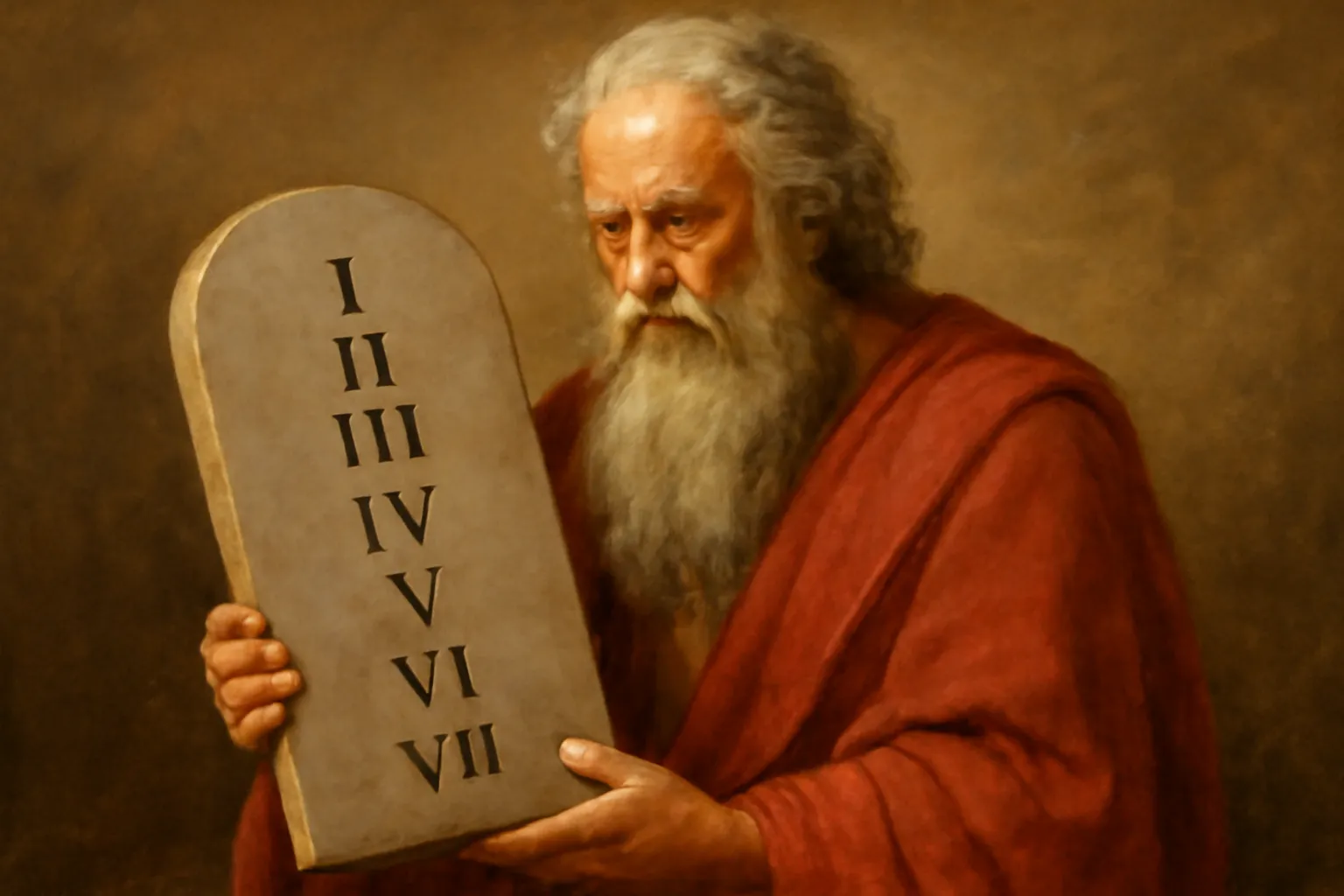
Commentary on Exodus 20: God’s Covenant Words for Worship and Life
Exodus 20 · King James Version
Quick Answer: This commentary on exodus 20 highlights God’s covenant foundation: exclusive worship, reverent speech, faithful Sabbath observance, and relationships governed by love and holiness. The thunder, fear, and distance show God’s majesty, while the commands shape daily life—protecting worship, truth, and human dignity. These words aren’t merely rules; they train the heart to fear God and live as His people.
Exodus 20 (King James Version)
“And God spake all these words, saying,
I
am the LORD thy God, which have brought thee out of the land of Egypt, out of the house of bondage.
Thou shalt have no other gods before me.
Thou shalt not make unto thee any graven image, or any likeness
of any thing that
is in heaven above, or that
is
in the earth beneath, or that
is in the water under the earth:
Thou shalt not bow down thyself to them, nor serve them: for I the LORD thy God
am a jealous God, visiting the iniquity of the fathers upon the children unto the third and fourth
generation of them that hate me;
And shewing mercy unto thousands of them that love me, and keep my commandments.
Thou shalt not take the name of the LORD thy God in vain; for the LORD will not hold him guiltless that taketh his name in vain.
Remember the sabbath day, to keep it holy.
Six days shalt thou labour, and do all thy work:
But the seventh day
is the sabbath of the LORD thy God:
in it thou shalt not do any work, thou, nor thy son, nor thy daughter, thy manservant, nor thy maidservant, nor thy cattle, nor thy stranger that
is within thy gates:
For
in six days the LORD made heaven and earth, the sea, and all that in them
is, and rested the seventh day: wherefore the LORD blessed the sabbath day, and hallowed it.
Honour thy father and thy mother: that thy days may be long upon the land which the LORD thy God giveth thee.
Thou shalt not kill.
Thou shalt not commit adultery.
Thou shalt not steal.
Thou shalt not bear false witness against thy neighbour.
Thou shalt not covet thy neighbour’s house, thou shalt not covet thy neighbour’s wife, nor his manservant, nor his maidservant, nor his ox, nor his ass, nor any thing that
is thy neighbour’s.
And all the people saw the thunderings, and the lightnings, and the noise of the trumpet, and the mountain smoking: and when the people saw
it, they removed, and stood afar off.
And they said unto Moses, Speak thou with us, and we will hear: but let not God speak with us, lest we die.
And Moses said unto the people, Fear not: for God is come to prove you, and that his fear may be before your faces, that ye sin not.
And the people stood afar off, and Moses drew near unto the thick darkness where God
was.And the LORD said unto Moses, Thus thou shalt say unto the children of Israel, Ye have seen that I have talked with you from heaven.
Ye shall not make with me gods of silver, neither shall ye make unto you gods of gold.
An altar of earth thou shalt make unto me, and shalt sacrifice thereon thy burnt offerings, and thy peace offerings, thy sheep, and thine oxen: in all places where I record my name I will come unto thee, and I will bless thee.
And if thou wilt make me an altar of stone, thou shalt not build it of hewn stone: for if thou lift up thy tool upon it, thou hast polluted it.
Neither shalt thou go up by steps unto mine altar, that thy nakedness be not discovered thereon.”
Exodus 20 devotional commentary in its ancient covenant setting
Exodus 20 comes just after Israel’s deliverance from Egypt and God’s descent upon Sinai (Exodus 19). In the ancient Near East, a covenant often began with a preface identifying the king and rescuing party, then established obligations for the people. Here, God identifies Himself as “the LORD thy God” who brought Israel out of bondage, meaning the commands are not a ladder to earn salvation, but a response to rescue.
Sinai is presented with vivid sensory drama—thunder, lightning, trumpet, smoke, and thick darkness. This communicated both God’s holiness and the seriousness of entering His presence. Israel’s posture “afar off” reflects that most people cannot casually approach divine holiness; mediation is required, and reverence is necessary.
The Ten Commandments function as a compact covenant charter for a newly formed nation learning how to worship, speak, rest, and relate. They address both vertical duties (God-centered worship) and horizontal duties (respect for life, marriage, property, and truth). Notably, several commands include generational or communal implications, indicating that faithfulness shapes families and society over time.
In this setting, Exodus 20 forms the moral and spiritual backbone of Israel’s life—so the people can live differently than Egypt and the surrounding nations, reflecting God’s character in daily choices.
Hebrew nuance: “jealous” and “remember” in God’s covenant tone
Exodus 20 is written in Hebrew, and several key words carry covenant-emotional weight. One notable term is God’s description as a “jealous God.” In Hebrew usage, “jealous” does not mean petty insecurity; it communicates passionate loyalty to His people and intolerance toward covenant unfaithfulness—similar to a marriage covenant where betrayal has moral consequences.
Another important verb is “Remember the sabbath day, to keep it holy.” “Remember” in biblical Hebrew often implies more than mental recall; it’s an act of intentional attention that leads to obedience. Remembering the Sabbath therefore means structuring time around God’s holiness and provision, treating rest as worship rather than mere downtime.
Together, these nuances emphasize that God’s commands engage the whole person—affections, attention, and action—because covenant life is lived in both worship and everyday rhythms.
God’s identity and the boundary of worship in exodus 20
The opening commands in Exodus 20 begin with God’s character and claims. “I am the LORD thy God… which have brought thee out of the land of Egypt, out of the house of bondage” grounds everything that follows. The covenant is not introduced as a random list of moral ideas, but as a relationship rooted in rescue. God’s authority is tied to His saving acts; therefore obedience flows from gratitude and trust.
“Thou shalt have no other gods before me” confronts the heart level of worship. In the ancient world, many gods were tied to local powers, fertility, war, or household needs. For Israel, deliverance from Egypt means the futility of pagan control systems. To put “another god” before the LORD is to return to the mindset that salvation comes from idols—whether religious images, cultural forces, or inner loyalties that displace God.
The command against making graven images and bowing to them addresses more than artistry or craftsmanship. It restrains the impulse to domesticate God. When people fashion a likeness “of any thing” in heaven or earth, they risk turning the Creator into a controlled object. God is not only to be avoided by distance; He is to be worshiped truthfully—on His terms, in the way He reveals.
This is why God follows with a statement about mercy and judgment: “visiting the iniquity… unto the third and fourth generation” and “shew[ing] mercy unto thousands.” The point is covenant reality. Choices affect more than the individual; families and communities are shaped by what they worship and how they live. Yet mercy is also emphasized to those who love God and keep His commandments. Exodus 20 therefore presents a balanced theology: holiness is real, and mercy is abundant for those who respond.
Reverence in speech and life: the command against taking God’s name in vain
Immediately after worship boundaries, Exodus 20 teaches reverence in speech: “Thou shalt not take the name of the LORD thy God in vain; for the LORD will not hold him guiltless that taketh his name in vain.” A “name” in biblical thought represents more than a label; it stands for the person’s reputation and character. To take the LORD’s name “in vain” is to use it as a tool without honoring what it signifies.
In practice, this command challenges empty religion. It includes careless use of God’s name—speaking it without reverence—but it also reaches deeper into hypocrisy: claiming loyalty while living otherwise. The command guards both God’s honor and the believer’s integrity. God’s name is bound to truth, so misuse corrupts one’s witness.
Interestingly, the covenant then pivots from words to time: “Remember the sabbath day, to keep it holy.” Sabbath observance becomes a daily reminder that God is Creator and Lord. Rest is not idleness; it is participation in God’s rhythm. The reason given is foundational: “in six days the LORD made heaven and earth… and rested the seventh day.” This means Sabbath is rooted in creation theology, not merely in Israel’s calendar.
Together, the name command and the Sabbath command train the conscience. Words should be truthful and weighty; time should be arranged around God’s holiness. When a believer’s speech becomes light and casual, worship becomes compromised. When life is consumed without rest, God becomes background noise. Exodus 20 insists that covenant loyalty includes what we say and how we live day after day.
Sabbath rest and human dignity: commandments that order relationships
The Sabbath command in Exodus 20 is detailed: no work for the person, children, servants, and even the cattle and the stranger “that is within thy gates.” This breadth reveals an ethical generosity. Sabbath protection extends beyond the household’s power structures; it includes those who are normally vulnerable to exploitation by labor demands.
Moreover, the Sabbath command teaches that life is not driven solely by productivity. By resting, Israel confesses that provision ultimately comes from God. The seventh day “is the sabbath of the LORD thy God,” meaning it belongs to Him. That ownership reshapes how a community understands authority: God’s holiness sets limits on human ambition.
After Sabbath, the covenant moves to relationships: “Honour thy father and thy mother,” followed by protections for life, marriage, property, and truth: “Thou shalt not kill… commit adultery… steal… bear false witness.” These commands show that worship is not separated from ethics. A society that truly honors God will practice justice in daily interactions.
Additionally, “Thou shalt not covet thy neighbour’s…” addresses desires. Coveting begins internally and then seeks expression through actions. Exodus 20 therefore targets not only visible crimes but the spiritual appetite that precedes them. Covetousness erodes gratitude and turns people into objects for personal gain.
Finally, the covenant is received with fear and distance: thunder, trumpet, smoke—and the people ask Moses to mediate, saying “let not God speak with us, lest we die.” This scene reinforces God’s holiness and the seriousness of covenant life. Yet Moses also reassures the people: God has come “to prove you, and that his fear may be before your faces.” God’s test is not arbitrary; it brings reverent accountability. Exodus 20 thus teaches that obedience is best understood not as self-improvement, but as living before a holy God.
Approaching God rightly: mediation, altar instructions, and holiness
Exodus 20 ends with instructions that clarify how God is to be approached. The people witness God’s terrifying presence and respond with distance. They say, in effect, “Speak through Moses; we cannot bear direct divine speech.” Moses draws near into “thick darkness where God was,” highlighting that access to God is real—but not casual. God’s holiness requires mediation.
The LORD then instructs Moses to tell Israel, “Ye have seen that I have talked with you from heaven.” This confirms that the covenant is divine speech, not merely human ethics. It also warns Israel not to imitate surrounding religious patterns by making “gods of silver” or “gods of gold.” The prohibition is not only about images but about alternative sources of security and worship.
God also gives altar guidance: “An altar of earth thou shalt make unto me,” and if stone is used, it must not be “hewn.” The instruction about lifting a tool upon the altar suggests that worship should not be shaped to impress humans. The altar is to be simple and God-centered—built so that worship does not become self-glorification.
Then comes the final reminder: “Neither shalt thou go up by steps unto mine altar, that thy nakedness be not discovered thereon.” This protects dignity and modesty, reinforcing that worship is not a human performance stage. Even in the act of sacrifice, holiness and reverence govern the details.
Therefore, Exodus 20 closes by connecting commandments to worship practice. The Ten Commandments are not merely abstract morals; they determine how Israel approaches God—with truth, reverence, simplicity, and respect.
How to Apply This Today (or similar, natural)
Start by anchoring your obedience in God’s rescue. Ask: “What has the LORD already done for me?” Then examine worship loyalties. Your “other gods” might not be carved idols; they can be money, career status, political identity, or private desires that you consult more than you consult God.
Next, practice reverent speech. Commit to speaking God’s name truthfully—no flippant talk, no manipulative spirituality. If you use Christian language, let your life match your words.
Regarding rest, choose a “Sabbath principle” even if your weekly schedule differs. Set aside consistent time for worship, rest, and mercy—protecting it like it belongs to the LORD. Involve your family and consider those who depend on you, since Sabbath in Exodus 20 includes servants and strangers.
For relationships, let the commands expose heart-level issues. If you struggle with anger, sexual temptation, lying, or stealing, return to God’s fear and mercy. Especially watch coveting: don’t feed comparisons. Replace them with gratitude, generosity, and contentment.
Finally, approach God with honesty. Hebrews later speaks of confidence through Christ, but Exodus 20 still teaches reverence: God is holy. Come near—yet come rightly.
Related Bible Passages
Deuteronomy 5:6-21
This passage repeats the Ten Commandments, helping readers see how they function as covenant standards for Israel’s worship and daily conduct.
Luke 16:13
Jesus teaches that you cannot serve both God and money, echoing the “no other gods” priority of Exodus 20.
Hebrews 12:18-24
The author contrasts fearful Sinai with Christ’s mediating presence, relating to Exodus 20’s thunder, distance, and need for approach.
Frequently Asked Questions
What is the main message in a commentary on exodus 20?
The main message is that God’s covenant begins with His saving identity and then forms a worship-centered, holy way of life. The commands address both what Israel worships and how they live—speech, Sabbath, family honor, protection of life and marriage, truthfulness, and the heart behind coveting.
How do the Ten Commandments reflect God’s character in exodus 20?
They reveal God as Creator, Redeemer, and holy Judge. Worship commands protect God’s uniqueness; Sabbath reflects God’s authority over time; and ethical commands protect neighbors because God values life, faithfulness, property, and truth. Mercy is also built into the covenant for those who love God.
Why was the presence of God so frightening in Exodus 20?
Sinai displays God’s holiness and majesty. The people’s fear highlights that human beings cannot approach God casually. God is not distant or indifferent, but He is weighty and pure, and therefore requires reverence, instruction, and mediation through His chosen servant.
How can I practice Sabbath today based on the meaning of the ten commandments in exodus 20?
Choose regular time for rest, worship, and mercy. Plan ahead so it’s not consumed by ordinary tasks. Treat that time as belonging to the LORD, and include your household or others under your care—so rest becomes a community practice, not just personal leisure.
A Short Prayer
Holy LORD, thank You for speaking and for rescuing Your people. Write Your reverence on our hearts so we worship You alone, speak Your name with truth, and honor Your holiness with faithful rest. Teach us to respect family, protect life, keep marriage faithful, tell the truth, and resist coveting. Draw us near with reverent confidence through Your mercy. Amen.
Key Takeaway: Exodus 20 teaches that God’s saving grace produces worship, reverence, and ethical holiness for every part of life.