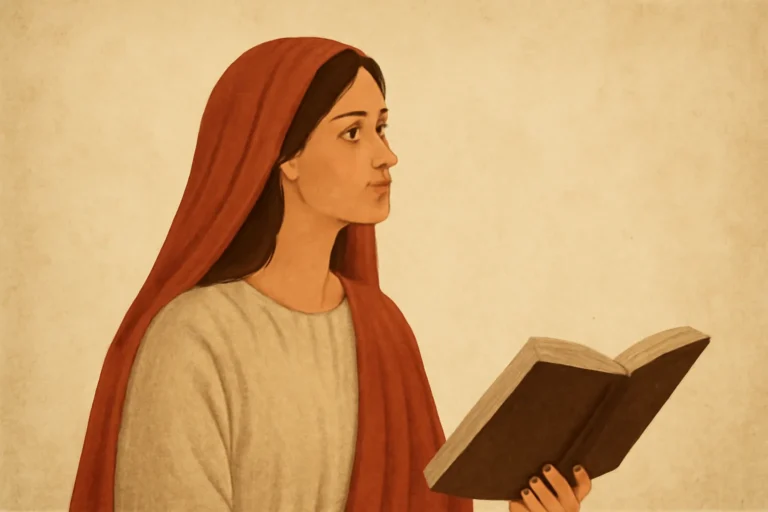
Commentary on Ruth 4: Boaz’s Redemption and God’s Covenant Faithfulness
Ruth 4 · King James Version
Quick Answer: This commentary on Ruth 4 focuses on Boaz’s public act of redemption—protecting Naomi’s family line, marrying Ruth, and honoring the laws of kinsman-redeemer. The scene at the city gate shows God’s providence working through ordinary steps: legal procedures, community witnesses, and faithful love. Through Ruth and Boaz, the story moves toward David’s lineage and God’s long-term promises.
Ruth 4 (King James Version)
“Then went Boaz up to the gate, and sat him down there: and, behold, the kinsman of whom Boaz spake came by; unto whom he said, Ho, such a one! turn aside, sit down here. And he turned aside, and sat down.
And he took ten men of the elders of the city, and said, Sit ye down here. And they sat down.
And he said unto the kinsman, Naomi, that is come again out of the country of Moab, selleth a parcel of land, which
was our brother Elimelech’s:
And I thought to advertise thee, saying, Buy
it before the inhabitants, and before the elders of my people. If thou wilt redeem
it, redeem
it: but if thou wilt not redeem
it, then
tell me, that I may know: for
there is none to redeem
it beside thee; and I
am after thee. And he said, I will redeem
it.
Then said Boaz, What day thou buyest the field of the hand of Naomi, thou must buy
it also of Ruth the Moabitess, the wife of the dead, to raise up the name of the dead upon his inheritance.
And the kinsman said, I cannot redeem
it for myself, lest I mar mine own inheritance: redeem thou my right to thyself; for I cannot redeem it.
Now this
was the manner in former time in Israel concerning redeeming and concerning changing, for to confirm all things; a man plucked off his shoe, and gave
it to his neighbour: and this
was
a testimony in Israel.
Therefore the kinsman said unto Boaz, Buy
it for thee. So he drew off his shoe.
And Boaz said unto the elders, and
unto all the people, Ye
are witnesses this day, that I have bought all that
was
Elimelech’s, and all that
was Chilion’s and Mahlon’s, of the hand of Naomi.
Moreover Ruth the Moabitess, the wife of Mahlon, have I purchased to be my wife, to raise up the name of the dead upon his inheritance, that the name of the dead be not cut off from among his brethren, and from the gate of his place: ye
are witnesses this day.
And all the people that
were in the gate, and the elders, said,
We are witnesses. The LORD make the woman that is come into thine house like Rachel and like Leah, which two did build the house of Israel: and do thou worthily in Ephratah, and be famous in Bethlehem:
And let thy house be like the house of Pharez, whom Tamar bare unto Judah, of the seed which the LORD shall give thee of this young woman.
So Boaz took Ruth, and she was his wife: and when he went in unto her, the LORD gave her conception, and she bare a son.
And the women said unto Naomi, Blessed
be the LORD, which hath not left thee this day without a kinsman, that his name may be famous in Israel.
And he shall be unto thee a restorer of
thy life, and a nourisher of thine old age: for thy daughter in law, which loveth thee, which is better to thee than seven sons, hath born him.
And Naomi took the child, and laid it in her bosom, and became nurse unto it.
And the women her neighbours gave it a name, saying, There is a son born to Naomi; and they called his name Obed: he
is the father of Jesse, the father of David.
Now these
are the generations of Pharez: Pharez begat Hezron,
And Hezron begat Ram, and Ram begat Amminadab,
And Amminadab begat Nahshon, and Nahshon begat Salmon,
And Salmon begat Boaz, and Boaz begat Obed,
And Obed begat Jesse, and Jesse begat David.”
A gate-centered culture and the meaning of redemption in Ruth 4 commentary
In ancient Israel, legal and community matters were often handled publicly at the city gate. The gate was not only a place of commerce and traffic, but also a setting for elders, witnesses, and formal transactions. In Ruth 4, Boaz takes care to conduct the redemption in the open, calling elders and the whole public to observe.
The passage also reflects the family and inheritance framework connected to Israel’s tribal life. When a household faced loss of a male heir, customs aimed to preserve a family name and secure the continuity of land ownership and kinship responsibilities. The concept of a “kinsman-redeemer” provided a moral and legal pathway for a close relative to step in—especially when property and future family identity were at stake.
Finally, Ruth’s Moabite identity shows the larger theme of belonging. Though Ruth began as an outsider due to her Moabite origins, her loyalty to Naomi and her decision to seek refuge in Israel move her into covenant history. Ruth 4 demonstrates how God’s providence can work through established structures—law, elders, witnesses, and inheritance—while still welcoming people into His unfolding plan.
Hebrew legal language and covenant tone in Ruth 4
Ruth 4 uses covenant-shaped, legal phrasing to describe “redeeming” (acting to reclaim and restore) and “changing” (altering the legal status of the matter). While English translations vary, the underlying Hebrew communicates transaction as more than commerce: it is a solemn transfer with moral weight, meant to preserve names, inheritances, and responsibilities.
The “shoe” gesture functions as a formal testimony—an ancient way to confirm a decision publicly. In many biblical contexts, symbolic actions served as visible proof, reducing ambiguity and protecting the parties involved. The tone in Ruth 4 is therefore both procedural and reverent: Boaz insists on witnesses and careful steps, because the outcome will affect real lives and a family line.
Even when the legal language is detailed, the emotional center remains loyalty and redemption—God’s faithfulness embodied through human obedience.
The city gate: public faithfulness in the story of Boaz the kinsman redeemer in Ruth 4
Ruth 4 begins with Boaz moving toward the gate and sitting down—an intentional posture that signals readiness to act within the community’s legal framework. This matters devotionally: God’s providence often comes through actions that are orderly, accountable, and witnessed, not through secrecy or shortcuts.
Boaz then calls the unnamed kinsman-redeemer and invites him to sit. The language of summoning and consulting highlights both respect and urgency. Boaz is not manipulating for personal gain; he is presenting a real responsibility connected to Naomi’s land.
Next, Boaz draws ten elders of the city to the scene. By doing so, he makes the transaction verifiable and fair. In a world where rumors and private arrangements could be harmful, this openness models integrity. The elders act as more than background characters; they are part of the “chain of truth” that protects Naomi’s interests and clarifies who will carry the obligation.
Boaz explains that Naomi has returned and that land belonging to Elimelech is for sale. He urges the kinsman-redeemer to buy it “before the inhabitants” and “before the elders.” The redemption is therefore framed as a visible, communal matter. Theologically, this also displays God’s character: He values truth and transparency in how His covenant purposes advance.
The gate scene therefore becomes a spiritual lesson. Redemption is not only a private feeling—it is a public commitment expressed through right steps, honest process, and willingness to bear responsibility.
Mercy and risk: the meaning of Ruth 4 redemption for faith today
The kinsman-redeemer’s response is complex. He declares an intention to redeem, yet his next words reveal hesitation rooted in self-protection: he fears that redeeming for himself will “mar” his own inheritance. In other words, he chooses caution over costly restoration. This is not portrayed merely as villainy; it is a realistic depiction of how legal duty can conflict with personal advantage.
Boaz, however, takes the risk. His willingness to redeem is not impulsive; it follows careful legal explanation. He names the condition plainly: if the land is redeemed for Naomi’s family, it must also involve Ruth the Moabitess to raise up the name of the deceased upon his inheritance. That requirement ties land, family identity, and covenant responsibility together.
For readers, this is the heart of the passage’s “meaning of Ruth 4 redemption.” Redemption is costly because love refuses to abandon someone’s story midstream. Boaz’s decision reflects a deeper fidelity than minimal compliance.
When the first redeemer refuses, he effectively yields his right. Then Boaz follows through. The “shoe” testimony confirms that the decision is settled and witnessed—again emphasizing that redemption is not a vague hope but a completed commitment.
Boaz’s words to the elders include an unmistakable purpose: to ensure the name of the dead is not cut off. The community hears that purpose and responds with blessing. Their blessing connects the new family line to celebrated Israelite roots (Rachel and Leah, and Pharez/Tamar), showing that God’s redemptive plan reaches beyond one household.
Thus Ruth 4 teaches that genuine faith often looks like bearing responsibility where others calculate risk. God’s grace advances through people who choose faithful action over self-preservation.
A providential family line: devotional study of Ruth chapter 4
After the legal and social steps are complete, the narrative moves from public transaction to personal life. Boaz “took Ruth, and she was his wife,” and the LORD gave her conception, leading to the birth of a son. This movement is crucial: the story does not end at the contract; it continues into the fruit of God’s blessing.
Naomi’s role also deepens the devotional impact. The women bless the LORD for not leaving Naomi without a kinsman. They describe the child as a restorer of Naomi’s life and a nourisher of her old age—language that shows how redemption is experienced as renewed hope and care, not merely restored property.
The community names the boy Obed, connecting the local event to larger redemptive history. The genealogy closes the chapter by placing Obed in the line of Jesse and David. This means Ruth 4 is not only about a successful marriage; it is about God’s faithful timing.
From a devotional perspective, the genealogy ending can feel surprising after the legal scene. Yet it confirms the theme: God’s covenant purposes unfold through faithful obedience across seasons. The ten elders, the gate witnesses, the act of redeeming, and the care for the family name all point toward God’s larger promise.
Ruth’s faithfulness earlier in the book now becomes a permanent part of Israel’s story. Ruth 4 shows that God can integrate the outsider into the covenant community and use that integration to build the future.
Ultimately, the chapter invites readers to see their own “gate moments”—the ordinary decisions made with integrity and courage—as part of God’s providential work. God is not only concerned with outcomes; He works through the faithful process that leads to blessing.
How to Apply This Today: choosing costly integrity in redemption moments
Ruth 4 invites you to examine whether your faith is mostly inward feelings or outward, accountable action. Boaz models integrity: he clarifies terms, involves witnesses, and follows through. When you face responsibilities—whether at work, in family, or in church—choose transparency over ambiguity and faithfulness over convenience.
Second, the passage challenges you to count the cost of love. The kinsman-redeemer hesitated because redeeming could affect his own inheritance. In daily life, similar tensions appear: giving time may “cost” comfort; forgiving may reshape your expectations; serving may interrupt your plans. Boaz shows that true redemption may require taking responsibility for what you did not fully create.
Third, celebrate God’s long-range timing. The blessing in Ruth 4 culminates in a lineage that leads to David. That means you may not see immediate results when you obey. Keep faith during the “waiting” between the gate decision and the later fruit.
Finally, if you feel like a “Ruth”—an outsider, overlooked, or displaced—remember that God welcomes loyalty and can incorporate you into His purposes. Your trust can become part of someone else’s restoration.
Prayerfully ask: Where is God asking me to act with clarity, courage, and costly love today?
Related Bible Passages
Leviticus 25:25-28
These laws outline redemption of land and clarify that restoration can involve a rightful relative, connecting the legal background to Ruth 4.
Deuteronomy 25:5-10
The principle of raising up a family name through a close relative aligns with Ruth 4’s emphasis on preserving the deceased’s name.
Matthew 1:5
Ruth is listed in Jesus’ genealogy, showing that God’s providential redemption in Ruth 4 reaches ultimately into the Messiah’s line.
Frequently Asked Questions
What is the main message of a Ruth 4 commentary?
Ruth 4 shows God’s faithfulness working through faithful, public action. Boaz redeems Naomi’s land and marries Ruth so that a family line is preserved. The chapter also highlights integrity (elders as witnesses) and long-term hope, culminating in David’s ancestry.
Why does the first kinsman redeemer refuse in Boaz the kinsman redeemer in Ruth 4?
He fears that redeeming for himself will affect his own inheritance. His refusal reveals how self-preservation can block duty. Boaz then willingly accepts the responsibility, demonstrating costly love that safeguards the vulnerable.
What does “redeem” mean in the meaning of Ruth 4 redemption?
In Ruth 4, redemption is restoring what is at risk—land, family continuity, and name. It is not merely purchasing property; it includes fulfilling kinship responsibilities so the deceased’s legacy is carried forward.
How can I practice lessons from a devotional study of Ruth chapter 4?
Act with integrity and transparency when obligations are on the line, especially in family and community matters. Choose faithful responsibility even when it costs you convenience, and trust God’s timing when results are delayed.
A Short Prayer
Lord, thank You for showing redemption as faithful love made public. Help me to act with integrity, to keep my commitments, and to choose responsibility over self-protection when it is hard. Teach me to trust Your long-range purposes, even when I cannot yet see the outcome. Like Ruth and Boaz, let my loyalty become a blessing to others. In Jesus’ name, Amen.
Key Takeaway: Ruth 4 teaches that God’s covenant purposes advance when faithful people accept costly responsibility to restore what is in jeopardy.