A Devotional Commentary on Luke 15:11-32: The Father’s Compassion for the Lost
Luke 15:11-32 · King James Version
Quick Answer: This commentary on luke 15 11 32 shows Jesus’ shocking picture of God’s welcome: the younger son wastes his inheritance, hits rock bottom, and returns—yet the Father runs to restore. The elder son stays “faithful” but resents grace. The passage reveals that God’s love is not earned; it is received, and it reshapes our hearts.
Luke 15:11-32 (King James Version)
“And he said,
A certain man had two sons:
And the younger of them said to
his father, Father, give me the portion of goods that falleth
to me. And he divided unto them
his living.
And not many days after the younger son gathered all together, and took his journey into a far country, and there wasted his substance with riotous living.
And when he had spent all, there arose a mighty famine in that land; and he began to be in want.
And he went and joined himself to a citizen of that country; and he sent him into his fields to feed swine.
And he would fain have filled his belly with the husks that the swine did eat: and no man gave unto him.
And when he came to himself, he said, How many hired servants of my father’s have bread enough and to spare, and I perish with hunger!
I will arise and go to my father, and will say unto him, Father, I have sinned against heaven, and before thee,
And am no more worthy to be called thy son: make me as one of thy hired servants.
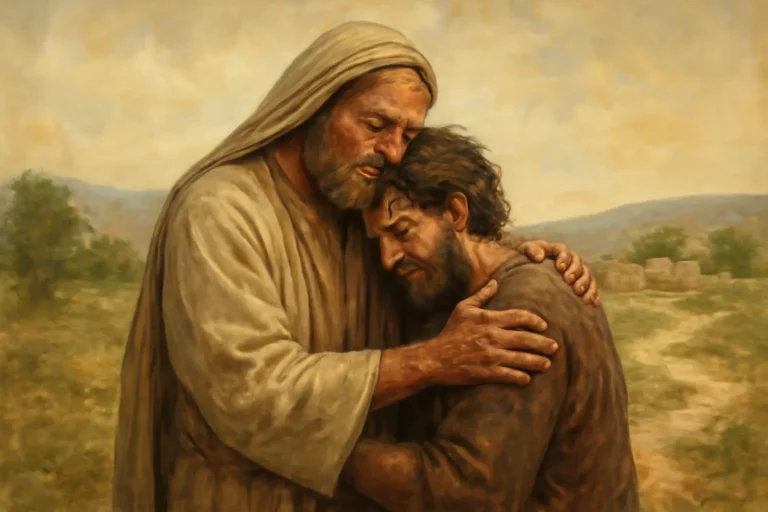
And he arose, and came to his father. But when he was yet a great way off, his father saw him, and had compassion, and ran, and fell on his neck, and kissed him.
And the son said unto him, Father, I have sinned against heaven, and in thy sight, and am no more worthy to be called thy son.
But the father said to his servants, Bring forth the best robe, and put
it on him; and put a ring on his hand, and shoes on
his feet:
And bring hither the fatted calf, and kill
it; and let us eat, and be merry:
For this my son was dead, and is alive again; he was lost, and is found. And they began to be merry.
Now his elder son was in the field: and as he came and drew nigh to the house, he heard musick and dancing.
And he called one of the servants, and asked what these things meant.
And he said unto him, Thy brother is come; and thy father hath killed the fatted calf, because he hath received him safe and sound.
And he was angry, and would not go in: therefore came his father out, and intreated him.
And he answering said to
his father, Lo, these many years do I serve thee, neither transgressed I at any time thy commandment: and yet thou never gavest me a kid, that I might make merry with my friends:
But as soon as this thy son was come, which hath devoured thy living with harlots, thou hast killed for him the fatted calf.
And he said unto him, Son, thou art ever with me, and all that I have is thine.
It was meet that we should make merry, and be glad: for this thy brother was dead, and is alive again; and was lost, and is found.”
Cultural background: honor, inheritance, and compassion in Luke 15
In first-century Jewish life, family honor and inheritance were deeply serious matters. An inheritance was typically tied to a father’s lifetime decisions and future provision for the household. For a younger son to demand his share early was not a small request; it communicated impatience with the father and effectively treated the father’s household as though it were already over. When Jesus tells this parable in the hearing of His audience, the emotional contrast would land strongly: the younger son’s rebellion leads to humiliation, while the father’s response to return is unexpected.
Meals and community celebration also carried major weight. To “be merry” after reconciliation was not mere entertainment; it signaled restoration of relationship and public affirmation of belonging. Meanwhile, working with animals like swine implied social and religious tension, because pigs were unclean for many Jews. Thus, the younger son’s progression—from freedom to waste, from independence to dependence—dramatizes how sin degrades life and relationships.
The parable’s final turn addresses another common human tendency: those who remain near to religious routines can still be far from compassion. The elder brother’s anger suggests that moral service without joyful gratitude can still miss the heart of the Father. Jesus uses everyday family dynamics to reveal God’s justice and mercy together.
Original nuance: “compassion” and “lost/found” language in Luke 15
Luke’s Gospel (originally written in Greek) uses vivid emotional terms to communicate God’s posture toward sinners. The father’s response includes “compassion,” highlighting not reluctant tolerance but heartfelt mercy. In addition, the parable repeatedly frames outcomes with the language of loss and restoration—“lost” and “found.” That wording is more than a description of location; it suggests a relational condition. The son is not simply missing; he is alienated from his father’s fellowship.
Greek narrative style in Luke often portrays repentance as a turn of the will that leads to a new direction in life. Yet the parable also emphasizes that the father initiates the welcome. The father “runs” and embraces before the son completes his rehearsed confession, underscoring grace that precedes performance. This tone helps readers see that repentance matters, but God’s love is primary and proactive.
The younger son: inheritance refused until it is surrendered (Luke 15:11-16)
Jesus begins with a “certain man” and two sons—an image that invites every hearer to ask, Which son am I? The younger son’s request for his portion of goods immediately signals a deeper desire: he wants the benefits of family life without submission to family authority. He treats the inheritance as if it were an asset to spend, not a gift entrusted for a purpose. In the parable’s world, that choice is not only financial; it is spiritual.
When the father divides his living, the story allows a painful truth: God sometimes permits people to follow their desires, even when those desires lead to collapse. Yet the parable does not celebrate freedom. It shows that misuse of provision results in devastation. The younger son “wasted” his substance with riotous living, then a famine strikes. Drought of food becomes a picture of inner famine—when sin has spent the resources, even “good things” can’t satisfy.
The moment he joins himself to a citizen and is sent to feed swine reveals the depth of humiliation. His hunger becomes worse than his embarrassment; he would eat the husks meant for the animals. No one gives him anything. That last detail matters: apart from God’s restoration, people can experience emptiness even when life is busy and choices are many.
His crisis is not merely that he lacks food, but that he realizes he has misjudged what the father’s house provided. The younger son begins to see that the father’s servants have bread enough—and he is perishing with hunger. That contrast prepares for repentance, not as self-justification, but as renewed dependence.
Repentance and return: confession meets mercy (Luke 15:17-24)
In the turning point, the younger son “came to himself.” This phrase communicates awakening—clarity that reaches the conscience. He recognizes the difference between what he deserved and what he received in the father’s house. Repentance here is specific: he plans to say, “I have sinned against heaven… I am no more worthy to be called thy son.” Notice the moral realism of his confession. He does not minimize his guilt, and he does not try to negotiate for a reward.
He rehearses a request: make me as one of your hired servants. That request aims at dignity without entitlement. Yet the astonishing element is the father’s response. While the son is “yet a great way off,” the father sees him, has compassion, runs, and falls on his neck, kissing him. The father’s initiative undermines any attempt to interpret grace as payment for repentance. The son is not met at the edge of the property only to be evaluated; he is met with embrace before he finishes his speech.
The robe, ring, and shoes are restoration symbols. They communicate honor, identity, and readiness for full belonging—not temporary tolerance. The fatted calf and the command to celebrate show that reconciliation is not grim paperwork; it is joy. The father declares, “For this my son was dead, and is alive again; he was lost, and is found.” In other words, what sin breaks, grace reverses.
This is why a proper “parable of the prodigal son commentary” must emphasize the father’s heart. Repentance is real, but the story teaches that God’s mercy is the first mover.
The elder brother: faith without celebration (Luke 15:25-28)
As the celebration begins, the elder brother returns from the field. He hears music and dancing and asks what is happening. The servant explains that the younger brother has come home and the father killed the fatted calf because he received him safely.
The elder son responds with anger and refuses to go in. This refusal is not simply personal preference; it is a sign that he has misread the meaning of his father’s authority and his own relationship to it. For years, he has “served” and claims he has never transgressed. Yet the parable exposes a danger: the elder brother’s righteousness is expressed as resentment.
He complains that the father never gave him even “a kid” to celebrate with friends. In effect, he compares his own life to the younger son’s rescue and concludes that grace is unfair. That is a major spiritual problem. When we measure God’s generosity by what we think we deserve, we can become blind to the very joy God intends for His people.
The elder brother’s posture also suggests he may have treated the father as a boss rather than as a loving father. His service sounds dutiful, but his response to mercy shows a heart that is not sharing the father’s compassion. The parable therefore addresses two forms of distance from God: the obvious rebellion of the younger brother and the subtle hardening of the elder brother.
This section teaches that religious activity is not the same as relational love. One can be near in location and far in attitude. Jesus uses the elder brother to challenge the assumption that obedience automatically produces gratitude.
The Father’s final appeal: grace invites participation (Luke 15:29-32)
The father comes out to the elder brother and “entreats” him. That word implies gentle insistence—invitation to join the joy rather than punishment for refusing. The father’s approach continues the theme of compassion: even the offended son is not abandoned.
The elder brother’s speech reveals his misunderstanding. He reduces the younger son’s life to moral performance: “devoured thy living with harlots.” He does not deny wrongdoing, but he cannot see past the label to the restored person. He fails to acknowledge what the father celebrates: that the son was dead in relationship and now lives.
Then the father makes a remarkable declaration: “Son, thou art ever with me, and all that I have is thine.” This statement is not threatened by the younger brother’s return; it is the basis for the elder brother’s security. The father explains that the purpose of celebration is not to make the elder brother feel deprived, but to acknowledge restoration. “It was meet that we should make merry, and be glad.”
The closing logic—“for this thy brother was dead, and is alive again; and was lost, and is found”—does more than justify a feast. It reframes the elder brother’s role. The elder is not meant to be the judge from outside; he is meant to be a rejoicing brother inside the house.
This is the heart of the whole passage: the Father’s welcome is comprehensive, but the invitation requires a change in attitude. The elder brother’s tragedy is not disobedience; it is refusal to rejoice in mercy. The commentary on luke 15 11 32 therefore culminates in this question: Will you enter the joy of grace?
How to Apply This Today: Repent, return, and learn to rejoice
First, examine your “younger brother” moments: places where you use gifts instead of honoring Giver. When life collapses, resist blaming circumstances only—ask where you’ve drifted from the Father’s will. Like the son “coming to himself,” choose clarity over denial. A simple prayer of confession—without excuses—can reopen a relationship.
Second, practice “return” as more than regret. The son planned to approach the father with honesty and a humble posture. In daily terms, return looks like making right what you can, seeking forgiveness where you’ve caused harm, and surrendering your need to control outcomes. God’s mercy is not a reward you earn after cleaning yourself up; it is the grace that empowers genuine change.
Third, watch for an “elder brother” heart. Are you serving God while resenting how God restores others? If you find yourself thinking, “They don’t deserve that,” pause. Consider whether you are treating God’s gifts as a scoreboard rather than a fatherly welcome. The invitation is to celebrate restoration—beginning with your own.
Finally, when God restores someone, choose to enter the house. Celebration may feel uncomfortable at first, but joy is part of obedience. The Father’s compassion is meant to shape your relationships, not merely your beliefs.
Related Bible Passages
Matthew 18:12-14
Jesus similarly emphasizes God’s desire to seek the lost, showing that mercy is intentional and relational.
Romans 5:8
God’s love is demonstrated while people are still undeserving, echoing the Father’s compassion before the son earns anything.
2 Corinthians 5:17-18
Paul describes reconciliation and new life as God’s work, matching the parable’s theme of “dead… alive” and “lost… found.”
Frequently Asked Questions
What is the main message of Luke 15:11-32?
The main message is that God’s mercy restores what sin destroys. The younger son shows the ruin of rebellion and the reality of repentance, while the elder brother exposes resentment toward grace. The Father’s joy invites both sons into renewed relationship.
How should we understand the elder brother lesson in Luke 15?
The elder brother represents people who may be “near” through duty yet miss the heart of God. His refusal to celebrate shows that righteousness without compassion becomes hard. The father’s invitation reveals that God’s grace is meant to produce joy, not envy.
Why does the father run and kiss the returning son?
In the parable, the father acts before the son finishes his speech, emphasizing grace that precedes performance. The act of running and embracing shows compassion and honor—restoration, not punishment, is the goal.
What does the phrase “lost and found” teach in this parable?
It teaches that sin causes relational separation, not just moral failure. “Lost” describes being outside fellowship, while “found” describes being restored into belonging. God’s mercy reverses the condition, not merely the consequences.
A Short Prayer
Father, thank You for compassion that runs toward us before we complete our excuses. Teach me to return with sincere repentance when I drift. Break any elder-brother resentment in my heart and help me rejoice when You restore others. Let celebration be the fruit of grace, not a reward I demand. Make me glad in Your mercy, in Jesus’ name, amen.
Key Takeaway: The Father’s grace restores the lost and invites even the resentful to rejoice in mercy.