Commentary on Psalm 24: Welcoming the King of Glory
Psalms 24 · King James Version
Quick Answer: This commentary on psalm 24 shows God as the Creator and rightful Lord of all. It invites worshipers to consider who is fit to stand in God’s presence—those with clean hands, a pure heart, and truthful devotion. The psalm then imagines the gates lifted for the coming King of glory, reminding believers to welcome God’s rule daily.
Psalms 24 (King James Version)
“The earth
is the LORD’S, and the fulness thereof; the world, and they that dwell therein.
For he hath founded it upon the seas, and established it upon the floods.
Who shall ascend into the hill of the LORD? or who shall stand in his holy place?
He that hath clean hands, and a pure heart; who hath not lifted up his soul unto vanity, nor sworn deceitfully.
He shall receive the blessing from the LORD, and righteousness from the God of his salvation.
This
is the generation of them that seek him, that seek thy face, O Jacob. Selah.
Lift up your heads, O ye gates; and be ye lift up, ye everlasting doors; and the King of glory shall come in.
Who
is this King of glory? The LORD strong and mighty, the LORD mighty in battle.
Lift up your heads, O ye gates; even lift
them up, ye everlasting doors; and the King of glory shall come in.
Who is this King of glory? The LORD of hosts, he
is the King of glory. Selah.”
Meaning of Psalm 24 in Israel’s worship setting
Psalm 24 is closely tied to the rhythms of Israel’s worship—especially pilgrimage to the temple and the movement of God’s presence into a holy place. In ancient Israel, “the LORD’s hill” and “holy place” evoke the temple mount, where offerings, prayers, and covenant faithfulness were publicly affirmed. The psalm’s language also reflects the worldview of the Old Testament: God is not merely one deity among others but the Creator who owns the land, sea, and every living thing.
At the same time, the psalm uses a striking entrance image: gates are commanded to lift up so “the King of glory” can come in. That portrayal fits the ceremonial anticipation of God’s rule being recognized in worship—whether through festival processions, sacrifices, or the symbolic welcoming of divine kingship. “Selah” likely marks a pause for reflection, encouraging worshipers to meditate on what the psalm claims: God’s holiness is real, and access to His presence is not casual.
Therefore, the psalm functions devotionally and spiritually. It begins with creation’s ownership, moves to moral and heart requirements for approaching God, and ends with triumphant anticipation of God’s kingly presence—inviting the worshiper to align both life and worship with the holy LORD.
Hebrew nuance behind “clean hands” and “pure heart”
In this passage, the psalm speaks of “clean hands” and “a pure heart,” presenting an inner-and-outer integrity that fits approaching the LORD. While the exact Hebrew wording involves common moral vocabulary in biblical Hebrew, the emphasis is consistent: cleanliness is more than outward religious activity; purity is a heart-level allegiance. “Hands” often represent actions—how a person lives publicly—while “heart” represents the center of will, motives, and desires.
The psalm also rejects “vanity” and “deceit” in worship and speech, linking sincerity with moral truthfulness. In Hebrew thought, hypocrisy is not merely a behavior issue but a spiritual distortion of what one truly trusts. Thus, the nuance is that genuine worship requires congruence: your practices should match your devotion, and your inner motives should not contradict your outward worship.
Creation belongs to the LORD (and therefore worship belongs to Him) — meaning of Psalm 24
Psalm 24 opens with a breathtaking claim of ownership: “The earth is the LORD’S, and the fulness thereof; the world, and they that dwell therein.” The psalm does not begin with human feelings or a list of religious duties. Instead, it grounds worship in God’s right as Creator and Sustainer. If the earth and all its inhabitants belong to the LORD, then worship is not a human attempt to reach God; it is a response to the One who already possesses all things.
That opening also reshapes how we think about daily life. If everything is “the LORD’s,” then our work, relationships, resources, and even the ground beneath our feet are held under divine authority. This means worship is not compartmentalized. The psalm trains the believer to see that approaching God is connected to how we recognize His Lordship over reality.
The psalm continues: God has “founded” the earth “upon the seas” and “established it upon the floods.” Ancient peoples often pictured the world as vulnerable to chaos. By using flood imagery, the psalm highlights God’s stability and sovereignty. The creation is not a random accident or a fragile structure held together by chance; it is a deliberate work of God, made secure by His command.
This foundation matters for everything that follows. When the psalm later asks, “Who shall ascend into the hill of the LORD? or who shall stand in his holy place?” it is not asking because God is hard to find. Rather, it assumes that the LORD—who is sovereign over creation—requires holiness in those who draw near. The God who established the world can also establish the terms of access.
Who is fit to stand? Clean hands, a pure heart, and truthful worship
After affirming God’s universal authority, Psalm 24 pivots to a very personal question: who can ascend into God’s presence? The psalm is not teaching that temple access is reserved for an elite class. It teaches that access corresponds to spiritual integrity.
The answer is memorable and searching: “He that hath clean hands, and a pure heart; who hath not lifted up his soul unto vanity, nor sworn deceitfully.” In other words, the worshiper must be honest—both in action and intention. “Clean hands” calls for integrity in behavior: a life that is not marked by exploitation, hidden wrongdoing, or hypocrisy. “Pure heart” addresses motives: the inner person must not be divided between God and hollow pursuits.
The psalm also warns against lifting the soul “unto vanity.” Vanity here suggests empty idols—anything that promises meaning but cannot truly deliver. When the soul clings to emptiness, worship becomes a performance. The psalm therefore connects devotion with desire: what captures your heart will shape how you approach God.
It further mentions “sworn deceitfully,” showing that speech and promises matter. In biblical spirituality, words are not casual; oaths and commitments reflect the heart’s trust. A deceitful tongue undermines trustworthiness, and the psalm insists that God’s presence is aligned with truth.
Then comes the promise: “He shall receive the blessing from the LORD, and righteousness from the God of his salvation.” This is significant. The psalm suggests that God grants blessing and righteousness—not as wages earned by perfection, but as gifts given when a person turns from vanity and deceit. The God who owns the earth also provides the moral restoration that makes true worship possible.
The generation that seeks God: face-to-face longing — Psalm 24 devotion about seeking God
Psalm 24 describes worship as active seeking: “This is the generation of them that seek him, that seek thy face, O Jacob.” The psalm does not portray religion as mere tradition or inherited status. It emphasizes a “generation” defined by pursuit. Those who truly seek the LORD are characterized by direction—toward God’s face.
To “seek” implies more than awareness. It suggests intentional movement: turning attention, adjusting priorities, and pursuing God with perseverance. The phrase “seek thy face” is especially vivid. In the Old Testament, “face” language often communicates presence, relational nearness, and covenant favor. Seeking God’s face means longing for fellowship with the LORD, not simply for solutions.
For “Jacob” the psalm may recall God’s covenant people—the descendants associated with the name Jacob. This grounds the message in God’s faithfulness to His promises. The invitation is therefore both personal and covenantal: people from Jacob’s line are called to seek, and God—who established creation—remains attentive to His covenant.
The psalm then pauses with “Selah,” a reminder to stop and consider. In devotional practice, “Selah” functions like a spiritual bracket: it slows the reader from analysis into worship. The psalm is not only information; it is a call to respond.
This section becomes a measuring instrument for the believer. Are we merely attending religious moments, or are we “seeking” God? Do we want His gifts more than His presence? Psalm 24 presses the worshiper toward face-seeking—toward a relationship that reshapes motives, speech, and actions.
Lift up your heads: the King of glory enters — King of glory in Psalm 24 explanation
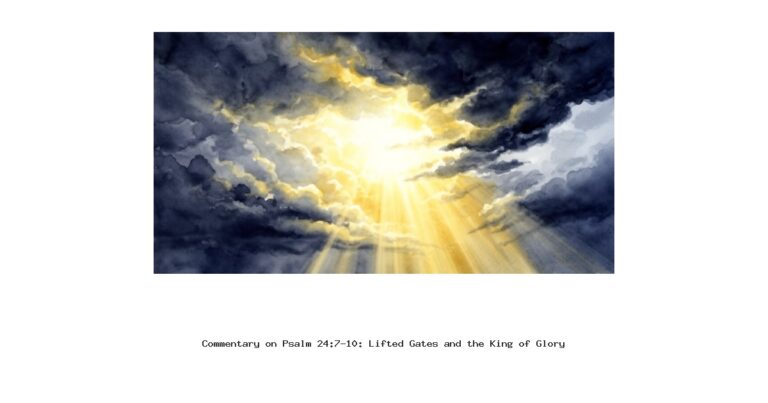
The psalm culminates in triumphant procession language: “Lift up your heads, O ye gates; and be ye lift up, ye everlasting doors; and the King of glory shall come in.” Here, the imagery becomes almost dramatic. Gates are addressed as if they can respond, and doors are called to readiness as if the entire city must prepare for the entrance of the LORD’s kingly presence.
This is worship language that points beyond a single event. The psalm’s God is not distant. The Creator who founded the world is also the King who comes near. The gates imagery communicates that God’s rule should be welcomed with openness and reverence. Nothing should be barred when the King of glory approaches.
The psalm then asks, “Who is this King of glory?” and answers directly: “The LORD strong and mighty, the LORD mighty in battle.” God is not only majestic; He is victorious. His kingship includes power that opposes evil and delivers His people. The psalm’s refrain is repeated—an intentional emphasis that worship should hold onto this truth: God’s entrance is a reality to be anticipated, not an idea to be admired.
Finally, the psalm identifies the King of glory as “the LORD of hosts.” “Hosts” (armies) underscores God’s command over heavenly and earthly forces. This means the King who invites worship is capable of upholding His promises and defending His people.
For the believer, this final movement is an invitation to spiritual readiness. If the King of glory is coming in, the heart must be prepared—by truth, purity, and seeking. The psalm’s logic is cohesive: creation belongs to God, worshipers must be aligned with God’s holiness, and then God’s reign is welcomed as King of glory.
A unified message: approach God rightly, because God rules everything — summary commentary on Psalm 24
Psalm 24 is often read as a set of separate ideas—creation, moral requirements, and a triumphant procession. But the psalm’s power is in its unity. God’s ownership of the earth sets the stage. Since the LORD is the rightful King, worship is not optional and not arbitrary.
Then the psalm asks who can ascend into God’s presence. That question is answered with moral and spiritual integrity: clean hands, pure heart, truthful speech, and a refusal of vanity. Importantly, the psalm frames righteousness as received—God provides blessing and righteousness from “the God of his salvation.” That keeps the message from becoming mere self-improvement. It is an invitation to turn toward God and receive what God gives.
Next, Psalm 24 identifies a “generation” characterized by seeking God’s face. Worship is relational pursuit. It is not just about location in the temple; it is about orientation of the heart.
Finally, the psalm portrays the King of glory entering through lifted gates. That image connects holiness and worship to kingship. God’s presence is not only something to think about; it is something to welcome.
In practical terms, this unified message challenges believers to align their inner life with their outward worship. It also encourages hope: the same LORD who founded creation is strong and mighty, the LORD of hosts. The King who calls for purity is also the King who is able to bless, rescue, and establish righteousness. That combination—holiness and help—makes Psalm 24 a devotional call to readiness and trust.
How to Apply This Today: welcome the King of glory with a whole-life posture
Psalm 24 invites you to treat worship as response to God’s rightful rule. Start by acknowledging God’s Lordship over your “earth”—your schedule, money, work, and relationships. Ask: Where am I living as though something else owns my life?
Next, evaluate your approach to God. “Clean hands” can be practiced by confronting hidden patterns: dishonest practices, resentment that damages relationships, or careless harm done in small ways. “Pure heart” can be practiced by refusing vanity—deciding that God’s presence matters more than whatever currently promises satisfaction. Consider writing down one “vanity” you habitually chase and one sincere step toward God.
Also, honor truth in speech. If you have broken trust, repair what you can with honesty and humility. Psalm 24 links access to God with truthful commitments.
Finally, practice “seeking thy face” daily. Set a short time to pray with intentionality: not to get quick answers, but to seek God’s presence. As you pray, imagine gates lifting—your heart opening to welcome the King of glory. If you do this consistently, your worship will become less about performance and more about real encounter.
Related Bible Passages
Isaiah 6:1-7
Like Psalm 24, Isaiah’s vision links encountering God’s holiness with an urgent awareness of the need for cleansing and readiness.
Matthew 5:8
Jesus echoes the theme of heart-purity, aligning with Psalm 24’s call for a pure heart that seeks God rather than vanity.
Hebrews 10:19-22
The call to draw near with true hearts and sincere faith resonates with Psalm 24’s description of approaching God with integrity.
Frequently Asked Questions
What does Psalm 24 teach about who may stand in God’s holy place?
Psalm 24 answers with character and worship integrity: clean hands and a pure heart. It describes rejection of vanity and deceitful promises. The psalm’s point is that approaching God is not casual; it requires sincerity that affects actions, motives, and speech.
How does the meaning of Psalm 24 connect creation to worship?
The psalm begins by declaring the LORD’s ownership of the earth. That foundation means worship is a response to God’s rightful kingship, not human effort to earn attention. Because God established creation, He also sets the moral conditions for drawing near.
What is the King of glory in Psalm 24?
The King of glory is the LORD—strong, mighty in battle, and the LORD of hosts. The psalm uses gate-and-door imagery to portray God’s triumphant presence being welcomed. It teaches that divine kingship is real, powerful, and deserving of reverent readiness.
How can I live a Psalm 24 devotion about seeking God throughout the week?
Treat “seeking God’s face” as a daily practice: short prayer, honest self-examination, and intentional choices that reject vanity. Aim to align your actions (“clean hands”) and motives (“pure heart”) with your worship. When you notice deceitful habits, take steps toward truth and repair.
A Short Prayer
King of glory, You created the earth and hold all things in Your hand. Lift the gates of my heart so I may welcome Your presence with sincerity. Cleanse my hands from wrong and purify my motives from vanity. Make my words truthful and my devotion wholehearted. Teach me to seek Your face, and receive from You blessing and righteousness. In Jesus’ name, amen.
Key Takeaway: Psalm 24 calls every worshiper to recognize God’s rightful kingship, approach Him with clean hands and a pure heart, and welcome the King of glory with hopeful, truthful seeking.