Jesus Fig Tree: Meaning, Symbolism, and Biblical Lessons
Jesus Fig Tree: Meaning, Symbolism, and Biblical Lessons
The episode often simply called the fig tree episode or the fig tree narrative sits at a pivotal moment in the Gospel record. It bridges Jesus’ public teaching with a dramatic sign that many readers interpret as a compact message about spiritual fruitfulness, divine judgment, and readiness for the kingdom of God. In this article we explore the Jesus fig tree story from multiple angles: its historical and agricultural context, its place in the Gospel accounts, its symbolic meanings, and the enduring lessons it offers for faith, prayer, and daily life. We will refer to the tree in question through several common formulations—the barren fig tree, the cursing of the fig tree, the fig tree episode, and the fig tree parable in Luke—to emphasize how this image travels across biblical literature and interpretation.
To understand the meaning of the Jesus fig tree moment, it helps to know something about fig trees in ancient Palestine and how fig trees were understood by people in the time of Jesus. In the climate of Judea and Galilee, fig trees were common and served as both a practical food source and a familiar symbol in poetry and proverbs. A typical fig tree would often put forth leaves early in the season, signaling that fruit was nearby. Yet the presence of foliage did not guarantee fruit, and early fruit would appear in stages before the main crop ripened. This agricultural pattern matters for reading the narratives carefully: if a tree has leaves, people expect fruit; if not, it’s a sign that something is not functioning as it should be.
In the biblical world, the fig tree could symbolize prosperity and blessing, but also judgment, depending on whether the expectations of fruitfulness were met. The image of a tree that seems healthy from the outside yet bears no fruit would have been understood as a powerful metaphor for a people or a religious system that appeared outwardly pious but lacked genuine righteousness or faithfulness. In this sense, the figure of a barren or unfruitful tree serves as a visual parable that invites viewers to examine the inner life and the outward signs of virtue.
The incident in the Gospels: Jesus and the cursing of the fig tree
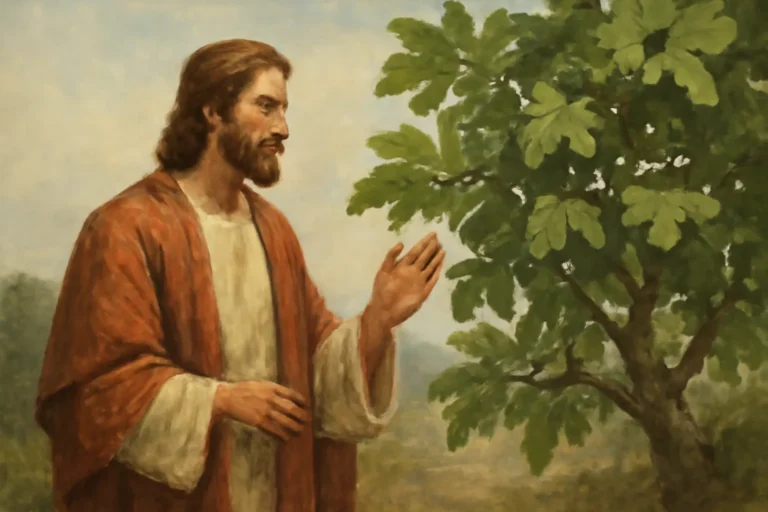
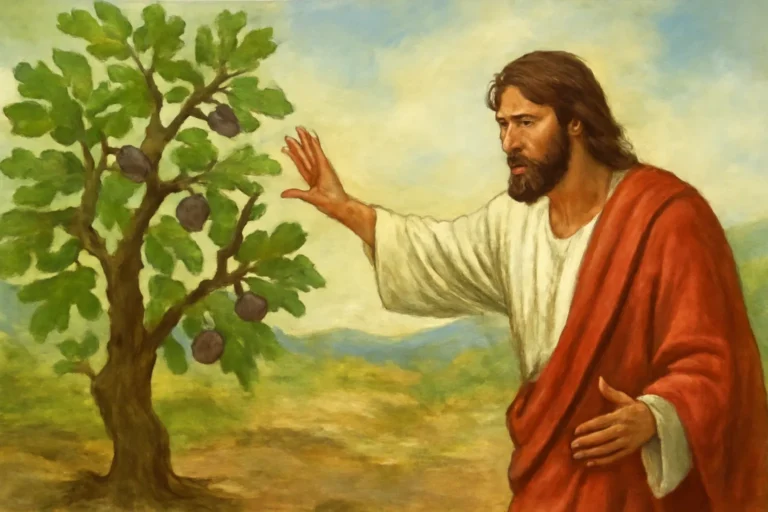
The stories about the fig tree appear in a few places in the New Testament, with the most discussed version being the encounter in the Synoptic Gospels of Jesus and the fig tree after he leaves Bethany. The accounts in Matthew 21:18–22 and Mark 11:12–14, 20–21 describe a scene in which Jesus approaches a fig tree that appears to have leaves, but when he finds no fruit, he speaks a word of judgment and the tree withers. The next day, the disciples notice that the tree has withered from its roots. A related, though different, vignette appears in Luke 13:6–9, in which a parable about a fig tree in a vineyard urges patience but warns of imminent judgment if fruit is not produced.
There are variations between the Gospel accounts. In Matthew’s account, the episode explicitly ties the fig tree to a lesson about faith and prayer, as Jesus teaches his disciples that “if you have faith and do not doubt”, even mountains can be moved. In Mark’s account, the narrative emphasizes the immediate decline of the fig tree after Jesus curses it, signaling a dramatic sign of authority and the theme of bearing fruit that will be tested in the life of the people. In both, the interplay between signs, judgment, and teaching is central. The connected sequence with Jesus’ cleansing of the Temple reinforces the motif: a place of prayer and worship is challenged when it becomes a marketplace, just as a fig tree that looks ready to bear fruit but fails to do so is challenged by the Lord who seeks true fruitfulness.
Key moments and their sequence
Jesus approaches the leafy fig tree, expecting fruit.
Finding none, he pronounces a curse, saying the tree will wither.
Shortly afterward, the tree withers from the roots in Matthew and Mark’s accounts (with a temporal nuance between the two).
Jesus uses the incident to teach about faith, prayer, and divine judgment against spiritual barrenness.
Meaning: literal event and symbolic depth
Scholars and readers have long debated how to read the fig tree story. There is value in a literal, historical sense—Jesus publicly performs a dramatic action that demonstrates his authority. Yet the broader significance is often read as symbolic, pointing to Israel’s spiritual state, to the necessity of authentic fruitfulness in God’s people, and to the way appearances can mask deeper realities. Here are two complementary angles on the meaning of the fig tree episode:
Literal reading — The narrative presents a real event in Jesus’ ministry. A fig tree, despite its leaves, is found to be barren of fruit in its season, and Jesus responds with a decisive pronouncement. The subsequent withering is portrayed as an immediate emblem of judgment, a sign to the disciples and to readers that Jesus has authority over creation and over the divine order of blessing and cursing. This reading highlights Jesus’ prophetic voice and action, inviting an appropriate response from those who witness it.
Symbolic reading — The fig tree functions as a powerful metaphor for spiritual Israel and, more broadly, for the Church or for any religious community that looks the part on the outside yet fails to bear the fruit God desires. In this sense, the leaves without fruit symbolize a faith that is performative rather than transformative. The episode invites readers to consider questions such as: What is the fruit that God seeks in the life of faith? How does a community cultivate authentic righteousness, mercy, justice, and devotion? The combined themes of judgment and mercy also surface here, reminding believers that fruitfulness is tied to intimate relationship with God, not mere external appearances.
Israel, the fig tree, and prophetic symbol
Throughout the Hebrew Bible and Second Temple literature, the fig tree carries rich symbolic freight. The tree is a familiar feature of the land, and the image often conveys ideas about fertility, prosperity, and covenant faithfulness. In prophetic literature, signs of fruitlessness or corruption are used to indict leaders and people who have forgotten the law or misused their sacred status. In this light, the fig tree episode can be read as a prophetic action, a dramatization of a larger biblical pattern: God’s people are called to bear fruit appropriate to their calling as a covenant people. When they do not, judgment follows, but mercy remains available for repentance and renewal.
Some scholars highlight the fig tree’s connection to national symbolism, noting that Israel’s story in the biblical narrative often uses trees as allegories for national life. The cursing of the fig tree thus bears a double audience: it speaks to Jesus’ contemporaries (the religious leaders who held outward legitimacy without genuine faith) and to future generations who read the story as a reminder that the presence of a visible religious life does not guarantee spiritual vitality. The symbol’s layered meaning makes the fig tree an enduring shorthand for fidelity, obedience, and the possibility of transformation through divine mercy.
The Lukean twist: the parable of the fig tree and patience
The parabolic figure of the fig tree in Luke (Luke 13:6–9) shifts the emphasis somewhat. In this parable, a man has a fig tree planted in his vineyard. When he comes looking for fruit and finds none, he instructs his keeper to cut it down. The keeper pleads for more time, asking to dig around it and fertilize it so that it might bear fruit in the future. If it does not, then it can be removed. This parable is often read as a parable about divine patience, the obstinacy of human hearts, and the opportunity for repentance before a final judgment. The Lukean version is not merely a re-telling of the same event; it reframes the imagery in a way that invites a compassionate pause before judgment, and it emphasizes God’s willingness to grant time for repentance and growth.
In reading Luke alongside Matthew and Mark, readers gain a broader biblical perspective: the fig tree tension is not one-dimensional. It serves as a multi-layered teaching instrument that exposes the difference between outward appearance and inward reality, foregrounds the need for ongoing spiritual cultivation, and invites listeners to respond with faith, humility, and fruitfulness.
Practical lessons: what the fig tree narrative teaches today
What can modern readers learn from the episode of the barren fig tree? Here are several takeaways that flow naturally from the biblical text and its interpretive history:
Fruitfulness matters more than appearance. A tree with leaves may signal vitality, but fruit is the test. The same principle applies to churches, communities, and individuals who profess faith but are not producing the characteristic fruits of love, justice, mercy, and holiness.
Faith and prayer are powerful. In Matthew’s version, Jesus links faith to milagrous outcomes through prayer. Faith is not a superstition but a relationship with God that aligns desire with God’s will, enabling believers to seek and receive the transformative work God desires.
Judgment and mercy can coexist. The fig tree episode is not only about condemnation; it also sits within a larger arc of mercy and invitation, especially visible in Luke’s parable, which gives time for repentance and renewal.
Outward religiosity is insufficient without inner life. The narrative challenges readers to examine whether their religious practices express genuine devotion or merely public performance.
Timing matters. The difference between immediate withering (in some accounts) and a process of drying up (in others) points to the complexity of divine timing in human-looking outcomes. God’s ways of judging and blessing unfold in time and within a broader narrative of mercy and restoration.
God as gardener in Luke’s parable. The vinedresser who asks for more time embodies divine patience and strategic cultivation for fruitfulness, suggesting a cooperative, ongoing process between God and the faithful community.
Fig tree symbolism in Christian devotion and art
Beyond the textual reading, the fig tree has appeared in Christian art, liturgy, and devotional imagery as a symbol of growth, perseverance, and prepared readiness for the coming kingdom. In some traditions, the fig tree is used as a meditation image for humility and repentance; in others, as a reminder of divine judgment tempered by mercy. In sermons and teachings, the fig tree image often anchors calls to examine personal lives for “fruit that remains” and to pursue authentic righteousness in daily decisions, family life, work, and service to neighbors.
In church architecture and iconography, the fig tree can appear alongside the vine, a scriptural emblem of Israel and the church, emphasizing the interconnectedness of God’s people with the land’s produce as a sign of blessing and covenant faithfulness when fruit is produced in response to divine initiative.
Because the story of the fig tree has been read and taught in many contexts, several questions commonly arise. Here are concise answers to a few frequently asked questions to help readers engage responsibly with the text:
Was Jesus angry at the fig tree? The narrative presents a decisive action that is often described as an expression of judgment. Some readers interpret this as anger, while others frame it as prophetic judgment—an acted parable intended to reveal a spiritual truth about faithfulness and fruitfulness.
Did the fig tree wither because of a lack of faith? Jesus’ teaching in the surrounding passages links faith with fruit-bearing and effective prayer. The withering of the tree is read by many scholars as a symbolic demonstration of the power of faith and the seriousness of spiritual barrenness, rather than a causal demonstration about the subject of faith itself.
Is the cursing of a tree a model for how Christians should act? The broader biblical witness cautions against simple, literal application of prophetic actions as normative behavior. The fig tree episode should be read within a larger ethical and theological framework that emphasizes mercy, truth, repentance, and active love for neighbor.
How should we interpret Luke’s parable alongside the Matthew/Mark episodes? Luke’s version emphasizes the possibility of repentance and timely mercy. Interpreting all three passages together helps believers see both the urgency of bearing fruit and the opportunity for transformation when God’s grace invites a reorientation of life.
For individuals and small groups, the fig tree narrative offers a structured way to reflect on personal growth, church life, and mission. Consider the following practical steps:
Examine personal fruit. Take time to assess what “fruit” means in your life. Consider qualities such as love, joy, peace, patience, kindness, goodness, faithfulness, gentleness, and self-control as a measure of spiritual fruit (Galatians 5:22–23) and align your actions with these virtues.
Assess public and private life. Are there areas where outward appearance does not match inward reality? Invite accountability from trusted friends or mentors who can help you grow toward greater integrity.
Pray with faith. Use the teaching about faith and prayer to structure spiritual disciplines: regular prayer, Scripture meditation, and discernment about where to invest your energy for fruitfulness in the kingdom of God.
Embrace repentance and mercy. The Lukean invitation to additional time is an invitation to change. Repentance is not only a one-time act but a pattern of ongoing growth and renewal.
Engage in communal cultivation. Just as the gardener in Luke’s parable tends the vineyard, communities can practice spiritual disciplines together—study, service, generosity, and outreach—that help cultivate fruit in collective life.
From a theological perspective, the fig tree narrative engages central concerns of Christian faith: judgment, mercy, faith, and fruitfulness. It invites readers to discern where the heart is aligned with God’s purposes and where the life of faith risks becoming merely ornamental. The imagery also resonates across the biblical testimony as a pattern: God acts decisively to correct misalignment, but God also invites ongoing repentance and transformation. This dual pattern—judgment tempered by mercy—has shaped Christian confession and practice across centuries, encouraging communities to pursue authentic faith that bears fruit in love for God and neighbor.
Readers approach the fig tree narrative from various hermeneutical perspectives. Some emphasize the prophetic dimension and read the episode as a direct challenge to the religious authorities of Jesus’ day. Others see the broader narrative arc in the Gospels as illustrating the arc of salvation history: God’s initiative in calling forth fruitfulness, humanity’s responsibility to respond, and the ultimate fulfillment of God’s purposes in the Messiah. A balanced reading respects both the immediate dramatic signal of the cursing and the larger eschatological expectation that genuine faith will express itself in concrete acts of love, justice, mercy, and stewardship.
The fig tree story remains a compelling lens for examining our own lives and communities. It challenges us to be wary of spiritual appearances that mask inner barrenness, to cultivate authentic fruit through reliance on God, and to respond to God’s call with bold faith, earnest prayer, and a commitment to justice and mercy. Whether read as a historical event or as a symbolic teaching device, the episode of the barren fig tree continues to provoke reflection on what it means to bear fruit in a world that longs for signs of life, hope, and renewal.



Leave a Reply