Yearly Bible Study Plan refers to a structured approach to reading the Bible over the course of one calendar year. It is designed to be simple, manageable, and sustainable, rather than overwhelming. A well-crafted 365-Day Reading Guide helps readers cultivate a steady daily habit, deepen biblical literacy, and grow in understanding and faith. The idea is not to rush through the text but to engage with Scripture in a way that supports memory, reflection, and application. In this article, you will find practical guidance, diverse formats, and concrete examples to kick off a year-long Bible study plan that fits your pace, schedule, and spiritual goals.
Whether you call it an annual Bible study plan, a year-long devotional schedule, or a 12-month scripture reading plan, the core components are the same: regular daily readings, context-aware interpretation, and a format you can actually keep. Below we explore the principles, structure, options, and tools that make a yearly Bible study plan effective for people at different stages of their spiritual journey.
Why a 365-Day Reading Guide Is Worth It
A 365-day plan offers several distinct advantages compared with shorter or irregular reading periods. It creates a rhythm, reduces decision fatigue, and fosters a long-term sense of progress. Here are some benefits to consider:
Consistency: A daily rhythm builds discipline and makes Scripture familiarity more likely.
Continuity: Reading across genres—narrative, poetry, prophecy, letters, and wisdom—helps you see the Bible as a coherent story and a diverse library.
Context: Regular exposure to different biblical books improves historical, literary, and theological understanding.
Memory: Short daily readings are easier to memorize, meditate on, and apply to daily life.
Faith formation: Ongoing engagement with Scripture stimulates spiritual growth, personal reflection, and prayer.
Flexibility: A well-designed plan accommodates busy days by offering lighter and heavier reading options without guilt.
Different people use variations of a yearly plan to suit personal goals, such as focusing on the life of Jesus, studying themes like faith and endurance, or tracing the storyline of salvation from Genesis to Revelation. When we speak of a yearly approach to Bible study, we mean a framework that can be adapted to individual preferences while preserving the core objective: steady, meaningful engagement with God’s Word across a full year.
Key Principles of a Simple 365-Day Bible Reading Plan
Before you choose a specific format, anchor your plan in a few timeless principles. These will help you avoid burnout and maximize the impact of your year-long study.
Balance Old Testament and New Testament readings to keep the narrative arc of Scripture in view and to connect covenants, prophets, gospels, and letters in meaningful ways.
Read with context—consider historical setting, genre, authorial intention, and audience. When possible, pair a daily reading with a short note or a reference you can revisit later.
Keep it practical—opt for readings that are doable in 15–20 minutes per day rather than demanding marathon sessions that lead to discouragement.
Include reflection time—set aside a few minutes for journaling, prayer, or contemplation to turn reading into transformation rather than information alone.
Allow flexibility—life happens. A plan should be forgiving, with options for catch-up days or lighter weeks without guilt.
Engage with community—where possible, discuss readings with a friend, a study group, or an online forum to deepen understanding and accountability.
Track progress—simple checklists or a digital tool can provide motivation and a sense of accomplishment as you cross off days.
In addition to these core principles, consider thematic diversity to prevent monotony. You can alternate between narrative chapters, prophetic writings, poetical books, and epistles, or you can follow a chronological approach to see events as they unfold in history. The following sections outline practical formats and templates you can implement as part of your yearly Bible study plan.
Structuring Your Yearly Bible Study Plan
When designing your annual scripture reading schedule, you’ll decide on rhythm, scope, and order. Here are common structural options you can mix and match.
Choosing a Translation and Reading Approach
Start with a plan for translation and readability. If you’re new to Bible study, you might prefer a modern, readable translation (such as a well-regarded contemporary English version). If you’re studying for deeper exegesis, you may opt for a more literal translation alongside study aids. The choice of translation affects how you approach the text, but the ultimate goal remains the same: understanding, application, and growth.
Plan for one daily reading in a chosen translation, with optional cross-references or a short devotional.
Experiment with a bilingual or parallel-text setup if you want to compare translations.
Include memory verses—short, central passages you want to recall throughout the year.
Setting Goals and Pacing
Decide how ambitious you want to be. Your pace may vary based on time constraints, reading speed, and prior exposure to Scripture. A simple and sustainable pace often looks like this:
Daily readings averaging about 1 to 2 chapters per day, with flexibility for longer or shorter days.
Alternate days with short devotional passages or Psalm or Proverb highlights to reinforce memory and meditative practice.
Weekly review sessions to summarize what you’ve learned and note questions for future study.
Designing the Daily Reading Structure
There are several practical structures that work well for most people. Here are three widely used templates that you can adapt:
Twice-a-day structure — read a short portion in the morning and a slightly longer section in the evening. This approach can reduce daily load and promote reflection at two distinct points in the day.
One-OT + One-NT daily — read one chapter from the Old Testament and one from the New Testament each day, ensuring balanced exposure to the whole Bible over the year.
Chronological or canonical blend — alternate between a chronological track and the canonical order to build historical awareness while preserving the Bible’s literary organization.
Whichever structure you choose, the key is to keep a consistent rhythm and to include spaces for contemplation. The following sample plan demonstrates a practical, ready-to-use layout you can adapt immediately.
Sample Yearly Plan: A Practical 12-Month Layout
Below is a practical blueprint for a yearlong Bible reading plan that balances Old Testament and New Testament content, includes poetry and wisdom, and provides space for reflection. It is designed to be resilient in the face of busy schedules while maintaining a sense of forward momentum.
Note: The numbers reflect approximate daily readings and may be adjusted to fit your pace. The goal is steady progress, not perfection.
Month 1: Foundations — Genesis 1–11 and Matthew 1–7
Focus: Creation, the fall, early humanity, and the beginnings of Jesus’ story.
Pattern: Read 1 Old Testament chapter and 1 New Testament chapter each day, with occasional Psalm 19 or Psalm 23 readings on weekends.
Month 2: The Promise and the People — Genesis 12–50 and Matthew 8–14
Month 3: The Covenant and the Kingdoms — Exodus 1–40 and Matthew 15–21
Month 4: Wisdom and Worship — Leviticus 1–27 and Luke 1–4
Month 5: Paths of Faith — Numbers 1–36 and Luke 5–9
Month 6: Mid-Year Reflection — Deuteronomy 1–34 and Luke 10–14
Month 7: The Story Expands — Joshua–Judges and Luke 15–20
Month 8: Psalms and Prothus — Psalms 1–150 and John 1–7
Month 9: Wisdom’s Voices — Proverbs 1–31 and John 8–13
Month 10: The Letters Begin — 1 Corinthians 1–16 and Acts 1–7
Month 11: Mission and Faith — Romans 1–16 and Acts 8–14
Month 12: Glory and Return — Hebrews through Revelation selections and Acts 15–28
Wrap-up: Review the major themes, memorize a few key verses, and reflect on how your understanding has evolved over the year.
This is a flexible blueprint. If you prefer a more thematic or chronological approach, you can modify the month-by-month focus while preserving the pattern of daily OT and NT engagement. The important thing is to maintain a sense of progress and a habit of reflection.
Alternative Formats Within a Yearly Plan
To add semantic breadth and reduce monotony, you can explore various formats within the umbrella of a yearly Bible study plan. Here are three popular variations:
Chronological Plan — Read Scripture in the order that events happened historically. This helps you see the unfolding story of redemption and how prophecies relate to their fulfillments.
Canonical Order Plan — Read the Bible in its traditional order (Genesis to Revelation), which builds a familiar sense of structure and continuity across genres.
Thematic or Topical Plan — Organize readings by themes such as grace, faith, worship, or righteousness. This format can be especially useful for devotional focus or group study.
Each variation has its own strengths. A chronological course emphasizes events and historical context, a canonical sequence reinforces the sense of a single story, and a thematic track helps you dig deeper into specific spiritual truths. You can rotate between formats from month to month or dedicate entire quarters to one approach.
Practical Tips for Staying on Track
Even the best plan can falter without practical habits that support daily engagement. Here are proven strategies to keep your year-long study plan on track and enjoyable.
Set a fixed time—consistency is easier when you reserve a predictable time each day, whether mornings, lunch breaks, or evenings.
Prepare the night before—place your Bible, notebook, and a pen in a visible spot to reduce friction when it’s time to read.
Use a reading journal—record key insights, questions, and practical applications. A few bullet points per day can accumulate into meaningful notes over the year.
Integrate memory work—select 1–2 verses per week to memorize. Recalling Scripture throughout the day strengthens retention and spiritual formation.
Incorporate prayer—build in a short devotional pause after each reading to pray through what you’ve learned and to seek guidance for living it out.
Adapt without guilt—some days will be lighter due to travel or work. Accept smaller readings and resume promptly when possible.
Leverage community—join or form a small group for accountability, discussion, and shared insights.
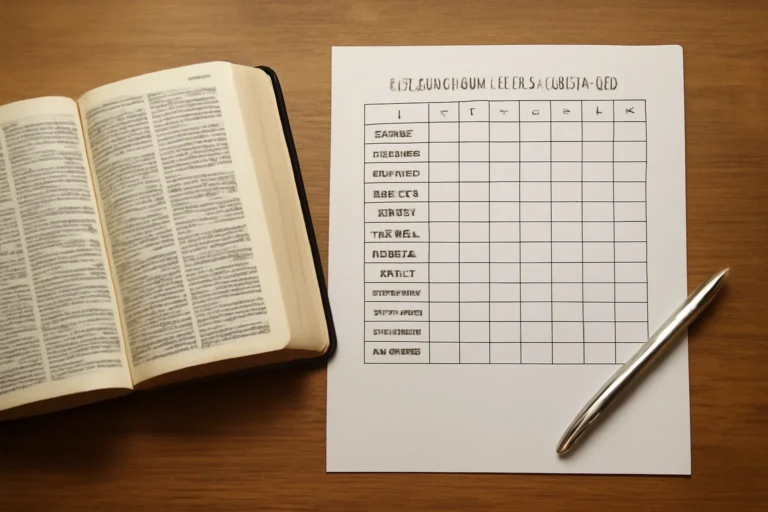
Use a flexible checklist—a simple app, a printable sheet, or a reusable journal helps you visually track days completed and days to go.
Tools and Resources to Support a Year-Long Bible Study
Many tools can help you implement and sustain a yearly Bible study plan. Depending on your preferences, you can combine these resources to create a personalized system that fits your lifestyle.
YouVersion Bible App or other mobile Bible apps for daily notifications, reading plans, and highlighting.
Printed devotional guides that provide brief reflections and prompts for each day, useful for readers who prefer offline resources.
Study Bibles with notes, maps, and timelines to enrich your understanding of historical and cultural contexts.
Commentaries and trusted Bible study books for deeper exploration of tricky passages or difficult questions that arise during the year.
Journaling notebooks or digital note-taking apps to capture insights and applications for life beyond reading.
Group study frameworks—workbooks or discussion guides designed for small groups to promote shared learning and accountability.
As you build your toolkit, emphasize reliability, clarity, and practical application. The best plan is the one that helps you engage with Scripture in a meaningful way day after day.
Common Pitfalls and How to Avoid Them
Even with a well-structured plan, certain challenges can derail your year-long study. Here are common pitfalls and practical strategies to stay committed.
Overloading on content—avoid trying to read too much at once. Focus on sustainable daily chunks and celebrate consistency over volume.
Neglecting reflection—reading without contemplation leads to information without transformation. Schedule time for journaling and prayer.
Skipping days—if you miss a day, don’t abandon the plan. Use a catch-up week or a lighter week to regain momentum.
Perfectionism—every plan has rough patches. Embrace the process, not the perfection, and keep moving forward.
Isolated study—engage with others when possible. Community can provide accountability, perspective, and encouragement.
Ignoring context—avoid cherry-picking verses without considering their surrounding chapters and historical setting. When possible, review a few passages before and after the reading for clarity.
Reflection and Growth: Measuring Spiritual Progress Over the Year
A healthy yearly Bible study plan includes opportunities to assess growth and adjust as needed. Consider these metrics for personal reflection:
A growing ability to explain the main message of each book and to relate Old Testament themes to New Testament fulfillment.
Increased ability to identify literary genres and their implications for interpretation and application.
Greater ease in applying biblical lessons to daily decisions, relationships, and work.
More consistent practice of prayer and worship as a response to Scripture.
Enhanced memory of key verses that anchor your faith during trials and celebrations.
To assess progress, you can conduct a quarterly review. Ask questions like: What themes have recurred? Which passages challenged my assumptions? How have I seen God at work in my life through this year’s readings? Use your answers to recalibrate the next quarter’s focus, if needed.
A yearly Bible study plan can be tailored for different contexts, such as family settings, youth programs, or congregational use. Here are some contextual variations to consider:
Family-friendly plan — simplify daily readings with short passages, include a daily family discussion question, and designate weekly family Bible time with a shared meal.
Youth-oriented plan — combine accessible translations with engaging questions, leverage multimedia devotionals, and incorporate group challenges or project-based reflections.
Church-wide plan — coordinate a communal reading schedule, provide study guides for sermon themes, and align readings with Sunday teaching to reinforce messages.
Cross-generational plan — pair older and younger readers for discussion, create mentoring opportunities, and share intergenerational insights to enrich understanding.
Frequently Asked Questions About a Yearly Bible Study Plan
Here are common questions people ask when starting a year-long Bible study plan and concise answers to help you decide on a path that fits you well.
Is a yearly plan too ambitious for beginners?
Not if you choose a gentle pace and a format that emphasizes consistency over volume. Start with one OT chapter and one NT chapter daily, and adjust as needed.
Should I read the Bible in a year if I’m not sure about my faith?
Reading alongside reflection and discussion can help. A gentle, exploratory approach allows you to ask questions, seek understanding, and grow at your own pace.
What if I miss days?
Missed days are a natural part of life. Use a lightweight catch-up plan and resume your routine without guilt. The key is continuity over perfection.
What if I prefer to study with others?
Look for a local Bible study group or online community. A shared accountability can be a powerful motivator and source of insight.
Conclusion: Embracing a Year of Transformation
A Yearly Bible Study Plan is more than a schedule; it is a pathway to steadier faith, clearer understanding, and a more intimate relationship with God. By choosing a 365-Day Reading Guide that emphasizes consistency, context, and reflection, you set yourself up for meaningful discoveries, personal growth, and practical life transformation. Whether you call it an annual scriptural plan, an annual devotional schedule, or a year-long reading track, the overarching aim remains the same: to know God through His Word and to live out that knowledge with wisdom and grace throughout the year ahead.
As you prepare to begin, remember these final encouragements: start with a clear, attainable plan; stay flexible; prioritize reflection; and seek community when possible. With intentional effort and patient consistency, a single year can become a turning point in your ongoing journey with Scripture. May your yearly Bible study plan bring light, courage, and hope to your daily life, one day at a time.








Leave a Reply