The Second Temple period marks a long era of Jewish religious life centered on the Temple in Jerusalem. From the rebuilding after the Babylonian exile to the destruction in 70 CE, the Temple sacrifices constituted the core framework of worship, ritual purity, communal identity, and notions of atonement. This article surveys the different kinds of offerings, the priestly roles, the ceremonial procedures, and the historical context that shaped how sacrifice functioned in daily life, festival observance, and national memory during this formative period.
After the builders completed Zerubbabel’s Temple and later Herod’s grand expansion, the ritual calendar remained anchored in the biblical categories of sacrifice while adapting to changing political landscapes. The Israelite priesthood—the Cohanim (priests) and the Levites—held primary responsibility for officiating, while lay worshippers participated under strict ritual guidelines. The sacrificial system drew from the Torah’s regulations in Leviticus, Numbers, and Exodus, but its enactment in the Second Temple era also reflected centuries of interpretation, debate, and tradition. The temple precincts functioned as a sacred space where heaven and earth were connected through ritual acts, prayers, and processions that reinforced communal memory and religious legitimacy.
Within this framework, the central aim of most offerings was to express devotion, seek atonement, celebrate gratitude, or dedicate first fruits to the divine. Purity rules, the proper intention of the offerer, and the correct handling of blood and fat were essential technical features. Throughout the Second Temple period, the law’s authority was interpreted by various groups—Pharisees, Sadducees, and later internal sects—producing nuanced differences in emphasis, such as formal purity, the degree of lay participation, and the interpretation of ritual text.
Daily offerings and ordinary worship
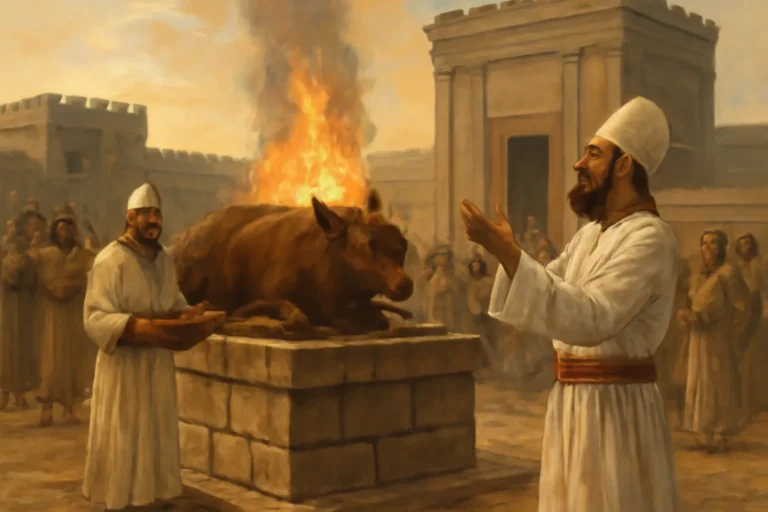
Two categories sit at the core of regular worship: the daily offerings (the tamid) and accompanying acts of devotion. The tamid burnt offering (olah tamid) was performed twice daily, in the morning and the evening, symbolizing continuous dedication to God and the restoration of a right relationship with the divine. In each cycle, a male animal—often a lamb—was offered as a burnt offering, accompanied by a grain offering (minchah) and a libation (a wine offering). The ritual included the laying on of hands, the slaughter, the sprinkling of blood, and the burning of the fat and portions on the altar, with other portions sometimes allotted to the priestly groups or shared in specific contexts.
In addition to the standard two-daily lambs, the routine also accommodated those who could not afford larger animals. The law provided for bird offerings, such as turtledoves or young pigeons, for the poor, ensuring that even the most modest worshippers could participate in the sacrificial system. The grain offerings that accompanied these sacrifices often consisted of flour mixed with oil, sometimes sweetened, and accompanied by a cup/measure of wine. These offerings served to sweeten and complete the ritual, and they functioned as a tangible sign of dedication beyond mere animal sacrifice.
Practically, the daily regimen kept the precincts alive with ritual action, and it established a rhythm that embedded obedience to law with the rhythms of city life. In parallel with the tamid, incidental offerings or voluntary offerings (nedavot) could be added by individuals who wished to pledge gifts or express particular gratitude or repentance. The daily cycle thus created a predictable cadence of worship, while enabling personal expressions of devotion within a communal framework.
Festival and special offerings
Beyond the routine, certain times in the Jewish calendar called for intensified offerings. The major pilgrimage festivals—Passover (Pesach), Shavuot (Weeks), and Sukkot (Tabernacles)—demanded additional sacrifices and gathered large crowds to the Temple. Each festival had its distinctive sacrificial profile, reflecting theological themes such as sacrifice-as-atonement, gratitude for harvests, and communal solidarity during sacred feasts.
Pesach and the Paschal lamb
Central to Passover sacrifices was the annual Paschal lamb—a male sheep or goat, typically one year old, roasted and shared in households or clusters of families if necessary. The day’s rite began with selecting a suitable animal that met ritual requirements and culminated in a tour through the Temple precincts to the altar. The suffering and deliverance motif embedded in this ritual connected national memory of the Exodus to the ongoing practice of sacrifice. The Pesach offering also involved symbolism around blood, redemption, and the notion of protection for the household and the community.
Shavuot and the two loaves
On Shavuot, the festival of Weeks, the ritual emphasized gratitude for firstfruits. The Temple ceremony included the offering of two loaves of bread representing the harvest and the unity of the people before God. The practice highlighted the agricultural calendar as a theological frame and reinforced the identity of the worshiping community as one people under covenant. The two loaves were waved as part of the ceremony in the temple precincts, a gesture of offering and communal blessing.
Sukkot and the festival of booths
During Sukkot, or the Festival of Booths, the Temple saw an elaborate sequence of offerings designed to accompany the pilgrims' celebration. It became customary for a succession of bull offerings, lambs, and other animals to be sacrificed over the course of the seven days, culminating in a total that expressed the nation’s reliance on divine provision and protection. The number of bulls and other sacrifices across the festival underscored the sense of national renewal and the communal devotion that characterized Sukkot. The ritual also included special water libations in some later traditions, associated with the gratitude and prayer of harvest and rain petition in the temple liturgy.
Yom Kippur and the Day of Atonement
The most solemn sacrificial rite occurred on Yom Kippur, the Day of Atonement. The central act involved the high priest entering the Most Holy Place, making atonement for himself and the people, and performing a sequence of offerings that included the sacrifice of animals and the ritual purification of the sanctuary. Two goats feature prominently in the Yom Kippur ritual: one goat was offered as a sin offering, and the other served as the scapegoat (the Azazel ritual), bearing the nation’s sins out of the camp into the wilderness. This dramatic ritual expressed the community’s desire for cleansing, forgiveness, and renewal. The Yom Kippur rites illustrate how sacrifice functioned not merely as a mechanical act but as a powerful symbolic process with deep moral and spiritual meaning.
Categories of sacrifices and their meanings
The sacrificial system of the Second Temple period can be organized around several key categories, each with its own purpose and theological emphasis.
Burnt offerings (olah): The entire animal (often a sheep or bull, depending on social and economic status) was burned on the altar, signifying devotion, surrender, and reconciliation with God. The smell of burnt offerings rose to the heavens as an act of worship and covenant faithfulness.
Grain offerings (minchah): Flour, oil, and sometimes frankincense accompanied burnt offerings and expressed sanctification and gratitude. While not always accompanied by an animal, the grain offering functioned as a vital complement to the ritual economy and symbolized the agricultural basis of the community’s life.
Peace offerings (shelamim): These offerings could be shared by the worshipper and the priest, symbolizing fellowship with God and communal fellowship among participants. The meat from shelami offerings was often eaten by those who brought the sacrifice, reinforcing social bonds and communal celebration.
Sin offerings (chatat): For unintentional sins or specific transgressions, the sin offering provided atonement and restoration of ritual purity. The precise act of atonement depended on the offender’s role (layperson, priest, or sanctuary functionary) and the nature of the violation.
Guilt offerings (asham): Related to certain transgressions that demanded restitution or compensation, the guilt offering served to secure purification and to acknowledge the offender’s liability before God and community.
Voluntary offerings (nedavot) and special offerings tied to particular events, vows, or acts of devotion, enabling individuals to express gratitude or seek special divine favor.
Blessing and purification through procession: The ritual movements, processions, and wave offerings (nesachim) formed part of the sacrificial ritual’s dynamic, marking transitions between spaces within the temple and highlighting the act of presenting offerings to God.
Ritual procedures and the roles of participants
The practical execution of temple sacrifices required a chain of steps, a spectrum of ritual forms, and the involvement of distinct communities. The narrative of sacrifice is not merely about slaughter; it is about purification, blessing, and the reorientation of the community’s life around divine presence.
Key moments in the sacrificial process include:
Approach and identification: The offerer approached the designated entrypoint carrying the offering or presenting it at the temple gate. If the offering involved a limb of an animal, the animal was brought to the slaughtering area adjacent to the altar.
Lay of hands (semikhah): The offerer laid hands on the animal to symbolize identification with the sacrifice, transferring sins (in the case of sin offerings) or dedicating the animal to God (in the case of burnt and peace offerings).
Slaughter and handling of blood: The animal was slaughtered in a manner prescribed by law. The blood often played a central role: it might be sprinkled around the altar or smeared on particular components depending on the type of offering.
Preparation of the animal: The fats, entrails, and other portions of the animal were prepared according to specific rules. The fat of the sacrifice, symbolic of a fragrant aroma, was typically burned on the altar; other parts might be offered on the altar or given to the priests as appropriate.
Burning and disposal: The primary portion of the sacrifice was burned on the altar as an offering to God. In the case of peace offerings, portions were allocated for the priest and other portions were consumed by the worshippers in a ritual meal.
Purification rituals: After a sacrifice, certain purification rites could be involved for the sanctuary and for the offerer, reinforcing the sense of spiritual cleansing associated with the ritual.
The practical actions were governed by a complex body of ritual rules and administrative norms. The priestly class, especially the Kohanim, oversaw the altar and the ritual acts of blood and fat; the Levites assisted with processions and music; lay worshippers participated within the boundaries of purity and ritual propriety. In many cases, the social and economic status of the offerer influenced the kind of offering selected, with the law allowing for more modest sacrifices for the poor, thereby ensuring that sacrifice remained accessible to a broad spectrum of the community.
The space, architecture, and symbolism of the Temple precincts
The Second Temple complex was more than a set of ritual acts; it was a carefully designed space that structured worship, community life, and national identity. The layout separated spaces according to purity and function: the Court of the Gentiles, the Court of the Women, the Court of Israel, and the Court of the Priests lead toward the altar and the Holy Place. The altar (Mizbeach) stood as the hinge of sacrifice, where the life of the animal met the sacred problem of sin and devotion. Beyond the altar lay the sanctuary and, behind veils, the Most Holy Place, where the divine presence was believed to reside in a particularly concentrated way.
Within this architectural arrangement, ritual purity determined who could approach, who could perform sacrifices, and who could partake of sacrificial meals. The Temple precincts thus functioned as a civic-religious center—a place where national memory, priestly authority, and the covenantal relationship between God and Israel were continually reenacted. The Halakhic framework associated with space, time, and ritual action helped bind a diverse population—priests, Levites, families, traders, and pilgrims—into a coherent religious enterprise.
Economic and social dimensions of ritual offerings
Sacrifices did not operate in a vacuum; they were embedded in an economy of offerings, tithes, and temple service. The annual half-shekel tax supported the Temple and its operations, and it functioned as a unifying civic ritual that everyone could contribute to, independent of their wealth. The economic dimension of sacrifice extended to the procurement of animals, the sale and exchange of currency, and the arrangement of space for buyers and sellers who supplied the needs of worshippers. This commercial side of sacrifice is well attested in historical and literary sources, including the Gospel accounts that describe the Temple marketplace and money-changers in the late Second Temple period. While the precise practices varied over time, the essential idea remained: sacrifice was not just a private act but a communal responsibility that required organization, governance, and shared participation.
Socially, the rituals surrounding sacrifice reinforced communal bonds, identity, and the sense of belonging to a people under covenant. Families gathered for Passover; villages participated in harvest rites during Shavuot; the population moved with the calendar through a sequence of offerings that bound daily life to sacred time. The interplay of ritual, economy, and politics—especially under Hasmonean and Herodian leadership—also shaped how sacrifices were framed as expressions of devotion, national renewal, and divine favor or judgment. The way people spoke about sacrifice in public discourse reflected their positions within the broader political and religious spectrum, highlighting tensions between central authority and local religious practice, between temple-centered life and the ambitions of communities beyond the city walls.
Historical currents shaping the practice of sacrifice
The Second Temple period spanned several centuries and multiple political regimes, each leaving its imprint on how sacrifice was understood and carried out. The Persian period's restoration of the Temple established the canonical frame; the Hellenistic era introduced new tensions and pressures, including debates about assimilation, religious reform, and access to temple rites under foreign rule. The Hasmonean era added a national-matriarchal dimension, with expansion and control of temple life, occasionally aligning temple authority with political legitimacy. The Herodian renovation intensified the architectural and ceremonial scale of the Temple, reflecting the grandeur and the contested sovereignty of the temple complex as a symbol of Jewish sovereignty in a volatile political landscape. Across these declines and renaissances, the essential sacrificial logic—appeasement, atonement, gratitude, and covenant renewal—remained a steady throughline, even as specific practices and emphases shifted with leadership and circumstance.
Religious groups with contrasting approaches to sacrifice—such as the Pharisees and Sadducees—often disagreed over the scope, interpretation, and enforcement of purity laws and temple ritual. The Pharisaic emphasis on the oral tradition, purity rules, and synagogue-centered piety offered a different pathway for worship when the temple ritual faced challenges, while the Sadducees adhered closely to the written Torah, foregrounding the Temple as the locus of authentic worship. These debates influenced how sacrifice was taught, practiced, and rationalized in public life, and they shaped the post-70 CE transformation that gave rise to Rabbinic Judaism in which prayer, study, and acts of charity gradually assumed central roles in lieu of temple sacrifice.
Purity, ritual, and the restrictions of access
Access to the sacrificial system depended on adherence to ritual purity and proper observance of designated spaces within the temple complex. Men and women, priests and laypeople, all had specific obligations related to purity, dress, and conduct. Ritual impurity could arise from contact with a corpse, leprosy, or certain bodily states, and the repair of impurity often required purification rites, which could involve water, time, and participation in the hospitality of the temple cult. These rules were not merely technicalities; they shaped who could participate in sacrifice, when, and to what extent. The system also included warnings against profaning sacred offerings through improper handling, noncompliance with ritual prescriptions, or entering forbidden zones during certain rites of purification. In this way, purity and sacred space maintained the integrity of the ritual system and safeguarded the perceived holiness of the sanctuary.
Within the broader matrix of Jewish religious life, sacrifices interacted with prayer, scripture study, fasting, and acts of charity. In many strands of Jewish thought, sacrifice remained a central means of drawing near to God, while others began to emphasize repentance, ethical behavior, and communal justice as paths to righteousness. The temple sacrifices also intersected with foreign policy, diplomacy, and collective memory. As the Hasmoneans and Herod sought political legitimacy, their support for temple reform and expansion reinforced the idea of the temple as an emblem of Israel’s covenantal identity in a world of empires and changing borders. Even as the practice of sacrifice evolved, the temple remained a powerful symbol of divine encounter, national destiny, and the covenantal relationship that bound the people to their God.
The destruction of the Temple in 70 CE by the Romans marked a turning point in Jewish religious life. The sacrificial system, central to temple worship for centuries, could not resume in the same form without the temple proper. In the wake of the catastrophe, early rabbinic authorities turned toward prayer, Torah study, and acts of ethical living as the new modes of engaging with the divine. The shift did not erase the memory of the sacrificial system; rather, it reframed religious life so that the meaning of sacrifice could be carried forward through liturgical prayer, communal ethics, and the interpretation of sacred texts. The Second Temple period thus leaves a rich legacy: a record of ritual precision, communal identity, and theological reflection that would shape Jewish worship for generations to come, even as the physical acts of sacrifice ceased within the ruined precincts of Jerusalem.
Key terms and quick reference
Olah — burnt offering; the animal entirely burned on the altar, signifying devotion.
Minchah — grain offering; flour and oil often offered with incense, symbolizing sanctification.
Shelamim — peace offering; shared meals with priests and worshippers, expressing fellowship with God.
Chatat — sin offering for unintentional sins or certain transgressions.
Asham — guilt offering, related to restitution and certain offenses demanding compensation.
Tamid — the perpetually offered daily sacrifices, both morning and evening.
Semikhah — laying on of hands, a symbolic act of identification and transfer of responsibility or guilt.
Yom Kippur — Day of Atonement, the holiest day with a distinctive set of sacrifices, including the high priest’s rites and the sin and scapegoat offerings.
Pesach — Passover, featuring the Paschal lamb and related rites within the temple calendar.
Shavuot — Weeks, celebrated with the offering of two loaves, representing first fruits and covenant renewal.
Sukkot — Tabernacles, a festival with elaborate offerings intended to express gratitude for divine provision and the harvest.
Kohanim — priests, the hereditary class responsible for officiating sacrifices and maintaining the altar’s sacred routines.
Levites — assistants to the priests, involved in musical, clerical, and ceremonial tasks related to temple worship.
Azazel — the scapegoat ritual on Yom Kippur, bearing the nation’s sins in the wilderness (the ritual is described in Leviticus 16).
In summary, temple sacrifices in the Second Temple period encompassed a broad spectrum—from the steady cadence of the tamid to the climactic rites of Yom Kippur, Passover, and the festival offerings. They were not only acts of worship but vehicles for shaping identity, memory, and political legitimacy within a dynamic and sometimes turbulent historical landscape. The system’s enduring memory—its questions about accessibility, purity, atonement, and covenantal devotion—continued to influence Jewish religious thought long after the Temple’s destruction, guiding later innovations in prayer, ritual life, and moral teaching.



Leave a Reply