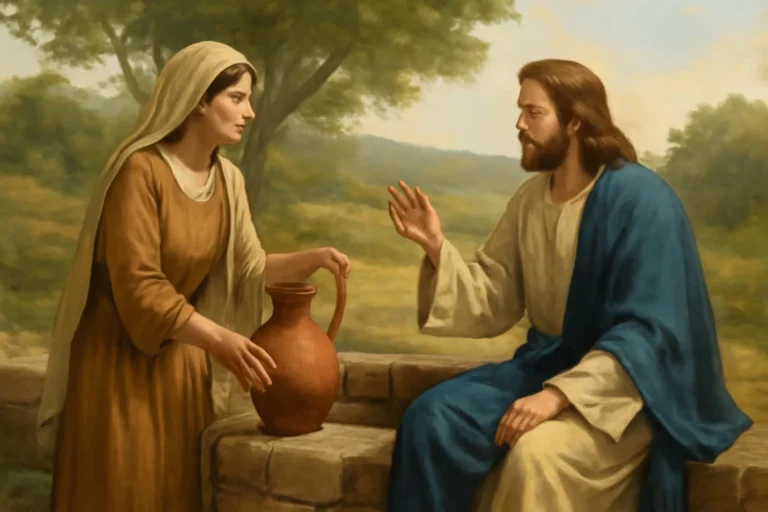
Commentary on John 4: Living Water, True Worship, and Faith That Spreads
John 4 · King James Version
Quick Answer: This commentary on john 4 shows Jesus crossing cultural boundaries to offer living water to a Samaritan woman, then teaching true worship in spirit and truth. He exposes her real need, reveals himself as the Christ, and turns the conversation into testimony. Finally, in Cana and at a distance, Jesus strengthens belief through his word, not spectacle—faith that reaches an entire household.
John 4 (King James Version)
“When therefore the Lord knew how the Pharisees had heard that Jesus made and baptized more disciples than John,
(Though Jesus himself baptized not, but his disciples,)
He left Judaea, and departed again into Galilee.
And he must needs go through Samaria.
Then cometh he to a city of Samaria, which is called Sychar, near to the parcel of ground that Jacob gave to his son Joseph.
Now Jacob’s well was there. Jesus therefore, being wearied with
his journey, sat thus on the well:
and it was about the sixth hour.
There cometh a woman of Samaria to draw water: Jesus saith unto her,
Give me to drink.
(For his disciples were gone away unto the city to buy meat.)
Then saith the woman of Samaria unto him, How is it that thou, being a Jew, askest drink of me, which am a woman of Samaria? for the Jews have no dealings with the Samaritans.
Jesus answered and said unto her,
If thou knewest the gift of God, and who it is that saith to thee, Give me to drink; thou wouldest have asked of him, and he would have given thee living water.
The woman saith unto him, Sir, thou hast nothing to draw with, and the well is deep: from whence then hast thou that living water?
Art thou greater than our father Jacob, which gave us the well, and drank thereof himself, and his children, and his cattle?
Jesus answered and said unto her,
Whosoever drinketh of this water shall thirst again:
But whosoever drinketh of the water that I shall give him shall never thirst; but the water that I shall give him shall be in him a well of water springing up into everlasting life.
The woman saith unto him, Sir, give me this water, that I thirst not, neither come hither to draw.
Jesus saith unto her,
Go, call thy husband, and come hither.
The woman answered and said, I have no husband. Jesus said unto her,
Thou hast well said, I have no husband:
For thou hast had five husbands; and he whom thou now hast is not thy husband: in that saidst thou truly.
The woman saith unto him, Sir, I perceive that thou art a prophet.
Our fathers worshipped in this mountain; and ye say, that in Jerusalem is the place where men ought to worship.
Jesus saith unto her,
Woman, believe me, the hour cometh, when ye shall neither in this mountain, nor yet at Jerusalem, worship the Father.
Ye worship ye know not what: we know what we worship: for salvation is of the Jews.
But the hour cometh, and now is, when the true worshippers shall worship the Father in spirit and in truth: for the Father seeketh such to worship him.
God
is a Spirit: and they that worship him must worship
him in spirit and in truth.
The woman saith unto him, I know that Messias cometh, which is called Christ: when he is come, he will tell us all things.
Jesus saith unto her,
I that speak unto thee am
he.And upon this came his disciples, and marvelled that he talked with the woman: yet no man said, What seekest thou? or, Why talkest thou with her?
The woman then left her waterpot, and went her way into the city, and saith to the men,
Come, see a man, which told me all things that ever I did: is not this the Christ?
Then they went out of the city, and came unto him.
In the mean while his disciples prayed him, saying, Master, eat.
But he said unto them,
I have meat to eat that ye know not of.
Therefore said the disciples one to another, Hath any man brought him
ought to eat?
Jesus saith unto them,
My meat is to do the will of him that sent me, and to finish his work.
Say not ye, There are yet four months, and
then cometh harvest? behold, I say unto you, Lift up your eyes, and look on the fields; for they are white already to harvest.
And he that reapeth receiveth wages, and gathereth fruit unto life eternal: that both he that soweth and he that reapeth may rejoice together.
And herein is that saying true, One soweth, and another reapeth.
I sent you to reap that whereon ye bestowed no labour: other men laboured, and ye are entered into their labours.And many of the Samaritans of that city believed on him for the saying of the woman, which testified, He told me all that ever I did.
So when the Samaritans were come unto him, they besought him that he would tarry with them: and he abode there two days.
And many more believed because of his own word;
And said unto the woman, Now we believe, not because of thy saying: for we have heard
him ourselves, and know that this is indeed the Christ, the Saviour of the world.
Now after two days he departed thence, and went into Galilee.
For Jesus himself testified, that a prophet hath no honour in his own country.
Then when he was come into Galilee, the Galilaeans received him, having seen all the things that he did at Jerusalem at the feast: for they also went unto the feast.
So Jesus came again into Cana of Galilee, where he made the water wine. And there was a certain nobleman, whose son was sick at Capernaum.
When he heard that Jesus was come out of Judaea into Galilee, he went unto him, and besought him that he would come down, and heal his son: for he was at the point of death.
Then said Jesus unto him,
Except ye see signs and wonders, ye will not believe.
The nobleman saith unto him, Sir, come down ere my child die.
Jesus saith unto him,
Go thy way; thy son liveth. And the man believed the word that Jesus had spoken unto him, and he went his way.
And as he was now going down, his servants met him, and told
him,
saying, Thy son liveth.
Then enquired he of them the hour when he began to amend. And they said unto him, Yesterday at the seventh hour the fever left him.
So the father knew that
it was at the same hour, in the which Jesus said unto him,
Thy son liveth: and himself believed, and his whole house.
This
is again the second miracle
that Jesus did, when he was come out of Judaea into Galilee.”
John 4 Bible commentary in its Samaritan and Jewish setting
John 4 unfolds amid tensions between Jews and Samaritans. Samaria sat between Judea and Galilee, and many Jews avoided traveling through it to bypass cultural and religious conflict. Yet Jesus “must needs go through Samaria,” intentionally placing himself where hostility existed. Sychar near Jacob’s well reflects a shared biblical geography: both Jewish and Samaritan communities claimed roots in the patriarchs, especially Jacob. Still, their worship practices diverged—most notably about where God should be worshiped. The woman’s remark about “no dealings” highlights everyday realities of separation: public trust was limited, and conversation across groups could be unusual. The disciples’ absence during the encounter also matters; Jesus speaks privately, not to defend himself publicly, but to reveal God’s heart personally. The passage then widens to include crowds of Samaritans who believe because of Jesus’ own word. Finally, the move into Galilee and the healing of the nobleman’s son shows Jesus’ authority extending beyond one location, meeting need with the promise of life. In short, the chapter is both relational and missional: it begins with a drink request at a well and moves toward a broader harvest of faith.
Original-language nuance in Jesus’ offer of “living water”
In John’s Gospel, key phrases are written with theological weight, and the conversation around “living water” functions on more than one level. The Greek wording John uses can evoke water that is fresh, active, and life-giving rather than merely stored in a container or drawn from a deep well. Jesus’ dialogue is intentionally layered: the woman understands “living water” in an immediate, practical sense (water that does not require drawing), while Jesus uses it to point beyond physical thirst to spiritual life. John’s style also emphasizes clarity through contrast—thirst again versus never thirst, external supply versus an inward “well” that springs up. This is not simply wordplay; it shows Jesus translating common religious imagery into a deeper reality: God’s gift becomes a source of ongoing life within the believer.
Jesus crosses boundaries: the encounter that becomes a “harvest” (explanation of John chapter 4)
John 4 begins with a strategic movement: Jesus leaves Judea, returns to Galilee, and, unexpectedly, travels through Samaria. This decision is not accidental geography; it signals that his mission follows God’s will rather than human prejudice. The setting—Sychar near Jacob’s well—grounds the moment in familiar biblical memory, yet Jesus treats it as a platform for something new. Wearied from the journey, he sits, then asks for a drink. By initiating conversation, Jesus overturns expected roles: a Jewish rabbi asks a Samaritan woman for help, and he does so at a public well where social dynamics are typically guarded.
The woman’s response reveals how much “no dealings” shapes daily life. She questions Jesus because he asks directly for what she can give. Her curiosity quickly turns into debate: religion, ethnicity, and worship geography. Jesus answers not by arguing her assumptions away, but by offering God’s gift as something she must receive and recognize. He speaks as the One who knows her—her past, her present living situation, and her spiritual hunger. When he says she has “well said” about having no husband, he demonstrates knowledge that cannot be guessed from distance.
At the same time, Jesus’ approach is pastoral rather than humiliating. His purpose is to lead her from surface misunderstanding to deeper faith. The disciples’ return finds “marvel,” but no direct critique. The woman, meanwhile, moves rapidly from private conversation to public witness—leaving her waterpot and bringing others to “come, see.” John ties this to the harvest theme: faith spreads when people discover that Jesus is more than information; he is living water and the Christ.
Thus the passage models mission: crossing boundaries, speaking truth with grace, and turning an encounter with Jesus into testimony that draws others to his word.
Living water and true worship: faith beyond location (commentary on John 4 living water and true worship)
The dialogue at Jacob’s well becomes a teaching moment about thirst, worship, and identity. The woman challenges Jesus: if the well is deep and he has nothing to draw with, where does “living water” come from? She interprets Jesus’ words through her immediate needs—practical water that prevents the inconvenience of repeated trips.
Jesus gently corrects the frame. Physical water leads to renewed thirst, but his gift brings a different kind of satisfaction. He describes it as water that becomes an inner source—“a well of water springing up into everlasting life.” This image shifts the focus from external provision to inward life. The gift is not merely better access to resources; it is participation in eternal life.
From there, Jesus moves to worship. The woman points to competing traditions: her people worship “in this mountain,” while Jesus’ people claim Jerusalem as the place. Jesus responds with a larger principle: worship will no longer be primarily defined by a physical site. The future arrival of the “hour” signals that God’s initiative is re-centering worship around his nature and his seeking heart.
Jesus identifies the essence of true worship: worship “in spirit and in truth.” “In spirit” highlights life from God, not mere ritual performance. “In truth” emphasizes reality rather than shadows—alignment with who God is and who Jesus is. Importantly, Jesus does not deny the importance of God’s prior work; he contrasts ignorance with knowledge that has salvation’s source. Yet he also shows that the boundaries are not ethnicity or geography. God seeks worshippers who respond to him.
When the woman then expresses hope that the Christ will come, Jesus reveals his identity directly: “I that speak unto thee am he.” This is the climax of the conversation. The woman’s faith emerges not from avoiding questions, but from Jesus’ person. True worship, in this chapter, is recognition—coming to trust the One who speaks.
In John 4, living water and true worship are inseparable: the gift of eternal life becomes the spring from which genuine worship flows.
Belief that trusts the word: from Samaritan testimony to a royal miracle (study notes on Jesus and the Samaritan woman)
After the woman testifies, Samaritans come to Jesus and ask him to remain. John notes that many believed first because of her testimony, but even more because they heard Jesus’ “own word.” This progression matters. Testimony opens the door, but encountering Christ is what deepens faith. Their conclusion is clear: Jesus is “indeed the Christ, the Saviour of the world.” In a chapter about crossing boundaries, the Gospel emphasizes that salvation is not limited by human categories.
Then the narrative shifts to Galilee, connecting belief with signs—but not as a substitute for trust. Jesus returns to Cana, where he previously transformed water into wine, and he now faces a different kind of crisis: a nobleman whose son is “at the point of death.” The man’s request is urgent and personal. He wants Jesus to “come down, and heal” his child.
Jesus’ response, “Except ye see signs and wonders, ye will not believe,” challenges a pattern common in humanity: demanding visible proof before trusting God. The nobleman counters with a plea for immediate action. Yet Jesus answers with a word of command and promise: “Go thy way; thy son liveth.” This is the heart of the chapter’s lesson on faith. Jesus does not rely on dramatic spectacle. He relies on his word.
When the nobleman’s servants meet him, they confirm the healing at the precise time Jesus spoke. The man and his whole house believe. John highlights this as both relational and communal: faith is not simply private relief; it becomes household transformation.
The chapter therefore balances two pathways of belief. First, Samaritan faith grows through relational testimony and direct listening to Jesus. Second, Galilean faith grows when a desperate father trusts the promise without waiting for immediate external evidence. In both, Jesus is the catalyst.
By the end of John 4, the reader is invited to see faith as participation in God’s initiative. Jesus speaks, God fulfills, and people respond with belief that spreads.
Why some believe and others struggle: the “prophet with no honour” principle
John does not present everyone as equally receptive. After Jesus leaves Samaria and returns to Galilee, John records Jesus’ earlier principle that “a prophet hath no honour in his own country.” In other words, familiarity can dull perception. People who think they already know the prophet may hesitate to recognize God at work.
This principle helps interpret the atmosphere surrounding Jesus’ ministry. The Galileans receive him having seen what he did at Jerusalem during the feast. Their readiness to listen may be tied to prior reports and public signs. Yet John’s earlier comment about signs and belief warns that observation alone can be insufficient. Signs can be useful, but they are not the foundation; the foundation is trusting the word of the One sent by God.
John also includes a subtle contrast in the Samaritan story: Jesus offers revelation and the woman responds decisively. In Galilee, the nobleman begins with urgency and a request for location-based healing—yet he too moves into deeper faith when he believes the word.
The chapter therefore teaches that faith is not determined solely by exposure to Jesus’ actions. Rather, faith responds to Jesus’ identity and message. Some believe quickly because they hear Jesus personally. Others believe when their crisis intersects with a spoken promise. Still others remain resistant.
For readers today, this is a reminder that spiritual receptivity matters. We may think we “know” Jesus through tradition, biography, or repeated exposure. But John 4 presses the reader to meet Christ again—to let his living water revive worship, and to let his word form belief.
In that sense, the chapter is both diagnostic and inviting: it asks how we respond when Jesus speaks, especially when his answer comes without immediate proof.
How to Apply John 4 Today: bring real needs to Jesus, then trust his word
John 4 invites you to bring your real thirst to Jesus—what you keep trying to satisfy, manage, or avoid. The Samaritan woman’s story suggests that Jesus does not ignore broken realities; he addresses them with truth that leads to healing. Start your prayer honestly: name the thing you return to for comfort, approval, or escape. Ask Jesus for the “living water” that becomes a source within you.
Next, reconnect worship to “spirit and truth.” This means more than attending religious activities or arguing about correct locations. Consider whether your worship flows from a living relationship with God through Christ. A practical step is to worship with intention: begin with gratitude for God’s gift, then speak truthfully—confess what you believe about Jesus, and let that shape your words and conduct.
Finally, trust Jesus’ word when circumstances don’t immediately change. The nobleman believed Jesus’ promise and then learned that God fulfilled it at the right time. You may not see an immediate outcome, but you can still take a step of faith: obey what Jesus has already said in Scripture, and release anxiety into prayer. If you need encouragement, remember that testimony matters. Like the woman leaving her waterpot, share what Jesus has revealed to you—simple, personal, and specific—so others can “come, see.”
Related Bible Passages
Psalms 139:23-24
Jesus’ knowledge of the woman reflects God’s ability to search hearts, inviting honest self-recognition before him.
Matthew 22:37-40
True worship in spirit and truth aligns with loving God whole-heartedly, not reduced to external forms.
Romans 10:17
Samaria believed as they heard Jesus’ own word, illustrating that faith grows through hearing.
Hebrews 11:1
The nobleman’s belief in Jesus’ promise before visible results reflects confidence in what God says.
Frequently Asked Questions
What is the main message in John 4?
John 4 emphasizes that Jesus offers living water—eternal life that satisfies inwardly—and that true worship is based on God’s truth, not merely a location. The chapter also shows faith growing through Jesus’ word, whether someone believes after personal conversation or after trusting a promise in crisis.
How does Jesus show love to the Samaritan woman in this John 4 Bible commentary?
Jesus crosses social barriers, speaks with compassion, and guides the woman from misunderstanding to faith. He confronts her real life with truth, yet his aim is restoration. The result is transformation: she becomes a witness, and many Samaritans come to hear Christ directly.
Why does Jesus talk about “living water” instead of only giving physical water?
Because physical water cannot cure deeper spiritual thirst. Jesus uses ordinary water imagery to reveal God’s gift—life that springs up within the believer. This invitation moves beyond convenience to everlasting life and a worship that flows from truth.
What does Jesus mean by saying people need signs and wonders to believe?
In John 4, Jesus warns against treating visible proof as the only basis for faith. The nobleman’s child is healed when Jesus’ word is trusted. The chapter teaches that signs may accompany belief, but they do not replace trust in who Jesus is and what he promises.
A Short Prayer
Lord Jesus, You crossed barriers to speak life into our hearts. Give me living water that springs up within and changes how I worship You—in spirit and in truth. When I face uncertainty, strengthen my faith to trust Your word even before I see results. Make me a witness like the woman at the well: honest, grateful, and eager to invite others to come and see You for themselves. Amen.
Key Takeaway: John 4 teaches that Jesus offers inward, eternal life and true worship, and that real faith trusts his word and spreads to others.